Style combination · Pairs well
Aloha Shirt Print × Tiki Pop
Shares the tropical motifs and mid-century leisure mood, but moves them from bar and restaurant kitsch onto wearable cloth.
01
What each style brings
Each part of the design comes from the style with the stronger say in it, and each style gives at least two.
Aloha Shirt Print (Hawaiian Pictorial Textile) Tiki Pop (Polynesian Pop)
- Type from Tiki Pop
- Colour from Aloha Shirt Print
- Form from Aloha Shirt Print
- Composition from Aloha Shirt Print
- Surface from Tiki Pop
02
The type
Open fonts standing in for each style’s own type, which is often hand-drawn or commercial.
Display · Tiki Pop
Wow
Yellowtail, standing in for Casual brush script for venue names, as on the Waikiki Room menu at the Pick-Nicollet Hotel
Text · Aloha Shirt Print
A Honolulu tradition of large-scale, all-over pictorial prints on shirt cloth, begun in the 1930s with Japanese kimono fabric and developed by local makers into hand-printed scenes of palms, florals, surfboards, drinks and Hawaiian quilt and tapa-derived patterns. It is a wearable commercial textile and local-identity dress, not bar kitsch.
Space Grotesk; Aloha Shirt Print used Hand-lettered 'Hawaii' and 'Aloha' labels and Mid-century brush-script and show-card lettering on garment labels
03
The colours
The ground and leading colours come from Aloha Shirt Print, with a counter-accent from Tiki Pop. The ink reads on the ground at 4.5:1 or more.
Aloha Shirt Print (Hawaiian Pictorial Textile) Tiki Pop (Polynesian Pop)
-
#f2e8d0ground · 36% -
#1c2b4aink · 14% -
#f0b429accent · 18% -
#d9622baccent · 14% -
#2a9d8faccent · 10% -
#0b6e8aaccent · 8%
As CSS
:root {
  --ground: #f2e8d0;
  --ink: #1c2b4a;
  --accent-1: #f0b429;
  --accent-2: #d9622b;
  --accent-3: #2a9d8f;
  --accent-4: #0b6e8a;
  --font-display: "Yellowtail", cursive;
  --font-text: "Space Grotesk", sans-serif;
}
Use it with care
Aloha Shirt Print (Hawaiian Pictorial Textile): The Hawaiian quilt (kapa lau) and kapa (tapa) patterns that aloha shirts borrow belong to Native Hawaiian craft and carry family, genealogical and place meanings, and the tradition itself was shaped by Japanese, Chinese, Portuguese and Native Hawaiian makers in a tourist economy. Use motifs as quoted commercial design rather than as Native Hawaiian art: do not copy a named quilt or kapa pattern without the maker's or community's permission, avoid generic 'Polynesian' mixes of Hawaiian, Maori and Marquesan symbols, and commission Native Hawaiian designers when the subject is Hawai'i itself. Vocabulary gap: garment-engineered pattern placement (matching across pocket and placket, cut-to-pattern); stand-in: layout.all-over. Vocabulary gap: tourist or leisure souvenir mood (resort, holiday, local-identity dress); stand-in: tone.playful. Many aloha prints are placed or engineered rather than repeating.
Tiki Pop (Polynesian Pop): Tiki Pop is an outsider's pastiche built from sacred things: Polynesian wood images such as a Mangarevan tiki were carved to hold the mana of deities and stood on marae, and Hawaiian ki'i, Māori and Marquesan tiki belong to particular peoples, yet the style fused them into one grinning bar mascot and paired it with topless 'wahine' and 'savage' jokes, which Pacific artists such as Dan Taulapapa McMullin ('Tiki Manifesto') describe as erasure. Quote it as mid-century American commercial design, not as Polynesian art: invent your own non-sacred mascot rather than copying a named deity or museum carving, drop the sexualised island women and 'cannibal' caricature, do not use tā moko or Hawaiian words as decoration, and commission Pacific Islander artists when the subject is the Pacific itself.
04
The two styles
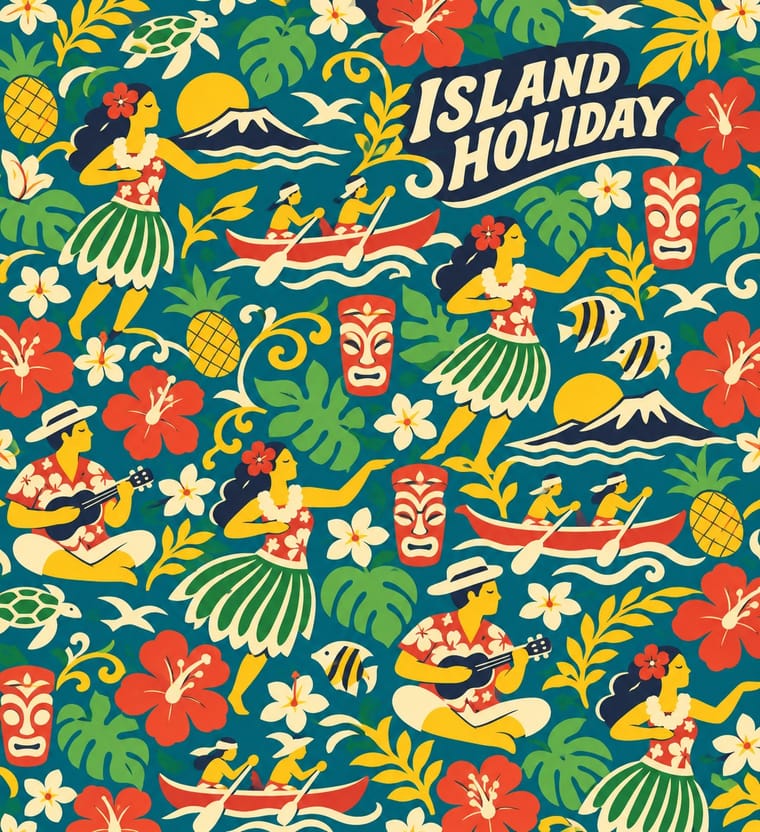
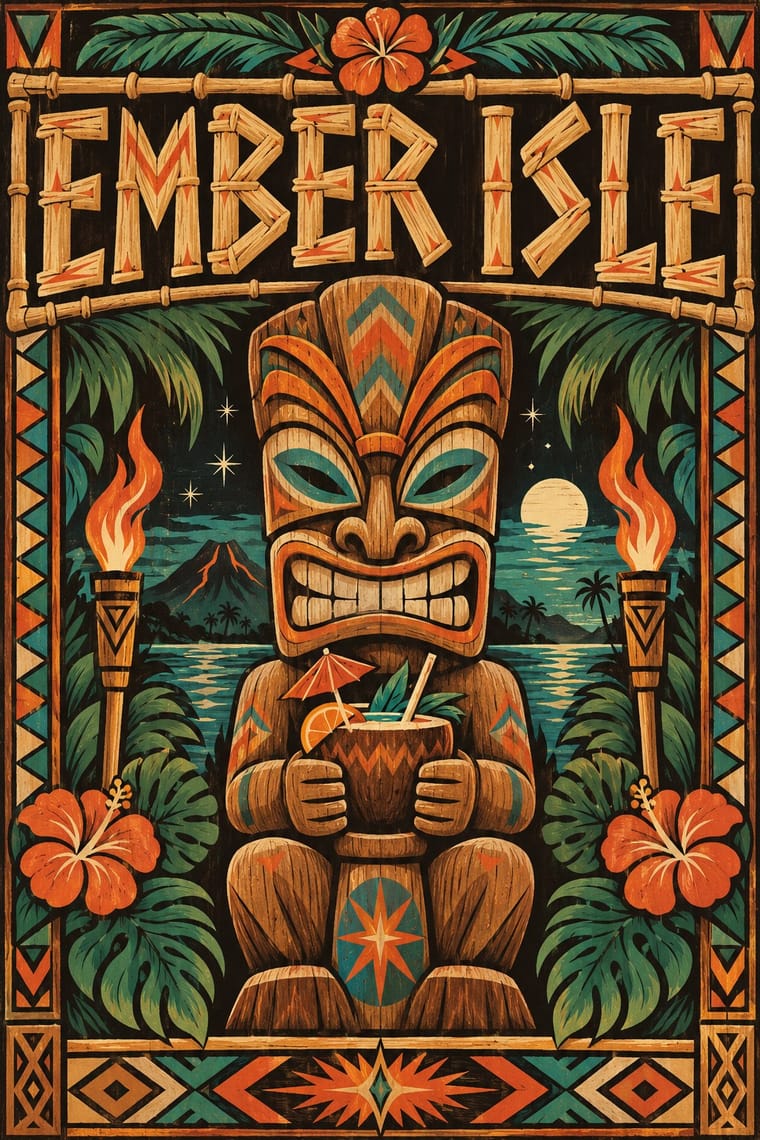
05
More combinations
With Aloha Shirt Print
- Pacific Barkcloth (Tapa) Design Contrasts · Borrows tapa patterns as decoration, whereas tapa itself is ritual and gift cloth; keep the distinction.
- African Wax & Fancy Print Pairs well · Another commercial all-over textile print that became a marker of regional identity.
- Serizawa Katazome and Mingei Stencil-Dye Graphics Pairs well · Japanese textile ties: the early shirts were cut from Japanese kasuri and kimono cloth; katazome stencil dyeing is a related Japanese cloth-printing tradition, not a documented source of aloha prints.
With Tiki Pop
- Japonisme Contrasts · Both are Western absorptions of another culture's art, but Japonisme learned formal lessons (flat colour, cropping, asymmetry) while tiki took the sacred figures themselves as mascots; borrow a way of composing, not a god.
- Googie & Atomic Age Contrasts · The same post-war roadside America built both, but Googie looks forward with boomerangs, starbursts and pastel space-age optimism while tiki looks back to a pseudo-primitive island in carved wood and torchlight; choose Googie to promise the future and tiki to offer an escape from it.
- Pacific Barkcloth (Tapa) Design Contrasts · Tiki menus borrowed tapa-like zigzag bands as mere borders; real ngatu, siapo and kapa are women's ceremonial wealth with named motifs, so set the two side by side to see what was flattened, and commission tapa makers rather than copying their patterns.
- Hand-Painted Signage & Vernacular Lettering Pairs well · Have a sign writer paint the bar's name in brush script and shaded bamboo capitals on weathered boards, so the lettering is made by hand rather than taken from a tiki font.
- Screenprinted Gig & Alt-Movie Poster Pairs well · For a tiki night or rum festival, hand-pull a flat, hand-lettered screenprint around one invented carved mascot in torch orange and lagoon teal, keeping the date and venue line legible.
- Kōwhaiwhai & Toi Māori Design Contrasts · Polynesian Pop folded Māori carving into one generic 'Tiki'; Toi Māori is taonga tied to particular iwi, so keep it out of tiki pastiche and work with Māori designers when the subject is Aotearoa.
- Mambo Graphics (Sydney Loud Shirt Art) Pairs well · Borrow its South Seas kitsch props to give a loud shirt an exotic-holiday layer under the satire.
- Lowbrow and Pop Surrealism (Juxtapoz Scene) Pairs well · Borrow its kitsch, nostalgic exotica and hand-lettered signage for a bar or record-sleeve context.