Style combination · Contrasts
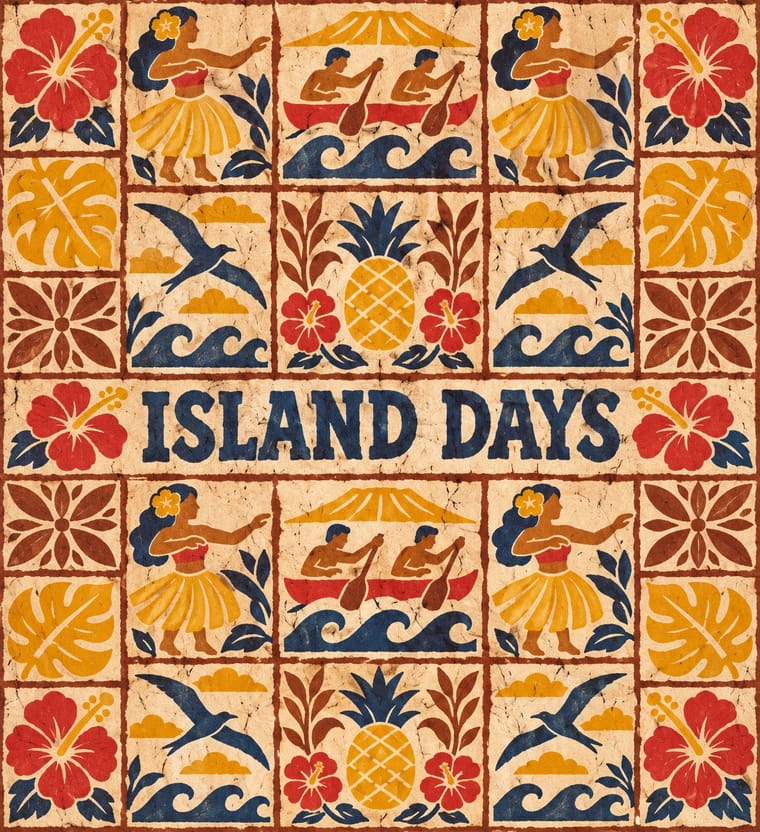
Aloha Shirt Print × Pacific Barkcloth Design
Borrows tapa patterns as decoration, whereas tapa itself is ritual and gift cloth; keep the distinction.
Mix them and make something Aloha Shirt Print Pacific Barkcloth Design
01
What each style brings
Each part of the design comes from the style with the stronger say in it, and each style gives at least two.
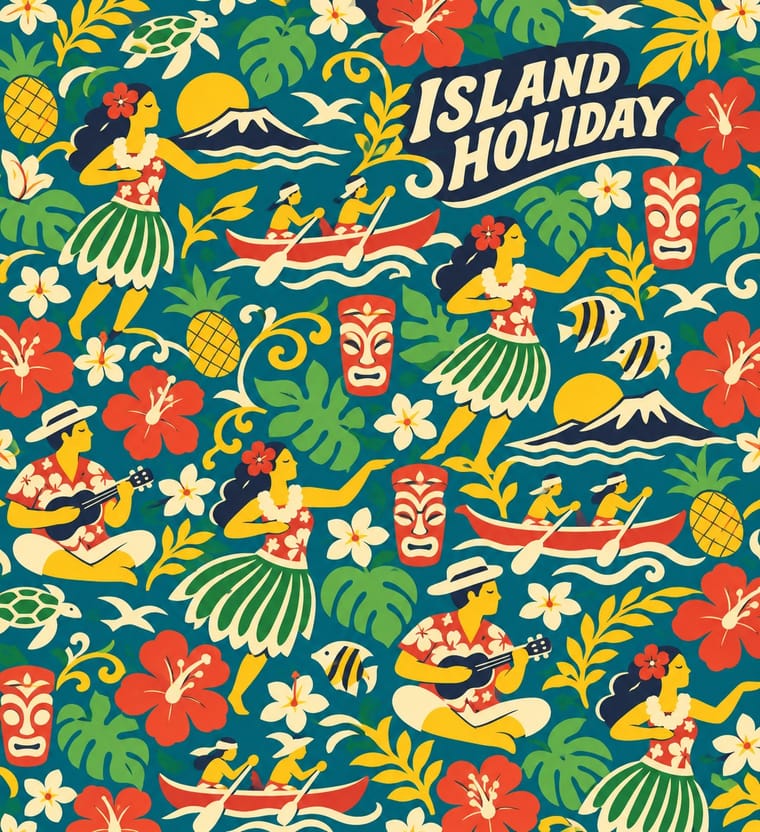
Aloha Shirt Print (Hawaiian Pictorial Textile) Pacific Barkcloth (Tapa) Design
- Type from Aloha Shirt Print
-
- Colour from Aloha Shirt Print
-
Pacific Barkcloth Design avoids full polychrome: this is where the two pull against each other, which is the point of the contrast.
- Form from Aloha Shirt Print
- Composition from Pacific Barkcloth Design
-
Aloha Shirt Print avoids modular grid: this is where the two pull against each other, which is the point of the contrast.
- Surface from Pacific Barkcloth Design
02
The type
Open fonts standing in for each style’s own type, which is often hand-drawn or commercial.
Display · Aloha Shirt Print
Ours
Yellowtail; Aloha Shirt Print used Hand-lettered 'Hawaii' and 'Aloha' labels and Mid-century brush-script and show-card lettering on garment labels
Text · Pacific Barkcloth Design
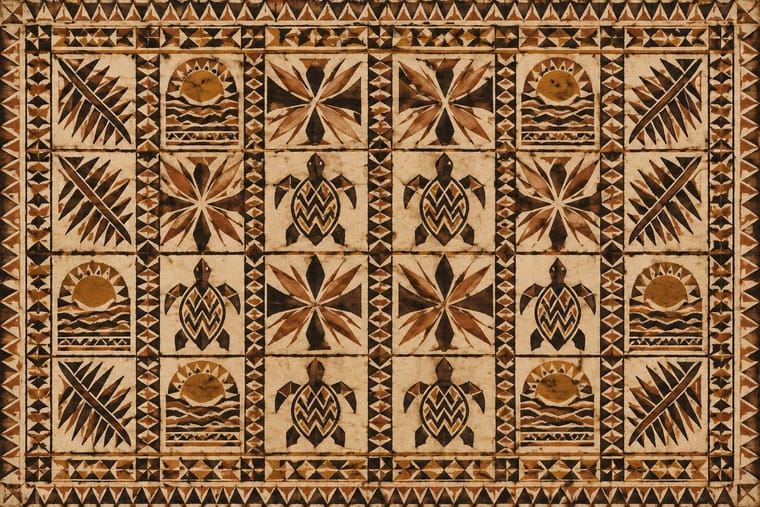
Barkcloth beaten from paper-mulberry inner bark and decorated across Polynesia and Fiji for gift exchange at weddings, funerals and chiefly investitures. Motifs are transferred rather than simply drawn: rubbed over pattern boards in Tonga and Samoa, stencilled in Fiji, stamped in Hawai'i, then sharpened by hand. The palette is earth browns and soot black on cream bark, inside ruled squares and bands on cloths that can run past twenty metres.
Archivo; Pacific Barkcloth Design used Freehand-painted numerals and capitals on ngatu, from length markers to commemorative inscriptions and Faces with full support for Tongan, Samoan, Fijian and Hawaiian orthographies (ʻokina and macrons), e.g. Noto Sans, for accompanying text
03
The colours
The ground and leading colours come from Aloha Shirt Print, with a counter-accent from Pacific Barkcloth Design. The ink reads on the ground at 4.5:1 or more.
Aloha Shirt Print (Hawaiian Pictorial Textile) Pacific Barkcloth (Tapa) Design
-
#f2e8d0ground · 36% -
#1c2b4aink · 14% -
#f0b429accent · 18% -
#b9772faccent · 14% -
#d6402faccent · 10% -
#8a3b1faccent · 8%
As CSS
:root {
  --ground: #f2e8d0;
  --ink: #1c2b4a;
  --accent-1: #f0b429;
  --accent-2: #b9772f;
  --accent-3: #d6402f;
  --accent-4: #8a3b1f;
  --font-display: "Yellowtail", cursive;
  --font-text: "Archivo", sans-serif;
}
Use it with care
Aloha Shirt Print (Hawaiian Pictorial Textile): The Hawaiian quilt (kapa lau) and kapa (tapa) patterns that aloha shirts borrow belong to Native Hawaiian craft and carry family, genealogical and place meanings, and the tradition itself was shaped by Japanese, Chinese, Portuguese and Native Hawaiian makers in a tourist economy. Use motifs as quoted commercial design rather than as Native Hawaiian art: do not copy a named quilt or kapa pattern without the maker's or community's permission, avoid generic 'Polynesian' mixes of Hawaiian, Maori and Marquesan symbols, and commission Native Hawaiian designers when the subject is Hawai'i itself. Vocabulary gap: garment-engineered pattern placement (matching across pocket and placket, cut-to-pattern); stand-in: layout.all-over. Vocabulary gap: tourist or leisure souvenir mood (resort, holiday, local-identity dress); stand-in: tone.playful. Many aloha prints are placed or engineered rather than repeating.
Pacific Barkcloth (Tapa) Design: Tapa is women's ceremonial wealth, made collectively and presented at weddings, funerals and the investiture of chiefly titles; particular motifs commemorate events, lineages and royalty, and some designs belong to families, villages or chiefly lines. Commission and pay tapa makers and their work groups (such as the koka'anga in Tonga), credit the island and the maker, and do not lift motifs from museum cloths onto products or treat Tongan, Samoan, Fijian and Hawaiian traditions as one interchangeable 'Polynesian' pattern.
04
The two styles
05
More combinations
With Aloha Shirt Print
- African Wax & Fancy Print Pairs well · Another commercial all-over textile print that became a marker of regional identity.
- Serizawa Katazome and Mingei Stencil-Dye Graphics Pairs well · Japanese textile ties: the early shirts were cut from Japanese kasuri and kimono cloth; katazome stencil dyeing is a related Japanese cloth-printing tradition, not a documented source of aloha prints.
- Tiki Pop (Polynesian Pop) Pairs well · Shares the tropical motifs and mid-century leisure mood, but moves them from bar and restaurant kitsch onto wearable cloth.
With Pacific Barkcloth Design
- Adinkra & Kente Symbol Systems Pairs well · Both are gridded ceremonial cloths of named motifs; borrow their shared square-by-square logic for a layout, while keeping each motif tied to its own culture and meaning.
- Risograph & Indie Print Culture Pairs well · Two earth-toned inks on cream stock and a slightly broken, rubbed impression give print work tapa's material warmth without copying its motifs.
- International Typographic Style Pairs well · A ruled grid already underlies ngatu; set text in a neutral grotesque within the same squares for exhibition and institutional graphics made with tapa makers.
- Kōwhaiwhai & Toi Māori Design Contrasts · Kōwhaiwhai flows in curvilinear koru bands while tapa is ruled into squares filled with angular repeats, a reminder that 'Pacific pattern' is not one style.
- Tiki Pop (Polynesian Pop) Contrasts · Tiki menus borrowed tapa-like zigzag bands as mere borders; real ngatu, siapo and kapa are women's ceremonial wealth with named motifs, so set the two side by side to see what was flattened, and commission tapa makers rather than copying their patterns.