Style combination · Contrasts
AIZ Political Photomontage × NSK Retro-Avant-Garde
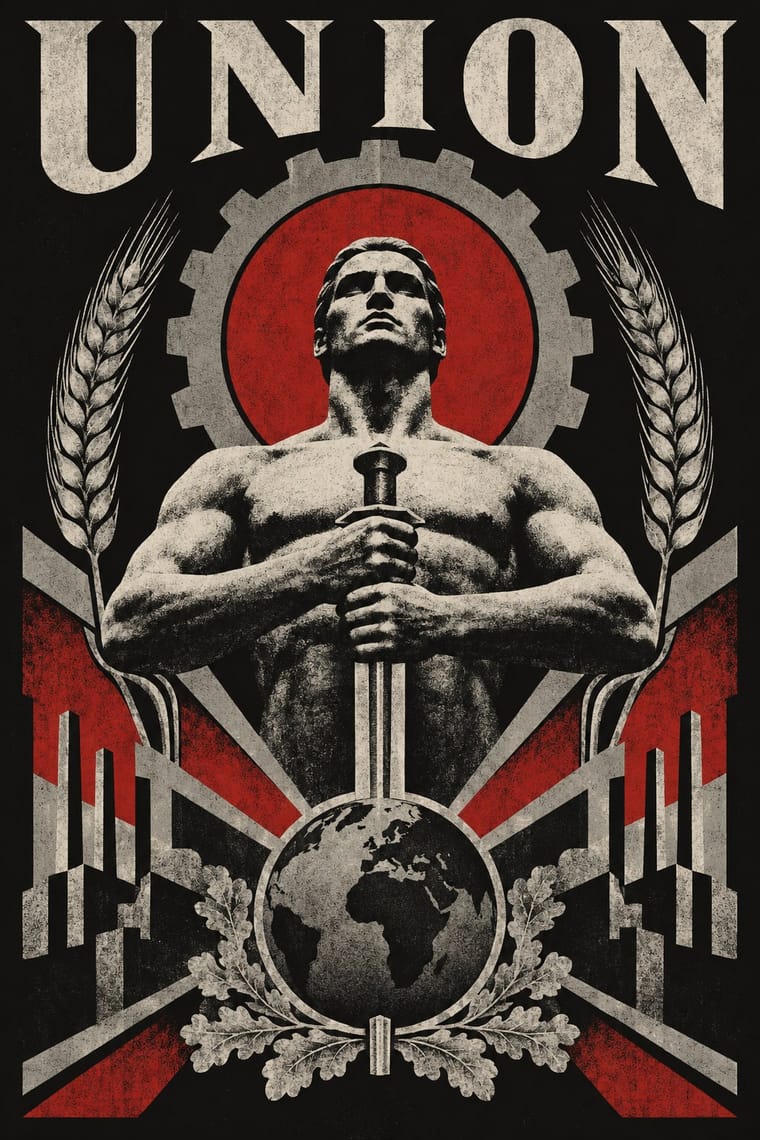
NSK lifts Nazi and socialist emblems whole into solemn, centred heraldry and over-identifies with power, leaving the verdict open; AIZ builds the same kind of centred emblem, like the axe swastika, but always adds a caption that convicts. Choose by whether the viewer should be left uneasy or told what to think.
Mix them and make something AIZ Political Photomontage NSK Retro-Avant-Garde
01
What each style brings
Each part of the design comes from the style with the stronger say in it, and each style gives at least two.
AIZ Political Photomontage (Heartfield) NSK Retro-Avant-Garde
- Type from AIZ Political Photomontage
- Colour from AIZ Political Photomontage
- Form from AIZ Political Photomontage
- Composition from NSK Retro-Avant-Garde
- Surface from NSK Retro-Avant-Garde
02
The type
Open fonts standing in for each style’s own type, which is often hand-drawn or commercial.
Display · AIZ Political Photomontage
Wake
Jost, standing in for Bold geometric or grotesque sans capitals of the Erbar, Kabel or Futura kind, with round C and G, for the headline, stacked above the picture ('DER SINN DES HITLERGRUSSES:', AIZ cover, 16 October 1932; 'BLUT UND EISEN', 1934) or widely letterspaced across the foot of a spread ('KRIEG UND LEICHEN – DIE LETZTE HOFFNUNG DER REICHEN', 1932)
Text · NSK Retro-Avant-Garde
The retro-avant-garde of Neue Slowenische Kunst, founded in Ljubljana in 1984 by Laibach, IRWIN and the Scipion Nasice Sisters Theatre, with Novi kolektivizem as its design department. Its posters, emblems, flags and NSK State passports lift socialist-realist, Nazi, religious and Suprematist images whole, join incompatible symbols in solemn, centred heraldry, and over-identify with power instead of mocking it. The 1987 Youth Day poster, reworked from a Nazi painting, is the best-known case.
Archivo; NSK Retro-Avant-Garde used Heavy block sans capitals for the name LAIBACH on the 1980 Thrower posters and Constructed mixed-case display capitals of the 'NEUE SLOWENISCHE KUNST' wordmark under the NSK coat of arms
03
The colours
The ground and leading colours come from AIZ Political Photomontage, with a counter-accent from NSK Retro-Avant-Garde. The ink reads on the ground at 4.5:1 or more.
AIZ Political Photomontage (Heartfield) NSK Retro-Avant-Garde
-
#ede1c3ground · 36% -
#1e1a17ink · 14% -
#c6a67caccent · 18% -
#b31b1baccent · 14% -
#86603faccent · 10% -
#8c8c88accent · 8%
As CSS
:root {
  --ground: #ede1c3;
  --ink: #1e1a17;
  --accent-1: #c6a67c;
  --accent-2: #b31b1b;
  --accent-3: #86603f;
  --accent-4: #8c8c88;
  --font-display: "Jost", sans-serif;
  --font-text: "Archivo", sans-serif;
}
Use it with care
AIZ Political Photomontage (Heartfield): The montages turn swastikas and portraits of Nazi leaders against the regime; displaying Nazi symbols is restricted by law in Germany and several other countries outside contexts such as art, satire, education and history, so keep any reuse unmistakably critical and check the rules where the work will be shown. AIZ was also a communist magazine informally financed by the Comintern: before 1933 its montages attacked the Social Democrats as well as the Nazis, and in 1934 it devoted a special issue to seventeen years of the Soviet Union, so treat the style as partisan propaganda, and do not turn its literal, accusatory montage on named living people without checking defamation and image-rights law.
NSK Retro-Avant-Garde: NSK's sources include Nazi propaganda, and its emblem incorporates John Heartfield's swastika of axes: taken out of its context such imagery reads as endorsement rather than critique, and showing Nazi symbols is restricted by law in Germany and several other countries. The black cross, the NSK coat of arms and the NSK passport belong to living artists who still use them, so do not copy them. Make a new quotation from public-domain state imagery, and only for a setting that can carry the provocation and make its critical frame clear. The NSK passport, an art project that is not valid for travel, has been taken for a real document: there are stories of holders crossing a border on one when their Bosnian passport failed in the 1990s, and by 2007 a growing number of applicants from one town in Nigeria treated it, in IRWIN's words, as 'a viable document'. Never make a mock passport, ID card, stamp or banknote that could be mistaken for, or used as, a real state document.
04
The two styles
05
More combinations
With AIZ Political Photomontage
- Surrealist Graphics Pairs well · Surrealist photography also makes the impossible look photographed; take its dream logic when a brief needs strangeness, and add the AIZ headline and caption when that strangeness has to land a political point.
- Russian Constructivism Contrasts · Constructivist photomontage drives heroic figures along diagonals with bars, red ink and exploding type; AIZ uses the same cut photographs in a centred, single-ink picture with a quiet caption, mostly to mock and sometimes, as in the 1937 radio-wave fist, to rally. The debt is direct: Heartfield spent April 1931 to January 1932 in the Soviet Union, looked after by Sergei Tretyakov and, it seems, getting on well with Gustav Klutsis, and the Art Institute of Chicago traces the 1934 many-arms fist cover to Klutsis's 1932 election poster of one raised hand repeated into a crowd.
- Situationist Détournement Graphics Pairs well · Both turn the opponent's own words and pictures against their source; take détournement's scattered press fragments and rewritten speech balloons for a looser, cheaper attack, and AIZ's seamless single picture when the charge must look like a photograph of fact.
- ACT UP & Gran Fury AIDS Activist Graphics Pairs well · Both put a photograph under a one-line charge against named people; set Gran Fury's facts and demands in small print beneath a Heartfield-style literal metaphor when the accusation needs evidence.
- Simplicissimus Satirical Style (Munich) Pairs well · Simplicissimus frames a drawn caricature between a set title and a one-line caption; once it dulled its satire in the First World War, the sharpest graphic satire passed to Grosz, Kollwitz and Heartfield. Keep that title-picture-caption sentence and swap the drawing for a seamless montage to make the satire look like evidence.
- West German Conceptual Film & Culture Poster (Hillmann and Rambow) Pairs well · Heartfield tied four bloody axes into a swastika in 1934; Rambow's broken pencils laid into a swastika over a 1938 PEN list (1983) make the same move of an object turned into an emblem. Borrow the AIZ caption when the poster must accuse, and Rambow's wordless object when it should commemorate.
- Israeli Political Poster (Tartakover to Lemel) Pairs well · Compare how a recognisable photographed object becomes an accusation, but keep the Hebrew slogan and local reference specific; resemblance in the montage method is not evidence of direct historical influence.
- Stenberg Brothers Constructivist Film Poster Pairs well · Borrow the political photomontage cut-and-assemble method, then add the Stenbergs' exaggerated scale for dynamism.
With NSK Retro-Avant-Garde
- Socialist Realist Propaganda Poster Contrasts · The same workers, torches and flags, but socialist realism believes them and NSK joins them to their enemies; choose between them by asking whether the viewer should be moved or made uneasy.
- Post-Punk Record Sleeve (Stiff, Factory, 4AD) Pairs well · Both quote an earlier image whole on a quiet or dark field and let a coded title do the rest; borrow Saville's restraint to make an NSK-style quotation read as a designed object rather than a provocation.
- Suprematism Pairs well · NSK turned Malevich's black cross into a heraldic badge; set one Suprematist primitive dead centre, framed by a cog or wreath, to turn pure form into insignia.
- Punk & DIY Zine Contrasts · Both answered power in the early 1980s, but punk is crude, cut-up and loud while NSK is polished, centred and solemn; use the pair to choose between shouting at power and impersonating it.
- Solidarność & Polish Underground Graphics Contrasts · Both answered a socialist state in the 1980s, but NSK impersonates power in solemn, centred heraldry, while the Polish underground mocked it with jokes, and the Orange Alternative with dwarfs, and Solidarity kept its reverence for church and nation; choose between over-identifying and laughing.
- Zagreb Modernist Graphics (EXAT 51 to Teatar &TD) Contrasts · A later Yugoslav answer to power: Ljubljana's retro-avant-garde of the 1980s lifts socialist, Nazi and religious emblems whole and joins them in solemn heraldry, while Zagreb's designers of the 1950s–70s kept such emblems out and built their posters from abstract units and letters; choose between impersonating power through its symbols and a sign system with none.