Style combination · Pairs well
AIZ Political Photomontage × Israeli Political Poster
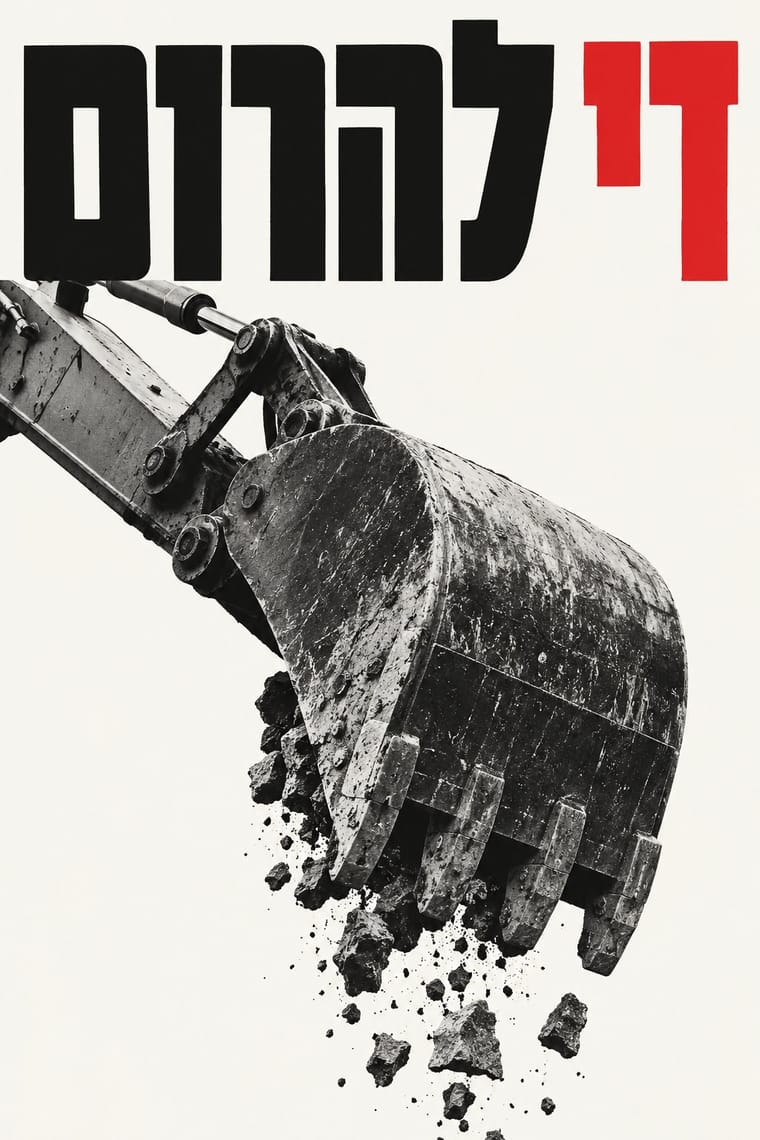
Compare how a recognisable photographed object becomes an accusation, but keep the Hebrew slogan and local reference specific; resemblance in the montage method is not evidence of direct historical influence.
Mix them and make something AIZ Political Photomontage Israeli Political Poster
01
What each style brings
Each part of the design comes from the style with the stronger say in it, and each style gives at least two.
AIZ Political Photomontage (Heartfield) Israeli Political Poster (Tartakover to Lemel)
- Type from Israeli Political Poster
- Colour from AIZ Political Photomontage
- Form from AIZ Political Photomontage
- Composition from Israeli Political Poster
- Surface from AIZ Political Photomontage
-
02
The type
Open fonts standing in for each style’s own type, which is often hand-drawn or commercial.
Display · Israeli Political Poster
Wake
Big Shoulders, standing in for Traditional-looking, stroke-modulated Hebrew display lettering contrasted with heavy monoline Hebrew block lettering, as visible in Peace Now (1978); exact font identifications are not asserted here.
Text · AIZ Political Photomontage
The political photomontage John Heartfield made for the communist weekly AIZ from 1930 to 1938, in Berlin and, from 1933, in Prague exile. Press photographs were cut, joined, retouched with airbrush and rephotographed into one seamless, believable picture that usually takes an opponent's slogan or symbol, most often a Nazi one, literally and, less often, raises a heroic emblem such as the clenched fist. It was printed full-page in single-ink photogravure between a short headline and a deadpan caption or quotation in plain bold sans.
Jost; AIZ Political Photomontage used Bold geometric or grotesque sans capitals of the Erbar and Bold geometric or grotesque sans upper- and lowercase, often with a double-storey a, for the punchline, often reversed white out of the dark gravure ('Kleiner Mann bittet um große Gaben', 1932; 'Hurrah, die Butter ist alle!', 1935; 'Die Stimme der Freiheit in deutscher Nacht – auf Welle 29,8', 1937)
03
The colours
The ground and leading colours come from AIZ Political Photomontage, with a counter-accent from Israeli Political Poster. The ink reads on the ground at 4.5:1 or more.
AIZ Political Photomontage (Heartfield) Israeli Political Poster (Tartakover to Lemel)
-
#ede1c3ground · 36% -
#1e1a17ink · 14% -
#c6a67caccent · 18% -
#ee7b28accent · 14% -
#86603faccent · 10% -
#d71920accent · 8%
As CSS
:root {
  --ground: #ede1c3;
  --ink: #1e1a17;
  --accent-1: #c6a67c;
  --accent-2: #ee7b28;
  --accent-3: #86603f;
  --accent-4: #d71920;
  --font-display: "Big Shoulders", sans-serif;
  --font-text: "Jost", sans-serif;
}
Use it with care
AIZ Political Photomontage (Heartfield): The montages turn swastikas and portraits of Nazi leaders against the regime; displaying Nazi symbols is restricted by law in Germany and several other countries outside contexts such as art, satire, education and history, so keep any reuse unmistakably critical and check the rules where the work will be shown. AIZ was also a communist magazine informally financed by the Comintern: before 1933 its montages attacked the Social Democrats as well as the Nazis, and in 1934 it devoted a special issue to seventeen years of the Soviet Union, so treat the style as partisan propaganda, and do not turn its literal, accusatory montage on named living people without checking defamation and image-rights law.
Israeli Political Poster (Tartakover to Lemel): These are situated arguments by individual designers, not a neutral national look or a statement of what all Israelis believe. Identify the maker, occasion and position when discussing a work, and distinguish Israeli dissent from official state communication and from Palestinian poster traditions. Photographs of suffering people require context and care; do not fabricate documentary scenes or recycle victims as decorative stock. The historical posters and contemporary responses examined here have no verified open file licences, so this entry supplies no specimen images or reuse permission. Borrow a compositional method without copying a movement's logo, an artist's work or an identifiable person's likeness.
04
The two styles
05
More combinations
With AIZ Political Photomontage
- NSK Retro-Avant-Garde Contrasts · NSK lifts Nazi and socialist emblems whole into solemn, centred heraldry and over-identifies with power, leaving the verdict open; AIZ builds the same kind of centred emblem, like the axe swastika, but always adds a caption that convicts. Choose by whether the viewer should be left uneasy or told what to think.
- Surrealist Graphics Pairs well · Surrealist photography also makes the impossible look photographed; take its dream logic when a brief needs strangeness, and add the AIZ headline and caption when that strangeness has to land a political point.
- Russian Constructivism Contrasts · Constructivist photomontage drives heroic figures along diagonals with bars, red ink and exploding type; AIZ uses the same cut photographs in a centred, single-ink picture with a quiet caption, mostly to mock and sometimes, as in the 1937 radio-wave fist, to rally. The debt is direct: Heartfield spent April 1931 to January 1932 in the Soviet Union, looked after by Sergei Tretyakov and, it seems, getting on well with Gustav Klutsis, and the Art Institute of Chicago traces the 1934 many-arms fist cover to Klutsis's 1932 election poster of one raised hand repeated into a crowd.
- Situationist Détournement Graphics Pairs well · Both turn the opponent's own words and pictures against their source; take détournement's scattered press fragments and rewritten speech balloons for a looser, cheaper attack, and AIZ's seamless single picture when the charge must look like a photograph of fact.
- ACT UP & Gran Fury AIDS Activist Graphics Pairs well · Both put a photograph under a one-line charge against named people; set Gran Fury's facts and demands in small print beneath a Heartfield-style literal metaphor when the accusation needs evidence.
- Simplicissimus Satirical Style (Munich) Pairs well · Simplicissimus frames a drawn caricature between a set title and a one-line caption; once it dulled its satire in the First World War, the sharpest graphic satire passed to Grosz, Kollwitz and Heartfield. Keep that title-picture-caption sentence and swap the drawing for a seamless montage to make the satire look like evidence.
- West German Conceptual Film & Culture Poster (Hillmann and Rambow) Pairs well · Heartfield tied four bloody axes into a swastika in 1934; Rambow's broken pencils laid into a swastika over a 1938 PEN list (1983) make the same move of an object turned into an emblem. Borrow the AIZ caption when the poster must accuse, and Rambow's wordless object when it should commemorate.
- Stenberg Brothers Constructivist Film Poster Pairs well · Borrow the political photomontage cut-and-assemble method, then add the Stenbergs' exaggerated scale for dynamism.
With Israeli Political Poster
- Polish Poster School Contrasts · Use the comparison to choose between a painted metaphor with the maker's handwritten title and a photograph or typographic confrontation; do not make painterly brushwork a defining trait of this grouping.
- West German Conceptual Film & Culture Poster (Hillmann and Rambow) Contrasts · Both can concentrate a poster into a photographed paradox and a set sans-serif title; choose the Israeli dissenting core when Hebrew slogans, national visual memory and the artist as critical witness must carry the argument, rather than a sign extracted from a film or play. Lemel's exhibition and pandemic images remain points of overlap, not a uniquely Israeli photographic technique.
- Hebrew Poster Lettering & Early Israeli State Design Contrasts · Compare the earlier entry's hand-drawn Hebrew, painted heroes and official emblems with this strand's set slogans and photographic contradictions; use the contrast to move from affirmative national address to situated criticism without implying a documented line of descent.