Craft & organic · 1860–1910 · Western Europe, North America, Central Europe
Japonisme
Also known as Japanism, Anglo-Japanese style
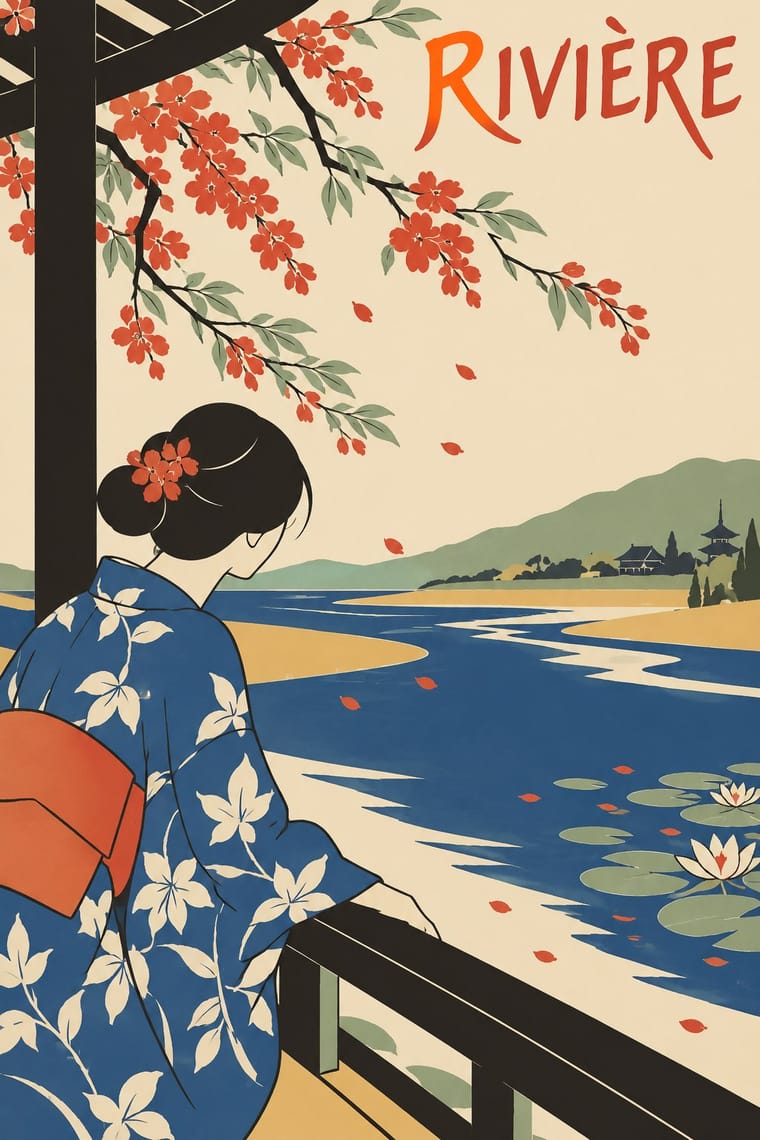
The Western absorption of Japanese woodblock prints, textiles and crafts after Japan reopened to trade in the 1850s. Artists and designers borrowed ukiyo-e's flat colour, bold contours, off-centre and cropped compositions, high viewpoints and crest-like emblems; these devices dissolved academic perspective and set the visual grammar of the modern poster and of Art Nouveau.
Make something in this styleGet advice in this styleMix it with another style
01
How it works
- Place the main subject off-centre and crop figures and objects abruptly at the edges of the frame.
- Flatten space: lay down unmodulated areas of colour bounded by firm contour lines instead of modelling with light and shade.
- Use a high or oblique viewpoint, steep diagonals and an empty foreground or sky as an active part of the composition.
- Favour tall, narrow or unusual formats derived from hanging scrolls and pillar prints.
- Sign with a compact monogram or seal-like emblem and keep lettering short, often in a small cartouche.
- Reduce waves, irises, cranes, bamboo and chrysanthemums to simplified silhouettes.
Paris and London, after Japanese prints reached Europe in the late 1850s and were shown at the 1862 London and 1867 Paris exhibitions
02
Its design choices
From Stylogeny’s vocabulary of design choices: defining choices make the style, characteristic ones are usual, occasional ones turn up now and then.
- Layout & composition
- Space & hierarchy
- Typography
- Colour
- Surface & texture
- Ornament
- Medium & production
- Tone & intent
- Avoids
- Central symmetry, Horror vacui, Naturalistic depiction, Eclectic mixing, Straight photography
Palette
#f1e6cf#22201e#2b4c7e#c8452c#d9b26f#8fa58a
Typefaces
Auriol
George Auriol, G. Peignot et Fils, 1901
Brush-drawn display lettering imitating Japanese calligraphy
Seal-like artists' monograms and vertical title cartouches
Known for
James McNeill Whistler
Peacock Room, 1876–77; butterfly monogram
Félix Bracquemond
Service Rousseau, 1866–67
Siegfried Bing, Le Japon artistique
1888–1891
Henri de Toulouse-Lautrec
Divan Japonais, 1893
Henri Rivière
Thirty-Six Views of the Eiffel Tower, 1902
Arthur Wesley Dow
Composition, 1899
Vincent van Gogh
copies after Hiroshige, 1887
03
Make something in this style
Say what you need, and Stylogeny’s image studio draws it from Japonisme’s design choices and checks it against them. It takes about a minute, and you get a link to share.
04
Where it comes from, and what it’s close to
Before it
The style it grew out of, and the styles it borrowed from.


After it
The styles that grew out of it.
No later style in the atlas grew out of it yet.
Alike in its design choices
Styles that make many of the same choices, related or not, besides those above.


05
Real works
Artefacts in museums, libraries and archives that show the style, linked at their source.
- "Myrane" et "Les Chapons" (programme for the Théâtre Libre)George Auriol · 1889 · The Cleveland Museum of Art
- Thirty-Six Views of the Eiffel Tower: From the Grenelle BridgeHenri Rivière; printed by Eugène Verneau · 1902 · The Cleveland Museum of Art
- Nursemaids' Promenade, Frieze of Carriages (four-panel screen)Pierre Bonnard; published by Molines, Paris · 1895 · The Cleveland Museum of Art
- In the OmnibusMary Cassatt · 1890–91 · The Cleveland Museum of Art
- The Long Road (Argilla Road)Arthur Wesley Dow · c. 1898 · The Cleveland Museum of Art
06
Sources
- Gabriel P. Weisberg et al., Japonisme: Japanese Influence on French Art 1854–1910 (Cleveland Museum of Art, 1975)
- The Metropolitan Museum of Art, Heilbrunn Timeline of Art History, 'Japonisme' (metmuseum.org/toah/hd/jpon/hd_jpon.htm)
- Philip B. Meggs & Alston W. Purvis, Meggs' History of Graphic Design
How Stylogeny researches and checks a style: where the facts come from.