Pictorial & machine age · 1879–present · Southern Europe
Spanish Bullfight Poster (Cartel Taurino)
Also known as Cartel de toros, Cartel taurino, Bullfighting poster, Cartell taurí
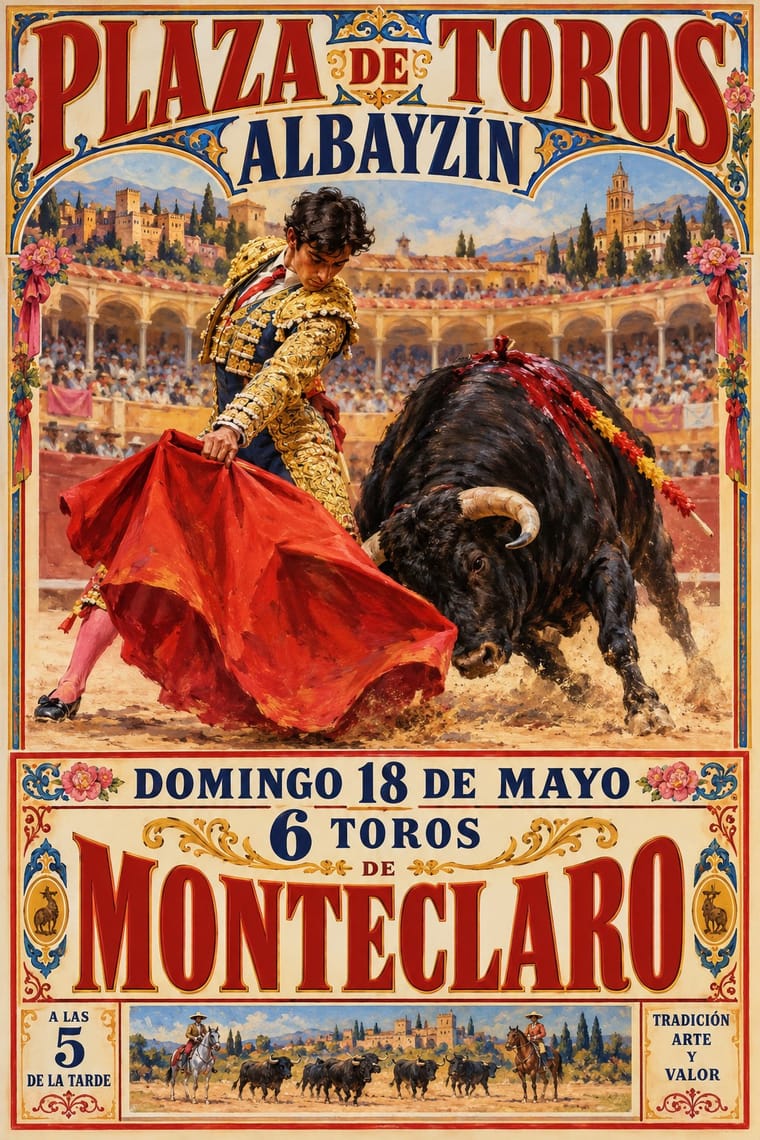
The Spanish bullfight poster in its illustrated form, from Marcelino de Unceta's lithographs (from 1879) to the Valencian house of Ortega, which supplied rings across Spain. From the 1910s the tall sheet, at its largest over two metres, usually splits in two: a brushy, naturalistic painting of a matador's pass, a picador or manolas in Manila shawls above, often under the ring's name, and below it a centred programme of date, bull breeders and matadors in mixed faces between rules, the names in heavy capitals. The picture was often a stock print, its text added afterwards by another printer.
Make something in this styleGet advice in this styleMix it with another style
Use it with care
Bullfighting is a living but contested practice, opposed by animal-welfare campaigners in Spain and abroad, so borrowing its imagery for unrelated products brings that dispute with it; the painted manolas also belong to a folkloric picture of Andalusia rather than a record of it. Ruano Llopis (d. 1950), Roberto Domingo (d. 1956) and Juan Reus (d. 2003) are still in copyright in Spain, so paint new pictures in the manner rather than reprinting their motifs.
01
How it works
- Split the tall sheet into a painted scene across the upper half to two-thirds and a typeset programme below, usually meeting at a rule, with the ring's name often run as a headline across the top above the picture. Nineteenth-century sheets instead stacked several scenes in compartments, or let text and pictures alternate (Unceta's Pilar posters, Calatayud 1898).
- Paint the fiesta naturalistically with visible brushwork (the matador's pass with cape or muleta, the picador, the encierro, or manolas in mantillas and embroidered Manila shawls) in the red, gold and black of cape, suit of lights and bull, often vignetted into the pale paper rather than framed.
- Rank the programme in centred lines, the names in capitals: the date (and the ring, if it is not headlined above the picture) at the head, then the number of bulls and their ganaderías, then the matadors' names largest of all, with the starting time, regulations and printer's imprint in small type at the foot.
- Mix faces freely so each part of the information has its own voice: heavy condensed grotesques and slab capitals for names in black, red or blue, lighter upper-and-lowercase for the linking lines, ornamented or hand-drawn letters for TOROS and the town, and ruled boxes that divide a feria's several corridas into columns.
- Treat the picture as reusable stock: commission an image that suits any ring and date, lithograph it in quantity and fill in the event's text later, so the bill, not the image, carries the news.
Spain. Printed bills replaced the town crier's spoken announcement of corridas in the eighteenth century (the earliest known is for Madrid's plaza del Soto de Luzón, 19 and 30 September 1737) and took on anonymous woodcut vignettes from the mid-nineteenth century. The painted colour poster began with Marcelino de Unceta (1835-1905), whose first known poster, of 1879, is considered the first painted bullfight poster (an 1853 Bilbao poster by Francisco Bringas has also been proposed); his later ones, many for Zaragoza's Pilar corridas, were lithographed by his former pupil Eduardo Portabella and often set several scenes in compartments. Portillo traces the picture to the easel painter specialised in the bullfight, who entered the poster in the early twentieth century, drawing on the costumbrista stereotypes of a Romantic Spain, and its expressive drawing to Goya and the Perea brothers of the review La Lidia. Specialist lithographic houses then supplied the rings of the provinces: Portabella in Zaragoza, Julián Palacios and Rufino Velasco in Madrid, and the Ortega house in Valencia (founded 1871 by Ramón Ortega, run from 1888 by his son José), where Carlos Ruano Llopis (1878-1950) painted exclusively from 1912 to 1934 and whose later painters included Juan Reus (1912-2003).
02
Its design choices
From Stylogeny’s vocabulary of design choices: defining choices make the style, characteristic ones are usual, occasional ones turn up now and then.
- Layout & composition
- Space & hierarchy
- Typography
- Colour
- Surface & texture
- Ornament
- Medium & production
- Tone & intent
- Avoids
- Lowercase only, Flush left, ragged right, Modular grid, Collage & layering, Photomontage, Non-representational, Flat, Generous white space, Monochrome, Ironic & self-aware, Rebellious & subversive
Palette
#f0e6cb#c42127#dcaa34#1b1816#2e3f7c#d8708e
Typefaces
Inherited from the typographic bills
letra normanda, an extra-black fat face with thin, geometric serifs, for the headings of the vertical bills from the mid-1840s (Zaragoza, 15 October 1844)
'Góticas' and 'latinas' with split serifs (remates hendidos) in the first illustrated posters of the 1880s and 1890s
Mecana (even-stroke slab serif) and heavy condensed grotesque capitals for the matadors' names, printed in black, red or blue
Lettering drawn on the stone with the painting
SEVILLA 1930 in outlined red capitals beside Ruano Llopis's manolas; a green TOROS wreathed in roses on Ortega's San Sebastián sheet (1931)
Known for
Probably Marcelino de Unceta (signed with the monogram 'MU 1880'), Zaragoza 1880, Fiestas de Ntra. Sra. del Pilar
una prueba y cuatro corridas de toros (Litografía Portabella, Zaragoza; Biblioteca Nacional de España; 264.5 x 131 cm): a mounted picador seen from the front, picked out in warm yellows against the black silhouette of his horse
Marcelino de Unceta, Zaragoza, Fiestas a N.ª S.ª del Pilar 1883
(signed 'M. Unceta'; Litografía Portabella; 245 x 130 cm, paper on canvas; Enrique Asín collection): four scenes at different heights joined by plant and floral motifs, among them a carriage driven diagonally towards the ring and wild bulls herded by two mayorales, for Lagartijo and Frascuelo
Marcelino de Unceta, Pamplona 1884, Ferias y fiestas de San Fermín (Litografía Portabella; Biblioteca Nacional de España)
encierro scenes signed 'Marcelino de Unceta 1884', with the programme for Currito, Gallito and Valentín
Eduardo Portabella after a sketch by Marcelino de Unceta, Grandes corridas patrióticas, Calatayud fair 1898 (Museo de Zaragoza, inv. 54228; 226.8 x 114.5 cm, printed in six sheets of 81 x 60 cm): text and pictures alternating, with photolithographed portraits of the matadors
Carlos Ruano Llopis, a bullfight oil of 1912 that won him his place at Ortega, lithographed for the corrida of 16 October 1913 announcing the farewell of Ricardo Torres 'Bombita'
Carlos Ruano Llopis (motif) and Ortega, Grandes corridas de toros, Sevilla, Pascua de Resurrección y Feria de Abril 1930
(Museo de Ávila, Colección Taurina Marqués de Benavites; 230 x 113.5 cm): two manolas in mantilla and Manila shawl beside a hand-lettered SEVILLA 1930, above the matadors Chicuelo, Márquez, Marcial Lalanda, Cagancho, Gitanillo de Triana, Bienvenida and Mérida
Carlos Ruano Llopis and Ortega, Seis grandes corridas de toros, Nueva Plaza de San Sebastián, August 1931 (Museo de Ávila; 230 x 113.5 cm)
a matador's pass under a green TOROS wreathed in roses, the six corridas in ruled columns below
Carlos Ruano Llopis and Ortega, Grandioso festival taurino, Plaza de Toros de Ávila, 15 July 1934 (Museo de Ávila; 110 x 58 cm)
two manolas with a Manila shawl and a fan under a 'Plaza de Toros de AVILA' headline, on a stock sheet (plantilla) whose motif Ortega printed and the Madrid Imprenta de Torerías then filled with the event's text
03
Make something in this style
Say what you need, and Stylogeny’s image studio draws it from Spanish Bullfight Poster (Cartel Taurino)’s design choices and checks it against them. It takes about a minute, and you get a link to share.
04
Where it comes from, and what it’s close to
Before it
The style it grew out of, and the styles it borrowed from.


After it
The styles that grew out of it.
No later style in the atlas grew out of it yet.
Alike in its design choices
Styles that make many of the same choices, related or not, besides those above.


05
Sources
- Mónica Vázquez Astorga, 'El cartel taurino zaragozano del siglo XIX', Artigrama 18 (2003), pp. 573-608, https://papiro.unizar.es/ojs/index.php/artigrama/article/download/8381/7086/29110 (typographic bills to the last third of the 19th century, woodcut vignettes from mid-century, signed colour posters with lithography in the last two decades; mural posters of two or three metres at the ticket offices; type styles mixed indiscriminately; letra normanda, 'extranegra y fina, de remates geométricos', on the 15 October 1844 bill; the 'mecana' of even strokes from the late 1840s, kept in the cartel taurino 'hasta nuestros días'; Unceta's 1879 poster considered the first bullfight poster painted in oil, with the hypothesis of an earlier 1853 Bilbao poster by Francisco Bringas; the 1880 poster at the BNE signed with the monogram 'MU', 'probablemente' Unceta's; Unceta's posters built of several scenes or a single one, his 1883 Pilar poster of four scenes at different heights joined by plant and floral motifs and his 1894 poster in three compartments under a semicircular main scene; Portabella as the first specialist printer; José Ortega, Valencia, founded 1871; Palacios and Velasco in Madrid as 'casas-madre' for the provinces; text and image rarely a harmonious synthesis because the artist seldom designed the whole poster)
- Rafael Portillo Martín, 'Historia del cartel taurino. Sala de Exposiciones de la Plaza de Toros de la Maestranza de Sevilla', Revista de Estudios Taurinos 2 (1995), pp. 183-190, https://dialnet.unirioja.es/descarga/articulo/5147962.pdf (anonymous workshop vignettes reused at the compositor's choice; photoengraved portraits and small silk posters; the easel painter enters early in the 20th century, after a century of taurine easel painting and costumbrista 'estereotipos' from the Romantic travellers; the roots of expressive taurine drawing in Goya, the Perea brothers of La Lidia and Unceta; Ruano Llopis, Juan Reus, Roberto Domingo and others with printers such as Ortega as the 'Edad de Oro'; Barceló and Pérez Villalta as later contributors)
- https://es.wikipedia.org/wiki/Cartel_taurino (earliest known bill, Madrid, Soto de Luzón, 1737; bills replace the street crier; vignettes after the royal heading was dropped in 1840; Sorolla, Benlliure, Picasso, Alberti and Barceló as contributors; the Catalan article is titled 'Cartell taurí')
- https://es.wikipedia.org/wiki/Carlos_Ruano_Llopis (born Orba 1878, died Mexico City 1950; his 1912 oil taken on by José Ortega; exclusive to Ortega until 1934; the 16 October 1913 Bombita farewell poster)
- https://es.wikipedia.org/wiki/Marcelino_de_Unceta (1835-1905; the 1879 poster considered the first bullfight poster; Portabella's lithographic workshop)
- https://es.wikipedia.org/wiki/Josep_Renau (learned the lithographer's trade at Litografía Ortega while studying at San Carlos, 1919-1925)
- Museo de Ávila, Colección Taurina Marqués de Benavites, CERES records: Sevilla 1930, http://ceres.mcu.es/pages/Main?idt=132903&inventary=C/65/1/190/43&table=FMUS&museum=MAV; San Sebastián 1931, http://ceres.mcu.es/pages/Main?idt=132911&inventary=C/65/1/190/45&table=FMUS&museum=MAV; Ávila 1934 (plantilla printed by Ortega and completed by the Madrid Imprenta de Torerías; 110 x 58 cm; thumbnail with the 'Plaza de Toros de AVILA' headline above the picture), http://ceres.mcu.es/pages/Main?idt=132915&inventary=C/65/1/190/36&table=FMUS&museum=MAV
- Museo Casa de los Tiros, Granada, CERES record DJ01271 (Corpus Christi 1939, Ruano Llopis and Imprenta y Lit. Ortega, chromolithography, 'Tinta azul'; thumbnail with the ring's name in the picture's upper corner), http://ceres.mcu.es/pages/Main?idt=130302&inventary=DJ01271&table=FMUS&museum=MCTGR
- Museo de Zaragoza, CERES record 54228 (Grandes corridas patrióticas, Calatayud 1898, Eduardo Portabella after Unceta), http://ceres.mcu.es/pages/Main?idt=175820&inventary=54228&table=FMUS&museum=MZ
- Biblioteca Nacional de España, Biblioteca Digital Hispánica: Unceta, Zaragoza 1880, https://bdh-rd.bne.es/viewer.vm?id=0000018787; Unceta, Pamplona 1884, https://bdh-rd.bne.es/viewer.vm?id=0000018094; Juan Reus and J. Ortega, Tetuán 1955, https://bdh-rd.bne.es/viewer.vm?id=0000018726
- Biblioteca Virtual de Madrid, record 24028 (Roberto Domingo, Nueva Plaza de Toros de Madrid, 17 June 1931, silk, Mateu; a picture of picadors 'enmarcado en dorado' with the Republican flag hanging behind it and the arms of Madrid above), https://bibliotecavirtualmadrid.comunidad.madrid/bvmadrid_publicacion/es/consulta/registro.do?id=24028
- Diari de Tarragona, 'Quan Tarragona reaprofità un cartell de Jerez', https://www.diaridetarragona.com/tarragona/188902/quan-tarragona-reaprofita-un-cartell-de-jerez-ae16124747.html (the Ortega house founded in 1871 by Ramon Ortega Fort at carrer Russafa 47, Valencia, and run from 1888 by his son Josep Ortega Paredes, known for bullfight and festival posters; Mongrell's 1908 fair-and-festivities poster for Jerez de la Frontera, not a bullfight bill, reused with new text for Ribadesella, Toledo, Guadalcanal and Tarragona: the printer's stock-motif practice the cartel shared)
- Wikimedia Commons, 'Cartel Taurino Alicante 21 Agosto 1963.jpg' (Lit. Ortega; 'Plaza de Toros de ALICANTE' as a headline above a matador's pass; a dark blue programme mixing upper-and-lowercase lines such as 'Monumental Corrida de Toros' and 'y Juan García' with the names in heavy condensed capitals), https://commons.wikimedia.org/wiki/File:Cartel_Taurino_Alicante_21_Agosto_1963.jpg

How Stylogeny researches and checks a style: where the facts come from.