Pictorial & machine age · 1930–1970 · Latin America & Caribbean
Mexican Calendar Chromo (Cromos calendáricos)
Also known as Cromos calendáricos, Calendarios de Galas, Almanaques, Mexican chromo art calendars, Mexican calendar art
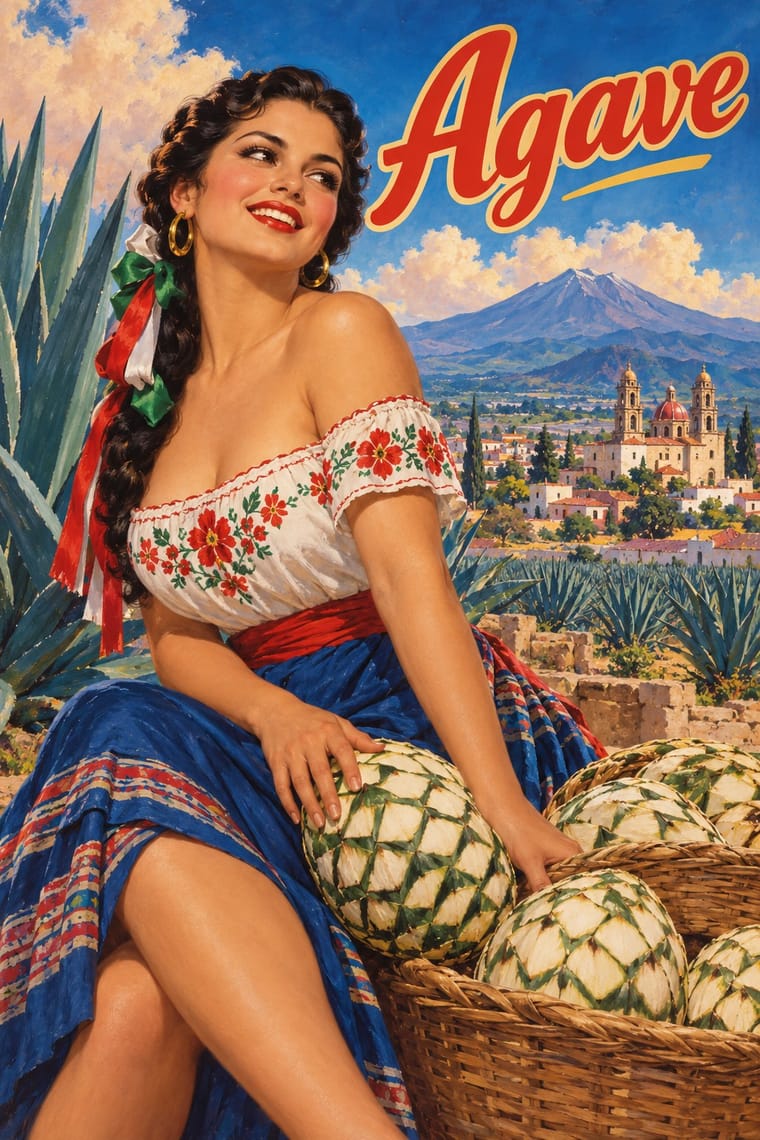
Mexico's give-away advertising calendars, at their height from the 1930s to the late 1960s. Printers led by Galas de México kept studios of painters, among them Jesús Helguera, Eduardo Cataño, Jorge González Camarena and Josep Renau, whose large oil paintings were printed by offset above a sponsor's name and a small calendar pad. In an idealising academic realism touched by Hollywood glamour they staged Aztec legends as melodrama, charros and chinas poblanas, saints, film stars and pin-ups, and hung all year in homes, shops and workshops.
Make something in this styleGet advice in this styleMix it with another style
Use it with care
The Aztec scenes are a nationalist fantasy of the pre-Hispanic past painted by academically trained artists, several of them born or raised in Spain, not Indigenous art: do not present them as Nahua or Mexica tradition or copy their feathered costumes as if they were ethnography. The saints and the Virgin of Guadalupe are devotional images that many owners pray before, so do not parody them, and the pin-ups were painted, as a UNAM study of the Galas archive puts it, to satisfy male longing and promote the sponsors' brands, carrying old and new stereotypes of women. The paintings are still in copyright (Helguera died in 1971) and Grupo Carso holds the rights to the Galas archive, while Alta reported in 2023 that Calendarios Landin owns the rights to Helguera, so paint new pictures in the manner rather than retouching old chromos.
01
How it works
- Commission one easel painting per sheet, in oil, gouache or pastel, from posed models and photographs, and let it fill the sheet as a single unified scene; keep the sponsor's name, logo and calendar pad in a band below or in a corner of the picture, never cut into it as collage.
- Paint in an idealising academic realism: luminous modelled flesh, heroic anatomy, feathers, embroidery and silk rendered in detail, from Helguera's smooth finish to the looser brushwork of the rumba and pin-up pictures, a deep landscape with atmospheric perspective and a theatrical sky, so that a cheap print still reads as a picture worth hanging for a year.
- Stage the nation as romance and longing: Aztec legends as melodrama (a warrior kneeling over a sleeping princess before Popocatépetl and Iztaccíhuatl), heroes of independence, charros and chinas poblanas, Xochimilco and the bullring, saints and the Virgin of Guadalupe, film stars and smiling pin-ups.
- Paint for the press: make large originals, mostly 75 cm to a metre on the long side, a few of 1.5 to 2 metres or more (Milagro del Tepeyac measures 200 × 163 cm, La leyenda de los volcanes 75 × 97 in.), in saturated colour that the printer photographs through filters into separations, usually six inks, and prints by offset; trim the palette so it reproduces cleanly, as Aurora Gil learned to do at Galas.
- Build the calendar as a gift from a business: either a 'line' picture from the printer's catalogue overprinted with a corner shop's name in the blank band below, or a 'special' painting commissioned by one brand, with the product put into the model's hand (a woman on a seaside terrace holding a Pepsi bottle, the bottle-cap logo in a top corner and three month grids at the foot) and the brand's logotype in a corner.
Mexico City printing houses, above all Galas de México, the press of the Santander-born printer Santiago Galas Arce (dated to 1913 in the Museo Soumaya's catalogue, to 1933 in a Milenio column), which from the 1930s kept a studio of painters, hired for a period or by the picture, to make originals for offset calendars, alongside La Enseñanza Objetiva, the pioneer of the trade, and Lito Latina; breweries, cigarette makers, soft-drink firms and corner shops gave the calendars away across Mexico, and their success let Galas expand into Central America, Cuba, Colombia, Venezuela and the United States; the printers worked in an international chromo genre through which Europe and the United States had spread their ideals of beauty, commissioning national scenes in place of foreign chromos, under the strong influence of Hollywood's aesthetic, as heirs of nineteenth-century costumbrista art (Morales Zúñiga 2005 and Ontiveros 2005, both after Alfonso Morales)
02
Its design choices
From Stylogeny’s vocabulary of design choices: defining choices make the style, characteristic ones are usual, occasional ones turn up now and then.
- Layout & composition
- Space & hierarchy
- Typography
- Colour
- Form & shape
- Surface & texture
- Ornament
- Medium & production
- Tone & intent
- Avoids
- Collage & layering, Photomontage, Abundant decoration, Flat, Non-representational, Type as image, Modular grid, Ironic & self-aware, Rebellious & subversive
Palette
#1f4e8c#f0c4a8#a8693f#c8372d#3d8b4f#e2b33c
Typefaces
The sponsor's name and address overprinted in the band left blank below the picture
a 2000 catalogue of Calendarios Galas, the line of Miguel Galas's Centro Gráfico Industrial, still labels it 'espacio para su anuncio'
Brand logotypes painted into the picture or carried on the product
the script Pepsi-Cola wordmark in its bottle cap, set in a corner of the calendar sheet; Corona's blackletter-style name over a smaller blackletter 'Extra', with 'LA CERVEZA MAS FINA' in sans-serif capitals, on a painted Corona showcard shown at the Museo Soumaya
Small month grids and tear-off pads with plain numerals and Spanish month names
(three small grids headed Enero, Febrero and Marzo at the foot of a Pepsi-Cola sheet at the Museo Soumaya); later pads, such as those in a 2000 catalogue of Calendarios Galas, also print the santoral, the saint of each day
The painter's signature brushed in capitals into a lower corner
JESUS HELGUERA on La leyenda de los volcanes
Known for
Jesús Helguera, La leyenda de los volcanes, 1940, oil on canvas, 75 × 97 in. (National Museum of Mexican Art, Chicago, 2023.323)
a feathered warrior kneels beside a sleeping princess under Iztaccíhuatl and Popocatépetl, the image reproduced on calendars ever since; another version, dated c. 1941 (mixed media on paper, 83.1 × 65.3 cm), is recorded in the Galas de México archive held with the Museo Soumaya (NMMA; Morales Zúñiga 2005)
Jesús Helguera's other calendar paintings, among them La Malinche
(1937), Grandeza azteca (a second version of the volcano legend), Gesto azteca, Cuauhtémoc and Amor indio (1965); a calendar vendor quoted in Milenio recalls that his first calendars were printed by La Enseñanza Objetiva, which bought La leyenda de los volcanes (English Wikipedia); from 1954 to 1970 he painted for Galas de México, which reproduced his work for the Cigarrera La Moderna (English and Spanish Wikipedia; Milenio; Ontiveros 2005)
Eduardo Cataño (1910–1964), calendar pin-ups and advertisements painted for Galas de México, often from magazine photographs, and the Corona beer label credited to him around 1935 (English Wikipedia, uncited); his Ataque a la Gran Tenochtitlan and El príncipe Popocatépetl (Ontiveros 2005)
Jorge González Camarena, Milagro del Tepeyac, c. 1947, oil on canvas, 200 × 163 cm, an apparition of the Virgin of Guadalupe painted for a calendar (recorded in the Galas de México archive, Museo Soumaya; Morales Zúñiga 2005)
Josep Renau, exiled from Spain in 1939, painted calendars for Galas, among them La Quebrada (1946), with women in regional dress and Mexican landscapes (Spanish Wikipedia; Morales Zúñiga 2005)
Luis Améndolla, who joined Galas in 1953 to draw labels and became a resident painter
humorous calendar scenes for Hércules radiators and Pan Bimbo; Armando Drechsler, Máscara roja (1947); Humberto Limón, La fundación de Tenochtitlan; Antonio Gómez R., Rumbera (1947, oil on paper, 152.5 × 115 cm); Aurora Gil, at Galas from about 1954, children and sensual women (Morales Zúñiga 2005)
The permanent calendar display at the Museo Soumaya, Plaza Loreto, photographed in 2015
original paintings of a woman in folk dress before a snow-capped volcano, charros on horseback, saints and the Sacred Heart, children with pets and rumba dancers; printed glamour portraits of women on saturated blue grounds above a blank band for the advertiser's imprint, hung beside an English-language pin-up calendar of a señorita in a big sombrero whose pad reads 'January'; Pepsi-Cola sheets with the script bottle-cap logo in a corner and three month grids, headed in Spanish, set at the foot of the picture; and a painted Corona Extra showcard of a smiling woman holding up the bottle on a flat cyan ground (Wikimedia Commons)
Exhibitions
Jesús Helguera, pintor de almanaques, Palacio de Bellas Artes, Mexico City (1986); La Patria Portátil: 100 Years of Mexican Chromo Art Calendars, curated by Alfonso Morales for the Mexican Fine Arts Center Museum, Chicago, and the Museo Soumaya (1999), which travelled to Los Angeles and San Francisco (Spanish Wikipedia; NMMA)
03
Make something in this style
Say what you need, and Stylogeny’s image studio draws it from Mexican Calendar Chromo (Cromos calendáricos)’s design choices and checks it against them. It takes about a minute, and you get a link to share.
04
Where it comes from, and what it’s close to
Before it
The style it grew out of, and the styles it borrowed from.
Nothing earlier is recorded: in the atlas it is a starting point.

After it
The styles that grew out of it.
No later style in the atlas grew out of it yet.
Alike in its design choices
Styles that make many of the same choices, related or not, besides those above.


05
Sources
- National Museum of Mexican Art, Chicago, Jesús Helguera, La leyenda de los volcanes (The Legend of the Volcanoes), 1940, oil on canvas, 75 × 97 in., NMMA Permanent Collection 2023.323 (image inspected: warrior with feather headdress and shield kneeling beside a sleeping woman in white before the two snow-capped volcanoes, signed JESUS HELGUERA in capitals at lower right): https://nationalmuseumofmexicanart.org/artworks/la-leyenda-de-los-volcanes-the-legend-of-the-volcanoes ; artist page (Helguera 'initiated his career by creating artwork for calendars'; many of his works were in the 1999 exhibition La Patria Portátil): https://nationalmuseumofmexicanart.org/artists/jesus-helguera
- National Museum of Mexican Art, 'La Patria Portátil: 100 Years of Mexican Chromo Art Calendars', 15 January–25 April 1999, curated by Alfonso Morales, organised by the Mexican Fine Arts Center Museum and the Museo Soumaya, travelling to The Latino Museum of History, Art and Culture, Los Angeles, and The Mexican Museum, San Francisco ('A retrospective of 20th Century Mexico, as seen through its popular art calendars'; subjects include the Mexican Revolution and romanticised pre-Columbian images): https://nationalmuseumofmexicanart.org/events/la-patria-portatil
- Erika Liliana Morales Zúñiga, 'Un acercamiento retrospectivo a los Cromos y Calendarios del Siglo XX en Galas de México', tesina, Escuela Nacional de Artes Plásticas, UNAM, 2005, drawing on Alfonso Morales, La leyenda de los cromos. El arte de los calendarios mexicanos del siglo XX en Galas de México (Museo Soumaya, 2001) (through chromolithographs and later offset 'se difundió la imagen de Occidente, los ideales y belleza que impusieron Europa y los Estados Unidos', while other countries adapted the genre; Mexican firms wanted typical scenes 'en lugar de recurrir a los cromos del extranjero', made 'en un momento de inquietudes nacionalistas y de fuerte influencia de la estética hollywoodense'; religious chromos 'el más antiguo género de la estampa mexicana' and still permanent in modern calendars; Santiago Galas Arce born in Santander in 1886; the firm traced to 1913, when he bought a small press; from the 1930s, with offset, Galas joined the chromo business like La Enseñanza Objetiva, the pioneer, and Lito Latina, founded 1886, setting up a studio of painters hired by time or by work for 'special' and 'line' calendars; large colourful paintings made with models and photographic documentation, photographed through filters into separations, 'normalmente seis' inks, and printed by offset; Galas expanded to Central America, Cuba, Colombia, Venezuela and the United States; the feminine figures aimed to satisfy male longing and embodied 'el catálogo de los viejos y nuevos estereotipos de la mujer'; Santiago Galas died 4 December 1970 and Galas joined Carso in 1976, which acquired the rights to the graphic works; Renau painted La Quebrada for Galas in 1946; Drechsler's Máscara roja, 1947; Améndolla joined Galas in 1953, painted for Hércules radiators and Pan Bimbo and is known above all for his 'cromos humorísticos'; Aurora Gil joined about 1954, had to reduce her palette for better reproduction and was asked most for 'escenas con niños y mujeres sensuales'; archive records of Helguera's La leyenda de los volcanes, c. 1941, mixed media on paper, 83.1 × 65.3 cm, González Camarena's Milagro del Tepeyac, c. 1947, oil on canvas, 200 × 163 cm, Antonio Gómez R.'s Rumbera, 1947, oil on paper, 152.5 × 115 cm, and works by Bribiesca, Cataño, Améndolla, Limón and Gil, all recorded as negatives, with long sides of 76 to 100 cm except Rumbera and Milagro del Tepeyac): https://ru.dgb.unam.mx/bitstream/20.500.14330/TES01000345801/3/0345801_A1.pdf
- Alejandro Ontiveros Tanus Heid, 'Propuesta de ilustración para calendario referente a la cultura Azteca y basada en la serie La leyenda de los cromos', tesis, Escuela Nacional de Artes Plásticas, UNAM, 2005, quoting Alfonso Morales Carrillo (the reproductions called cromos after chromolithography; Galas producing calendars from the 1930s by offset; techniques of the originals mainly oil, gouache, watercolour and pastel; subjects: the pre-Hispanic past, religion and above all the Virgin of Guadalupe, folklore, heroes of independence, the Revolution, charrería, golden-age cinema, Xochimilco, progress, bullfighting and erotic images; 'special' paintings for brands such as Sidral Mundet, Goodyear, Corona and Crush and 'line' pictures for small shops; Helguera's Gesto azteca, Grandeza azteca, La leyenda de los volcanes and Cuauhtémoc, Cataño's Ataque a la Gran Tenochtitlan and El príncipe Popocatépetl, Limón's La fundación de Tenochtitlan; the chromos as 'herederos del arte costumbrista del siglo pasado', allies of the cultural nationalism unleashed by the Revolution and of golden-age cinema; the boom lasting 'de principios de los años 30 a fines de los años 60' until television, cosmopolitan fashions and photography displaced it; some of the painters 'españoles que huían de la guerra'; the 2000 catalogue of Calendarios Galas, made by Centro Gráfico Industrial, the press Miguel Galas split from Galas de México in 1957, with the picture above a blank 'espacio para su anuncio' and pads printing the santoral; Galas de México's own line given as 'Calendarios Landing' in the scan): https://ru.dgb.unam.mx/bitstream/20.500.14330/TES01000343097/3/0343097_A1.pdf
- Wikipedia: Jesús Helguera (born 1910 in Chihuahua, raised and trained in Spain, returned to Mexico during the Spanish Civil War, hired by the Cigarrera La Moderna for calendar artwork printed by Galas de México; La Malinche, 1937; La Leyenda de los Volcanes, 1940, bought by Enseñanza Objetiva and widely reproduced on calendars; Amor indio, 1965): https://en.wikipedia.org/wiki/Jes%C3%BAs_Helguera
- Wikipedia (Spanish): Jesús Helguera (worked for Galas de México from 1954 to 1970, which reproduced his work for the Cigarrera La Moderna; influenced by the nationalism of the muralists; retrospective 'Jesús Helguera, pintor de almanaques', Palacio de Bellas Artes, 1986; originals in private collections and the Museo Soumaya): https://es.wikipedia.org/wiki/Jes%C3%BAs_Helguera
- Wikipedia: Eduardo Cataño (1910–1964; worked for the Galas de México studio founded by Santiago Galas; calendar pin-ups often modelled on magazine photographs; Corona beer label around 1935; the Corona sentence is uncited, and the article cites the Museo Soumaya's Mexican Calendars, 2014, only for a general phrase on calendar art): https://en.wikipedia.org/wiki/Eduardo_Cata%C3%B1o
- Wikipedia (Spanish): Josep Renau (in Mexican exile from 1939 'realizó calendarios para la imprenta Galas'): https://es.wikipedia.org/wiki/Josep_Renau
- Agustín Gutiérrez Canet, 'Jesús Helguera: pintor del nacionalismo', Milenio (29 February 2024; the columnist gives Galas de México as founded in 1933 by Santiago Galas Arce and now owned by Grupo Carso; Mauro Fuentes Espinoza of the calendar kiosk La Chulita recalls that Helguera's first calendars were printed by La Enseñanza Objetiva, 'el primer taller que trajo offset a México', and that he worked for Cervecería Modelo, Cervecería Cuauhtémoc, Cigarrera La Moderna and Cigarrera El Águila): https://www.milenio.com/opinion/agustin-gutierrez-canet/sin-ataduras/jesus-helguera-pintor-del-nacionalismo
- Wikimedia Commons, photographs by LauKawaii, 23 September 2015, CC BY-SA 4.0, of the permanent calendar display at the Museo Soumaya, Plaza Loreto (images inspected: original paintings and printed calendar sheets, including glamour portraits above a blank imprint band, Pepsi-Cola sheets with Spanish month grids at the foot (Enero, Febrero, Marzo on one) and the script bottle-cap logo in a corner, a painted Corona Extra showcard on a flat cyan ground, an English-language pin-up calendar with a 'January' pad hung alongside the Mexican sheets, rumba dancers, two of them loosely brushed on red grounds, and a room of religious chromos): https://commons.wikimedia.org/wiki/File:Exposici%C3%B3n_Calendarios_Mexicanos5.JPG ; https://commons.wikimedia.org/wiki/File:Exposici%C3%B3n_Calendarios_Mexicanos6.JPG ; https://commons.wikimedia.org/wiki/File:Exposici%C3%B3n_Calendarios_Mexicanos4.JPG ; https://commons.wikimedia.org/wiki/File:Exposici%C3%B3n_Calendarios_Mexicanos2.JPG ; https://commons.wikimedia.org/wiki/File:Exposici%C3%B3n_Calendarios_Mexicanos3.JPG ; https://commons.wikimedia.org/wiki/File:Explosi%C3%B3n_Calendarios_Mexicanos7.JPG
- El Siglo de Torreón, 'Realiza el mayor catálogo de almanaques mexicanos', 2007, on Ángela Villalba's Mexican Calendar Girls (Galas de México 'la principal fábrica de los almanaques'; Litografía Latina issuing calendars since 1886; the greatest boom in the 1930s and 1940s): https://www.elsiglodetorreon.com.mx/noticia/2007/realiza-el-mayor-catalogo-de-almanaques-mexicanos.html
- Smithsonian American Art Museum, Rebekah Mejorado, 'Chicanx Graphic Arts in Focus: RIFA, from Méchicano 1977 Calendario', 30 July 2021 (many Chicanos grew up with 'illustrated Mexican-themed calendars hanging in their homes', often giveaways from local businesses; Chicano organisations adopted the calendar format for prints and calendars became an essential fundraising tool; RIFA, a 1976 screenprint of Zapata; Terezita Romo: 'Chicana/o artists revised its single image format, offset medium, and commercial objective'): https://americanart.si.edu/blog/chicanx-graphic-arts-focus-rifa
- Gustavo Arellano, 'The Past, Present, and Future of Calendarios de Varilla', Alta, 5 January 2023 (calendarios de varilla named for the metal rod at the top, with glossy artwork above a business's name and tear-away month sheets; Calendarios Landin, the biggest maker, 'also owns the rights to the genre's most famous artist, Jesús Helguera'): https://www.altaonline.com/dispatches/a42408028/the-past-present-and-future-of-calendarios-de-varilla/


How Stylogeny researches and checks a style: where the facts come from.