Pictorial & machine age · 1925–1960 · Middle East & North Africa
Early Turkish Republican Graphic Design
Also known as Kemalist graphic design, Alphabet-reform graphics, İhap Hulusi style, Erken Cumhuriyet grafiği
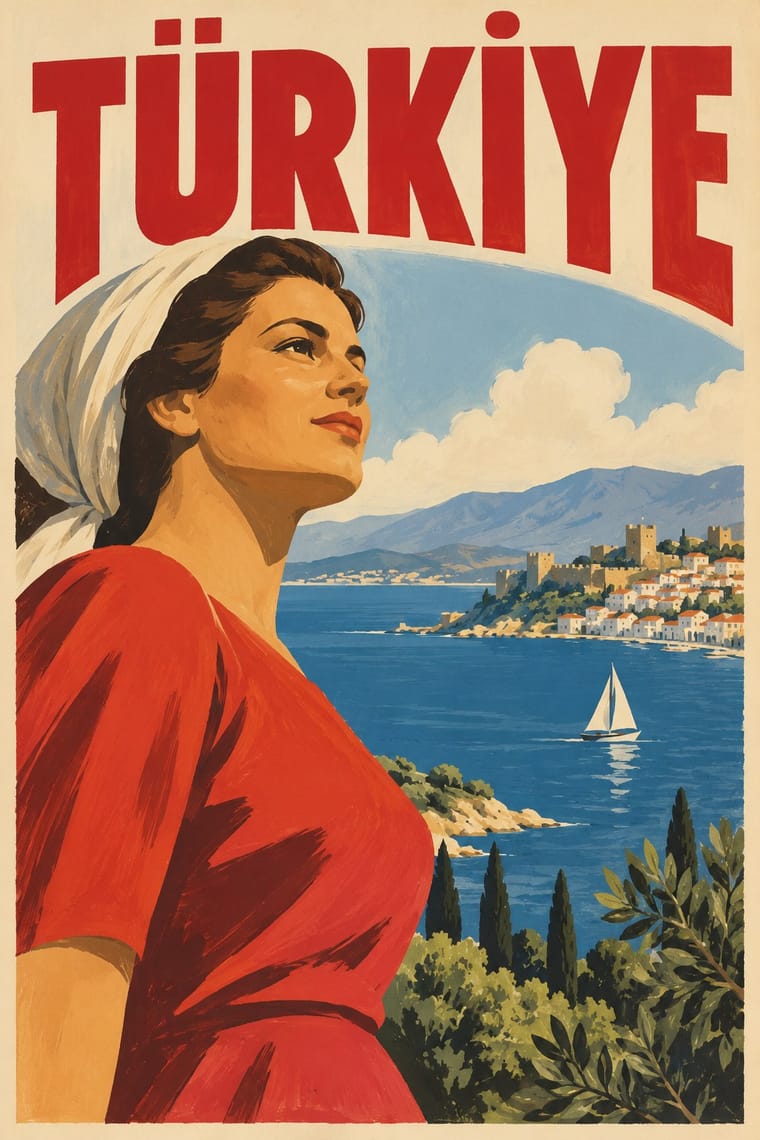
The pictorial poster, label and ticket art of the young Turkish Republic, led by İhap Hulusi Görey after his Munich training in Ludwig Hohlwein's orbit, with Münif Fehim Özarman and, after 1943, Kenan Temizan. Lithographed figures modelled in crisp patches of light and shadow, sometimes in only one or two inks, giant numerals and letters, framed emblems and bold hand-drawn lettering in the Latin script adopted in 1928 advertised banks, the State Lottery, the state monopolies and tourism, and promoted the state's new alphabet.
Make something in this styleGet advice in this styleMix it with another style
Use it with care
Atatürk's likeness, the Turkish flag and the star and crescent are living national symbols, and Turkey's Law No. 5816 (1951) criminalises insulting Atatürk's memory, so do not caricature, distort or trivialise them when borrowing this style. Much of this imagery was produced for a one-party state and its campaigns, and Kemalist iconography (the unveiled "modern" woman, the six arrows, Atatürk portraits) is still politically charged in Turkey, read differently by secularists, religious conservatives and minorities whom the nation-building imagery left out. Do not present the regime's modernising narrative as neutral, and do not reuse party emblems as decoration.
01
How it works
- Letter every name by hand in the new Turkish Latin alphabet, drawing Ç, Ğ, İ, Ö, Ş and Ü with their marks at display size.
- Build the picture around one modelled figure or object, painted in a few flat tones, at times reduced to one or two inks, with crisp patches of light and shadow.
- Let a single giant numeral or initial (a lottery draw date, a bank's letter) become the picture, often drawn shaded or extruded and sometimes tilted on a diagonal.
- Show citizens, families and institutions as calm, dignified and modern, so the state and its banks speak as a reassuring host rather than a shouting agitator.
- Hold labels, lottery tickets and bank material in framed panels with emblems, numerals and borders so that everyday ephemera reads as official.
- Print by colour lithography on a light paper ground and keep ornament to a frame, a seal and a rule.
Istanbul and Ankara, Turkey; commissions from the State Lottery, the state monopolies (İnhisarlar, later Tekel), state and private banks, savings and tourism campaigns, with poster training at the Istanbul fine-arts academy's poster atelier (from 1927)
02
Its design choices
From Stylogeny’s vocabulary of design choices: defining choices make the style, characteristic ones are usual, occasional ones turn up now and then.
- Layout & composition
- Space & hierarchy
- Typography
- Colour
- Surface & texture
- Ornament
- Medium & production
- Tone & intent
- Avoids
- Non-representational, Abundant decoration, Collage & layering, Experimental & distorted, Lowercase only, Rebellious & subversive
Palette
#f0e7d2#cf1f2e#1b1b1b#c89b3c#2c5a7a#3f7a4a
Typefaces
Hand-drawn Latin display capitals with Turkish diacritics (Ç, Ğ, İ, Ö, Ş, Ü) for brand and institution names
Shaded and extruded display letters and giant numerals
Milli Piyango '7', İş Bankası '12', Köy Halk Kıraatı
İhap Hulusi Görey's lettered logotypes and labels
Kulüp Rakısı, Ziraat Bankası, Kurukahveci Mehmet Efendi
Parallel strand
Emin Barın's custom Latin lettering informed by Ottoman calligraphy (Anıtkabir inscriptions, 1952–53)
Known for
İhap Hulusi Görey (1898–1986), cover illustration of the primary-school Alfabe primer for the new Latin script, showing Atatürk teaching his adopted daughter Ülkü
İhap Hulusi Görey, Kulüp Rakısı bottle label
1930
İhap Hulusi Görey, Tayyare Piyangosu / Milli Piyango (State Lottery) posters and tickets (1928–1975), including the poster built on a giant red '7'
İhap Hulusi Görey, 'Bursa' and 'İzmir' posters, awarded at the Vienna International Poster Exhibition
1948
İhap Hulusi Görey, 'Yalova Kaplıcaları' spa poster, and 'Egypt for Sunshine, Sport & Gaiety' travel poster
c. 1937, printed by S.C. Allen & Co., London
İhap Hulusi Görey, Türkiye İş Bankası '1952 İkramiye Planı' advertisement built on a giant shaded '12' (Bahçeli 12 ev; Hürriyet, 1 December 1951), Ziraat Bankası savings poster with a diagonal 'Z', and the Ziraat Bankası and Kurukahveci Mehmet Efendi logos
Münif Fehim Özarman (1899–1983), theatre posters, stamps and book covers
Kenan Temizan (1895–1953), Berlin-trained poster artist who made film posters for UFA and Tobis before returning to Istanbul in 1943; 'ECA malgré tout', Turkey's prize-winning entry in the Marshall Plan (ERP) intra-European poster competition (1950)
03
Make something in this style
Say what you need, and Stylogeny’s image studio draws it from Early Turkish Republican Graphic Design’s design choices and checks it against them. It takes about a minute, and you get a link to share.
04
Where it comes from, and what it’s close to
Before it
The style it grew out of, and the styles it borrowed from.


Alike in its design choices
Styles that make many of the same choices, related or not, besides those above.


05
Sources
- Marmara University Cumhuriyet Museum, 'İhap Hulusi Görey Collection: About the Collection' (https://cumhuriyetmuzesi.marmara.edu.tr/en/ihap-hulusi-gorey-collection/about-collection)
- Serpil Kazancı Yılmaz, 'İhap Hulusi Görey'in Afişlerinde Sanatsal Dil ve Anlatım' (Artistic Language and Expression in İhap Hulusi Görey Posters), TURAN-SAM 15, no. 58 (2023), pp. 277–285 (https://ceeol.com/search/article-detail?id=1128382)
- Emine Danacı, 'İhap Hulusi Görey ve Harf İnkılabı'ndan Günümüze Afiş Sanatının Gelişim Süreci', MA thesis, Ondokuz Mayıs Üniversitesi (2003), ch. 4, analysis of 26 Görey posters (https://acikerisim.omu.edu.tr/entities/publication/68e60652-98a6-4ef9-8a69-62f038e13675)
- Begüm Beşir Doğan, '2000'li Yıllarda Türk Grafik Tasarımının Gelişimi', MA thesis, İstanbul Aydın Üniversitesi (2018), ch. 2 (https://acikarsiv.aydin.edu.tr/bitstream/11547/2322/1/502279.pdf)
- İlhami Turan, 'Barın, Mehmet Emin', TDV İslâm Ansiklopedisi, vol. 5 (1992), pp. 70–72 (https://islamansiklopedisi.org.tr/barin-mehmet-emin)
- Wikipedia (Turkish), 'İhap Hulusi Görey' (https://tr.wikipedia.org/wiki/%C4%B0hap_Hulusi_G%C3%B6rey)
- Wikipedia, 'Turkish alphabet' (https://en.wikipedia.org/wiki/Turkish_alphabet)
- Wikipedia, 'Law on Crimes Committed Against Atatürk' (https://en.wikipedia.org/wiki/Law_on_Crimes_Committed_Against_Atat%C3%BCrk)
- Grapheine, 'Graphic design around the world: Turkey' (https://grapheine.com/en/magazine/graphic-design-around-the-world-turkey/)
- Swann Auction Galleries, 'Hulusi Görey (1898–1986). Egypt for Sunshine Sport & Gaiety. Circa 1937', sale of 19 November 2015 (https://www.swanngalleries.com/auction-lot/ihap-hulusi-goerey-1898-1986-.-egypt-for-sunshine_5c44e09858)
- NATO, 'NATO posters', NATO history by theme: Symbols of NATO (https://www.nato.int/en/about-us/nato-history/history-by-theme/symbols-of-nato/nato-posters)
- Ayşe Nur Reçberoğulları, 'İhap Hulusi GÖREY', Atatürk Ansiklopedisi (https://ataturkansiklopedisi.gov.tr/detay/11327/%C4%B0hap-Hulusi-G%C3%96REY)
How Stylogeny researches and checks a style: where the facts come from.