Traditions & vernacular · c. 0–present · East Asia
Chinese Calligraphy & Seal Carving (Shufa & Zhuanke)
Also known as Shufa (書法 / 书法), Zhuanke (篆刻, seal carving), Chinese brush calligraphy, Red seal marks (zhuwen and baiwen seals)
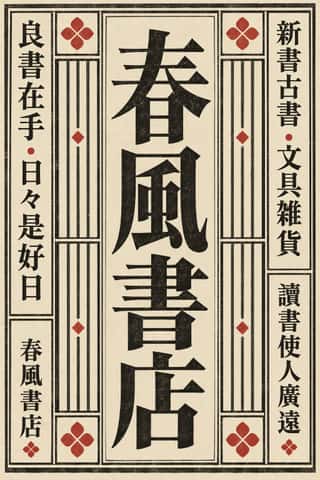
The written art of China and the root of East Asian lettering. A soft, pointed brush writes ink characters in vertical columns read right to left; pressure swells and thins each stroke, and a drying brush breaks into 'flying white'. Five script families run from even seal script to cursive so fast it becomes gesture. In literati work the only colour is the red seal, cut in stone, on pale paper or silk; at the New Year the brush writes couplets and 福 in black or gold on red paper. Carved in steles and plaques, the writing returns as white-on-black rubbings and signboards over doors and shops.
Make something in this styleGet advice in this styleMix it with another style

Use it with care
Chinese calligraphy and seal engraving are living arts, inscribed on UNESCO's Representative List in 2009 and passed on from master to apprentice, so commission or credit calligraphers and seal carvers rather than tracing their hands, and never present generated writing as the work of a named master. Japanese shodō and Korean seoye grew from this root but are distinct living traditions with their own masters; do not label them Chinese or use this entry as a stand-in for them. Have every character written or checked by a fluent reader: image models produce pseudo-characters, and mirrored, reversed or wrongly ordered characters read as nonsense (the upside-down 福 posted at the New Year is a deliberate exception). A seal is a personal signature and is still used on official documents, so never make a seal bearing a real person's or institution's name without their consent, never copy a historical collector's or emperor's seal onto new work, and remember the seal face is cut in reverse so that the impression reads correctly. Never write a living person's name in red ink, a traditional taboo that marks the condemned and the dead. Buddhist sutras and other devotional texts written as calligraphy should not be cropped into texture or put on floors and throwaway items.
01
How it works
- Write with a soft, pointed brush and let pressure make the line: press to swell a stroke, lift to thin it, let the ink run from wet and dark to dry and pale, and keep the dry 'flying white' where the brush runs out of ink instead of retouching it.
- Run the characters in vertical columns read from right to left and give each character its own balance. Formal seal, clerical and regular script is often set in even columns of equal length, as on the Jiucheng Palace Stele with 24 columns of 50 characters, on paper or silk ruled in columns or squares, the grid on which learners still practise; in running and cursive script the movement of the column carries the rhythm.
- Write the main text in one script family: the even, rounded lines of seal script, the flat, flaring strokes of clerical script, the poised regular script, the linked running hand or the abbreviated cursive; the signature and inscription are often in running or regular script, even beside seal script.
- Treat the empty paper as part of the work: leave wide margins and air between the columns, and close the piece with a narrower column of smaller characters for the signature and date.
- Sign and balance with a red seal: cut its characters in reverse in soft stone, either standing in red (zhuwen) or reserved white in a red square (baiwen), and stamp it beside the signature or in an empty corner as the only colour of literati work; for the New Year, write couplets and 福 in black or gold ink on red paper instead.
China. Seals go back to the Shang dynasty (the earliest known were found at Anyang); writing begins with Shang oracle-bone inscriptions and Shang–Zhou bronze inscriptions (great seal script); after the Qin unified China in 221 BCE, Li Si standardised small seal script; clerical, cursive, running and regular script developed from the Han onwards, regular script maturing around the 7th century. Literati seal carving in soft stone is traced to Wen Peng (1498–1573), who used Qingtian stone, and his associate He Zhen (c. 1530–1604) founded the Hui (Anhui) school; the Zhe (Zhejiang) school followed Ding Jing (1695–1765) in the 18th century. The Xiling Seal Art Society was founded in Hangzhou in 1904 by seal carvers including Ding Ren and Wang Ti, and Wu Changshuo became its first president in 1913
02
Its design choices
From Stylogeny’s vocabulary of design choices: defining choices make the style, characteristic ones are usual, occasional ones turn up now and then.
- Layout & composition
- Space & hierarchy
- Typography
- Colour
- Form & shape
- Surface & texture
- Medium & production
- Tone & intent
- Avoids
- Flat, Gloss & highlights, Full polychrome, Fluorescent & neon, Straight photography, Abundant decoration, Grotesque & neo-grotesque, Illusion of depth
Palette
#f2ebdc#151311#5e5a55#b8282e#d8c7a0
Typefaces
Seal script (zhuanshu)
the great seal of bronzes and the Stone Drums, the source of Wu Changshuo's hand, and the small seal standardised under the Qin by Li Si, still the script cut into seals
Clerical script (lishu), which grew out of Qin clerks' writing and became the main script of the Han dynasty
Regular script (kaishu) after Ouyang Xun and Yan Zhenqing
the 'Yan style', Yanti
Running script (xingshu), the hand of the Lantingji Xu
Cursive script (caoshu), in its most unrestrained form in Zhang Xu and Huaisu
Regular-script (kai) fonts for screen and print, such as KaiTi and BiauKai, for text set in a brush-derived letter
Known for
Wang Xizhi (303–361), Lantingji Xu (Orchid Pavilion Preface), 353, in running script
the original is lost, and the Shenlong copy attributed to Feng Chengsu, thought closest to it, is in the Palace Museum, Beijing
Wang Xizhi, Timely Clearing after Snowfall (快雪時晴帖), perhaps a Tang copy, National Palace Museum, Taipei, on which the Qianlong Emperor wrote 71 inscriptions and stamped his seals
Ouyang Xun (557–641), the Jiucheng Palace Stele, a model of regular script studied through rubbings
Yan Zhenqing (709–785), Draft of a Requiem to My Nephew (祭姪文稿), 758, running script with strike-throughs left in, National Palace Museum, Taipei
Huaisu (737–799), Autobiography (自敘帖), 777, cursive script, National Palace Museum, Taipei; he and the older Zhang Xu are paired as the two greatest cursive writers of the Tang
Huang Tingjian (1045–1105), Biographies of Lian Po and Lin Xiangru, handscroll, c. 1095, with 'flying white' in the strokes
Metropolitan Museum of Art, 1989.363.4
Mi Fu (1051–1107), Poem Written in a Boat on the Wu River, handscroll, c. 1095
Metropolitan Museum of Art, 1984.174
Wang Duo (1592–1652), Poem Written on Mount Qingliang, 1641, a hanging scroll 3.5 m tall
Metropolitan Museum of Art, 1989.363.116
03
Make something in this style
Say what you need, and Stylogeny’s image studio draws it from Chinese Calligraphy & Seal Carving (Shufa & Zhuanke)’s design choices and checks it against them. It takes about a minute, and you get a link to share.
04
Where it comes from, and what it’s close to
Before it
The style it grew out of, and the styles it borrowed from.
Nothing earlier is recorded: in the atlas it is a starting point.

After it
The styles that grew out of it.

Alike in its design choices
Styles that make many of the same choices, related or not, besides those above.

- Ottoman Tughra & Dîvânî Chancery Calligraphy60% alike


05
Sources
- UNESCO Intangible Cultural Heritage, 'Chinese calligraphy', inscribed 2009 on the Representative List: https://ich.unesco.org/en/RL/chinese-calligraphy-00216
- UNESCO Intangible Cultural Heritage, 'Art of Chinese seal engraving', inscribed 2009 on the Representative List: https://ich.unesco.org/en/RL/art-of-chinese-seal-engraving-00217
- https://en.wikipedia.org/wiki/Chinese_calligraphy
- https://en.wikipedia.org/wiki/Seal_(East_Asia)
- https://en.wikipedia.org/wiki/Seal_carving
- https://en.wikipedia.org/wiki/Lantingji_Xu
- https://zh.wikipedia.org/wiki/快雪時晴帖
- https://zh.wikipedia.org/wiki/祭姪文稿
- https://zh.wikipedia.org/wiki/自敘帖
- https://en.wikipedia.org/wiki/Yan_Zhenqing
- https://en.wikipedia.org/wiki/Ouyang_Xun
- https://en.wikipedia.org/wiki/Huaisu
- https://en.wikipedia.org/wiki/Huang_Tingjian
- Metropolitan Museum of Art, Huang Tingjian, Biographies of Lian Po and Lin Xiangru, 1989.363.4: https://www.metmuseum.org/art/collection/search/39918
- Metropolitan Museum of Art, Mi Fu, Poem Written in a Boat on the Wu River, 1984.174: https://www.metmuseum.org/art/collection/search/39919
- Metropolitan Museum of Art, Wang Duo, Poem written on Mount Qingliang, 1641, 1989.363.116: https://www.metmuseum.org/art/collection/search/49029
- Metropolitan Museum of Art, Zhao Zhiqian, Couplet, 1867, 2000.345.1, .2: https://www.metmuseum.org/art/collection/search/55495
- Metropolitan Museum of Art, Qi Baishi, Seal, soapstone (Shoushan type), 2015.500.6.16: https://www.metmuseum.org/art/collection/search/39849
- https://en.wikipedia.org/wiki/Zhao_Zhiqian
- https://en.wikipedia.org/wiki/Wu_Changshuo
- https://zh.wikipedia.org/wiki/吴昌硕
- https://zh.wikipedia.org/wiki/文彭
- https://en.wikipedia.org/wiki/Xiling_Seal_Art_Society
- https://zh.wikipedia.org/wiki/西泠印社
- https://en.wikipedia.org/wiki/2008_Summer_Olympics
- Pinyin.info, 'Beijing Olympics to use icons modeled after seal script' (8 August 2006): https://pinyin.info/news/2006/beijing-olympics-to-use-icons-modeled-after-seal-script/
- Tsinghua University news (1 September 2006) on the Beijing 2008 sport pictograms, 35 icons for 37 disciplines by experts from the Central Academy of Fine Arts and Tsinghua's Academy of Arts and Design: https://www.tsinghua.edu.cn/en/info/1255/9550.htm
- https://zh.wikipedia.org/wiki/何震_(明朝)
- https://zh.wikipedia.org/wiki/丁敬
- https://en.wikipedia.org/wiki/Chinese_bronze_inscriptions
- https://en.wikipedia.org/wiki/Large_seal_script
- https://zh.wikipedia.org/wiki/大篆
- National Museum of Asian Art, Smithsonian, Wu Changshuo, Couplet in Stone Drum Script (left side), S2018.19: https://asia-archive.si.edu/collections/new/acquisitions-2018/couplet-in-stone-drum-script-left
- National Palace Museum, Taipei, 'Marvelous Couplets, Superb Characters' (Wu Changshuo and stone drum script; gridlines and other paper decoration; couplets for the Lunar New Year): https://theme.npm.edu.tw/MarvelousCouplets114/en/page-1 and https://theme.npm.edu.tw/MarvelousCouplets114/en/page-2
- Metropolitan Museum of Art, Weng Tonghe, Regular-script Calligraphic Couplet, ink on red printed paper, 1976.384.2a, b: https://www.metmuseum.org/art/collection/search/36122
- https://en.wikipedia.org/wiki/Fai_chun
- https://zh.wikipedia.org/wiki/九成宫醴泉铭
- https://zh.wikipedia.org/wiki/蜀素帖
- Bonhams, Huang Binhong, Couplet in Large Seal Script, 1943, with the artist's transcription in running/regular script: https://www.bonhams.com/auction/26738/lot/5/
- Australian Museum, 'Stone Rubbing from Nestorian Stele: 1900s' (characters left white in the inked paper): https://australian.museum/learn/cultures/international-collection/chinese/stone-rubbing-from-nestorian-stele-1900s/
- https://zh.wikipedia.org/wiki/拓本
- https://zh.wikipedia.org/wiki/匾額
- University of Hong Kong, CCCH9051, 'Plaque (牌匾)': https://learning.hku.hk/ccch9051/group-24/items/show/33
- People's Graphic Design Archive, Kan Tai-keung, 'Emotion of Hanzi' Chinese Character poster series, 1995: https://peoplesgdarchive.org/item/17589/emotion-of-hanzi-chinese-character-poster-series-mountain-water-wind-clouds
- https://en.wikipedia.org/wiki/Japanese_calligraphy
- https://en.wikipedia.org/wiki/Korean_calligraphy
- https://en.wikipedia.org/wiki/Color_in_Chinese_culture
- USC Digital Folklore Archives, 'Why You Can't Write Your Name in Red': https://folklore.usc.edu/?p=43613
How Stylogeny researches and checks a style: where the facts come from.