Style combination · Contrasts
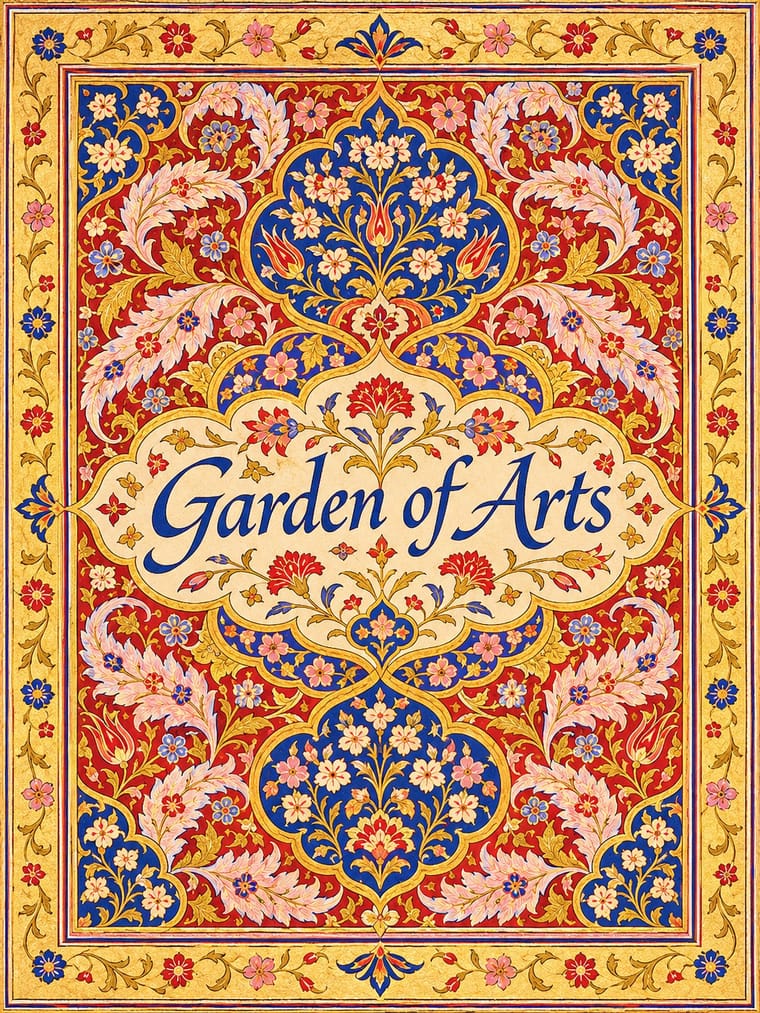
Ottoman Tezhip × Persian Miniature
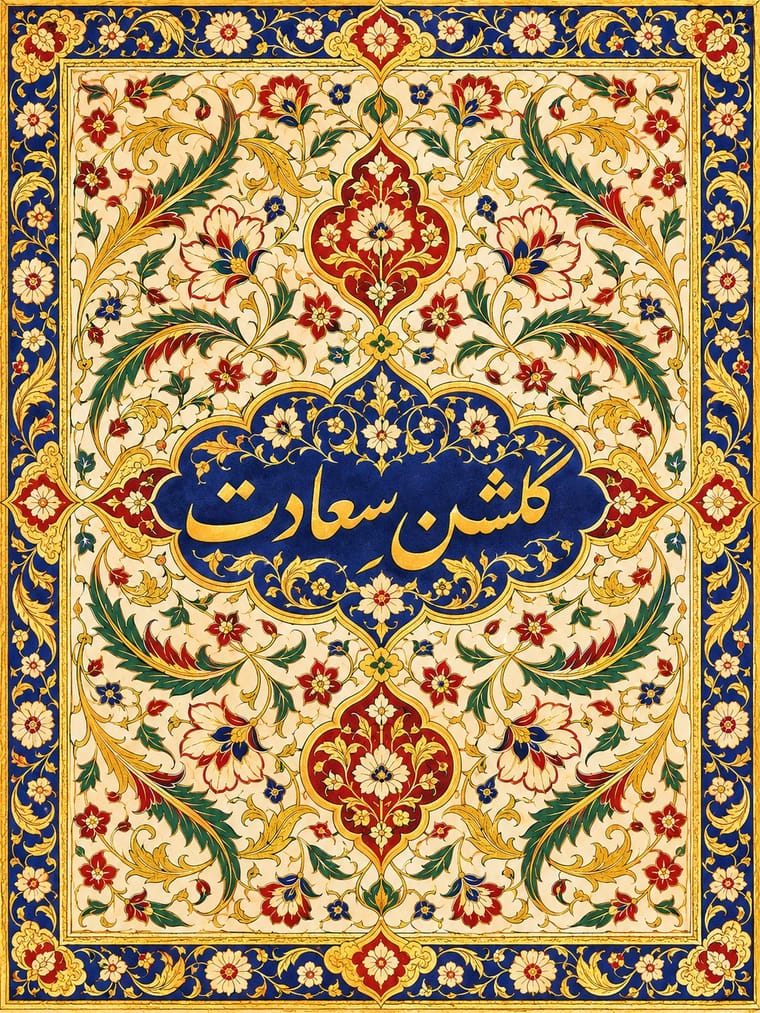
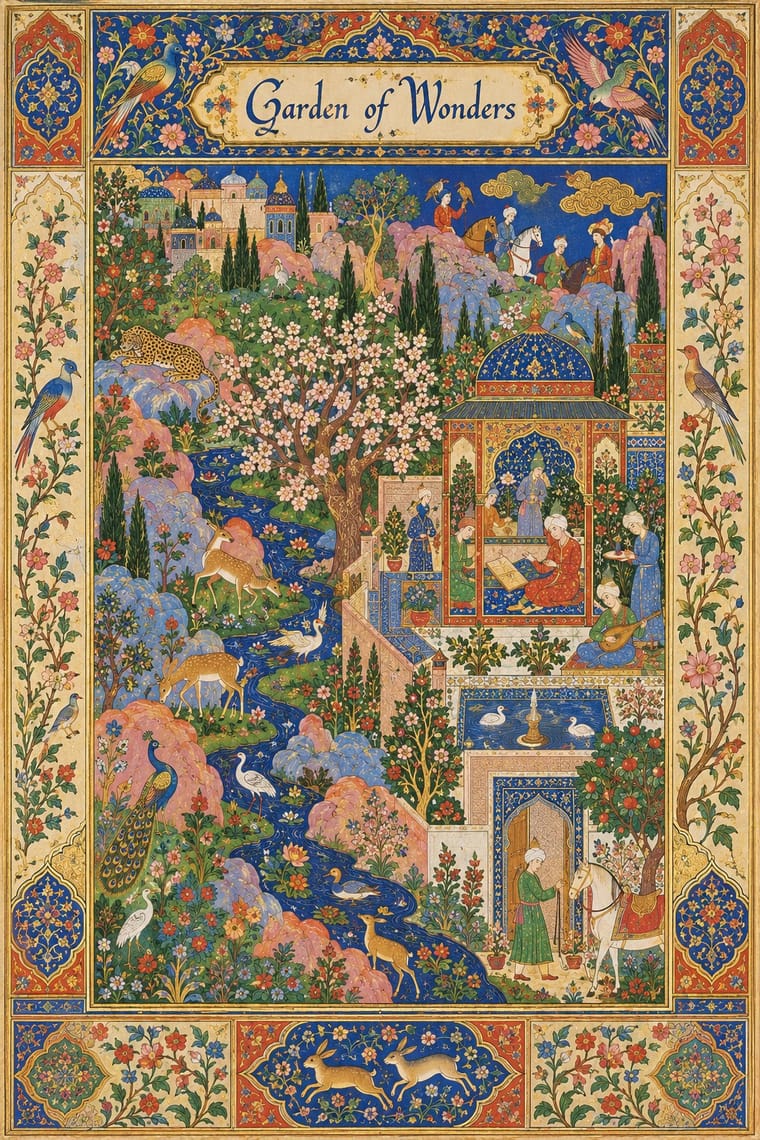
Miniatures tell scenes with figures; tezhip frames text with ornament and, in the saz style, mythical beasts rather than narrative scenes. Ottoman illumination grew from Persian practice (Şahkulu trained with Persian artists), so pair them when a book needs both image and frame.
Mix them and make something Ottoman Tezhip Persian Miniature
01
What each style brings
Each part of the design comes from the style with the stronger say in it, and each style gives at least two.
Ottoman Tezhip & Saz Illumination Persian Miniature (Ilkhanid, Timurid and Safavid Book Painting)
- Type from Persian Miniature
- Colour from Persian Miniature
- Form from Ottoman Tezhip
- Composition from Persian Miniature
- Surface from Ottoman Tezhip
02
The type
Open fonts standing in for each style’s own type, which is often hand-drawn or commercial.
Display · Persian Miniature
Velvet
Rakkas, standing in for Nastaʿlīq, the hanging Persian hand of Timurid and Safavid manuscripts, written in ruled columns around the paintings (the Baysonghor Shahnameh of 1430 and the Shahnama of Shah Tahmasp are both written in it)
Text · Ottoman Tezhip
Largely non-narrative gold-and-colour ornament of Ottoman manuscripts, edicts and album pages: hatayi flowers and rumi split-leaf scrolls, then the saz style (mainly 16th century) of serrated leaves, composite blossoms and some mythical beasts, filling borders and medallions in gold and deep blue. Saz is one phase of tezhip; the Tulip Period added naturalistic bouquets under French Rococo influence. It grew from Persian illumination (Şahkulu came from Tabriz) but has its own vocabulary.
Bodoni Moda; Ottoman Tezhip used Sülüs and nesih Qur'anic hands and Dîvânî chancery script
03
The colours
The ground and leading colours come from Persian Miniature, with a counter-accent from Ottoman Tezhip. The ink reads on the ground at 4.5:1 or more.
Ottoman Tezhip & Saz Illumination Persian Miniature (Ilkhanid, Timurid and Safavid Book Painting)
-
#efe4c8ground · 36% -
#1f3f8fink · 14% -
#c8412caccent · 18% -
#c9a227accent · 14% -
#a8201aaccent · 10% -
#d98f86accent · 8%
As CSS
:root {
  --ground: #efe4c8;
  --ink: #1f3f8f;
  --accent-1: #c8412c;
  --accent-2: #c9a227;
  --accent-3: #a8201a;
  --accent-4: #d98f86;
  --font-display: "Rakkas", cursive;
  --font-text: "Bodoni Moda", serif;
}
Use it with care
Ottoman Tezhip & Saz Illumination: Tezhip is a living craft taught by master-apprentice lineages and at institutions in Turkey, and it frames Qur'ans, hilye panels and other sacred texts: never crop, flip or distort illuminated sacred pages, keep them off throwaway surfaces, and commission a trained müzehhip for work that claims to belong to the tradition rather than imitating it as a generic 'oriental' pattern. Because it also adorned imperial edicts, it can read as a claim to Ottoman rule where that rule is remembered as conquest, so consider how the audience will read it.
Persian Miniature (Ilkhanid, Timurid and Safavid Book Painting): Some histories and poems in this tradition depict the Prophet Muhammad, such as his Night Journey (Miʿraj) on Buraq (a Bustan of Saʿdi folio of c. 1525–35, made probably in Bukhara and Herat rather than in Safavid Iran; Metropolitan Museum of Art, 1974.294.2); after about 1500 Persian painters usually veiled his face, and many Muslims consider any image of him forbidden, so do not adapt or generate such scenes, never supply a face for the Prophet, and keep holy figures off trivial products. Verses, names of God and Qur'anic phrases in the text panels are real texts: have them written or checked by a fluent reader of Persian and Arabic and never fill panels with pseudo-script. Many famous folios are dispersed: George Demotte broke up the Great Mongol Shahnama and altered its pages, and Arthur Houghton gave folios of the Shahnama of Shah Tahmasp to the Metropolitan Museum and sold others one by one before the remains of the manuscript went to Tehran in 1994, so credit each leaf to its manuscript as well as to its present collection. The court tradition declines from the 17th century, which is why the period ends in 1700, but the art of miniature is still practised (Abu'l-Hasan Khan Gaffari in 19th-century Qajar Iran, Mahmoud Farshchian (1930–2025) in our own time); it is living heritage, inscribed on UNESCO's Representative List in 2020 on a joint nomination by Azerbaijan, Iran, Türkiye and Uzbekistan and passed on from master to apprentice, so commission or credit practising painters rather than tracing their work, credit the court and city (Tabriz, Herat, Shiraz, Isfahan) rather than a single modern nation, and never present a generated image as a historical folio.
04
The two styles
05
More combinations
With Ottoman Tezhip
- Ottoman Tughra & Dîvânî Chancery Calligraphy Pairs well · The tughra is the calligraphic sign that illumination frames; pair a tezhip headpiece with a calligraphic panel.
- Armenian Manuscript Illumination Contrasts · Armenian manuscripts mix human figures and ornament in polychrome; tezhip keeps human figures and narrative scenes out of the main field, so choose it when the page should carry mainly ornament.
- Ebru and Ottoman Marbled Paper Pairs well · Marbled end papers and borders sit beside gold illumination in the same book; use ebru for fluid colour and tezhip for fine line.
- Islamic Geometric & Calligraphic Tradition Contrasts · The parent builds on girih and calligraphic geometry; tezhip uses curving vegetal scrolls. Use geometry for rigid structure and tezhip for flowing, floral richness.
- Art Nouveau Pairs well · Both turn plant stems into sinuous lines; borrow saz curves for a floral Art Nouveau frame, but keep tezhip's gold and flipped symmetry.
With Persian Miniature
- Armenian Manuscript Illumination Contrasts · Both frame jewel-coloured paintings with gold and ornament, but Armenian Gospel books build symmetrical arcades, canon tables and bird letters for sacred text, while Persian pages crowd secular epic and lyric scenes into an asymmetric, climbing space; decide whether the frame or the story leads.
- Persian Popular Narrative (Lithographs & Coffeehouse Painting) Pairs well · Its popular heir: the same epics in ruled columns of Nastaʿlīq, but drawn in hatched black ink for lithography; pair a court-style coloured frame with a lithographic line drawing to move between luxury and street register.
- Iranian Modernist Graphic Design Pairs well · Iranian modernists drew on miniature imagery; take one stylised figure, a cloud band or a gold rule from the miniature and set it in the open, single-focus space of a modern poster rather than copying a whole crowded page.
- Rinpa & Saga-bon Contrasts · Another court art of gold and mineral colour, but Rinpa enlarges a few plants on open gold, while the Persian page fills every corner with small figures and flowers; borrow Rinpa's emptiness to calm a crowded miniature-inspired layout.
- International Typographic Style Contrasts · Its opposite: neutral sans, white space and a modular grid against crowded, gilded, figurative pages; a single framed miniature panel can give a strict grid a narrative focal point.
- Kanoon Children's Book Illustration (Iran, 1965 to 1979) Pairs well · A possible visual kinship in framed compartments and ornament; not established by the cited sources.
- Baghdad School of Arab Book Painting (Maqamat Illustration) Pairs well · Both are figural book painting; borrow the Persian jewel palette and panel framing, but keep the Arab school's plainer, documentary social types.
- Ebru and Ottoman Marbled Paper Pairs well · Both come from the Persianate book arts; use marbled margins around painted pages or text.