Style combination · Pairs well
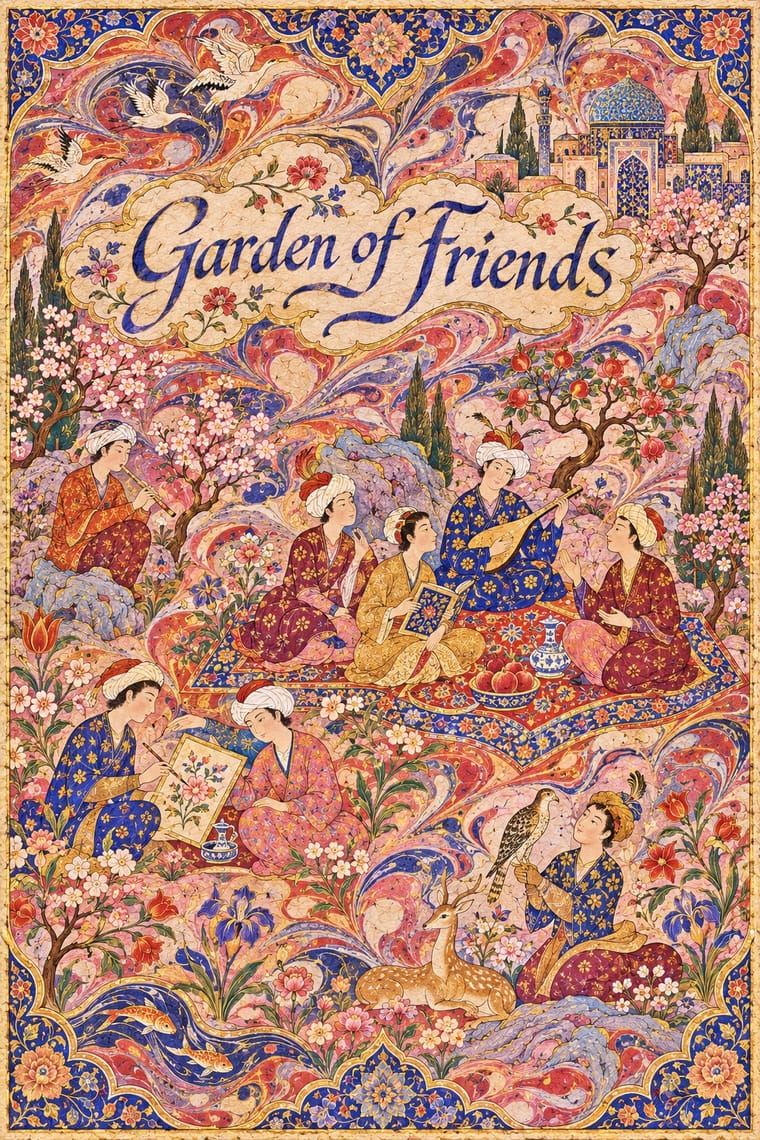
Ebru and Ottoman Marbled Paper × Persian Miniature
Both come from the Persianate book arts; use marbled margins around painted pages or text.
Mix them and make something Ebru and Ottoman Marbled Paper Persian Miniature
01
What each style brings
Each part of the design comes from the style with the stronger say in it, and each style gives at least two.
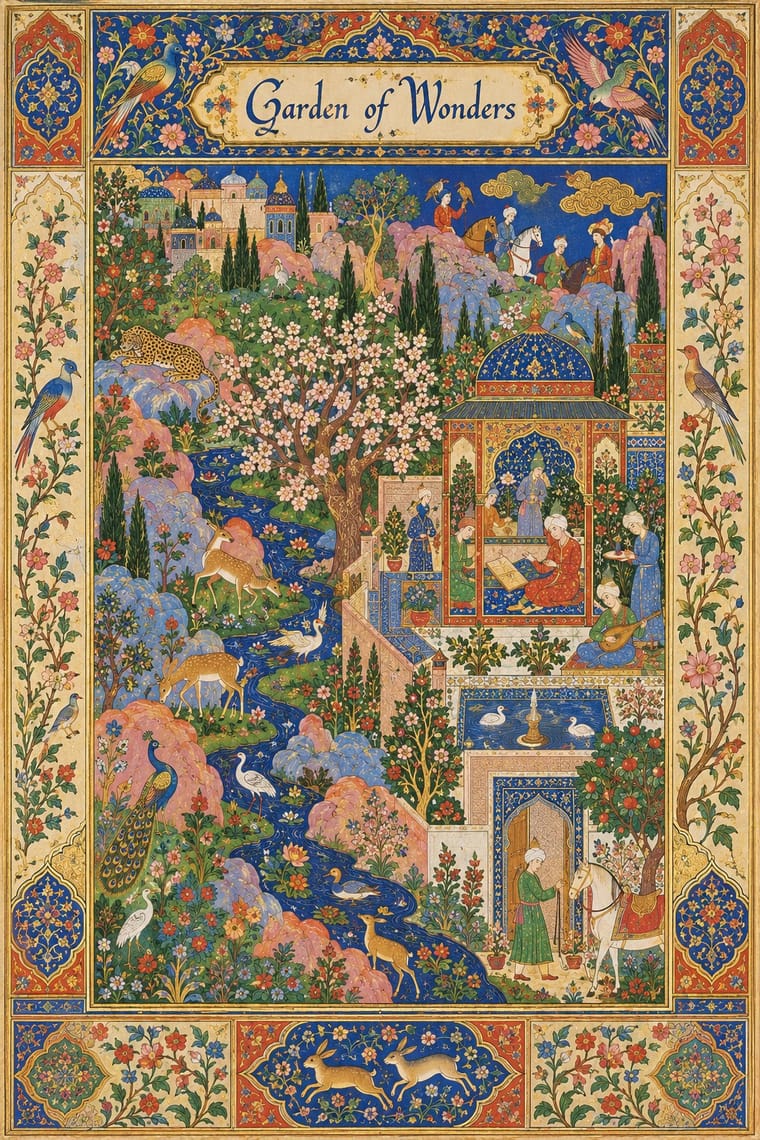
Ebru and Ottoman Marbled Paper Persian Miniature (Ilkhanid, Timurid and Safavid Book Painting)
- Type from Persian Miniature
- Colour from Persian Miniature
- Form from Persian Miniature
- Composition from Ebru and Ottoman Marbled Paper
- Surface from Ebru and Ottoman Marbled Paper
02
The type
Open fonts standing in for each style’s own type, which is often hand-drawn or commercial.
Display · Persian Miniature
Bloom
Rakkas, standing in for Nastaʿlīq, the hanging Persian hand of Timurid and Safavid manuscripts, written in ruled columns around the paintings (the Baysonghor Shahnameh of 1430 and the Shahnama of Shah Tahmasp are both written in it)
Text · Ebru and Ottoman Marbled Paper
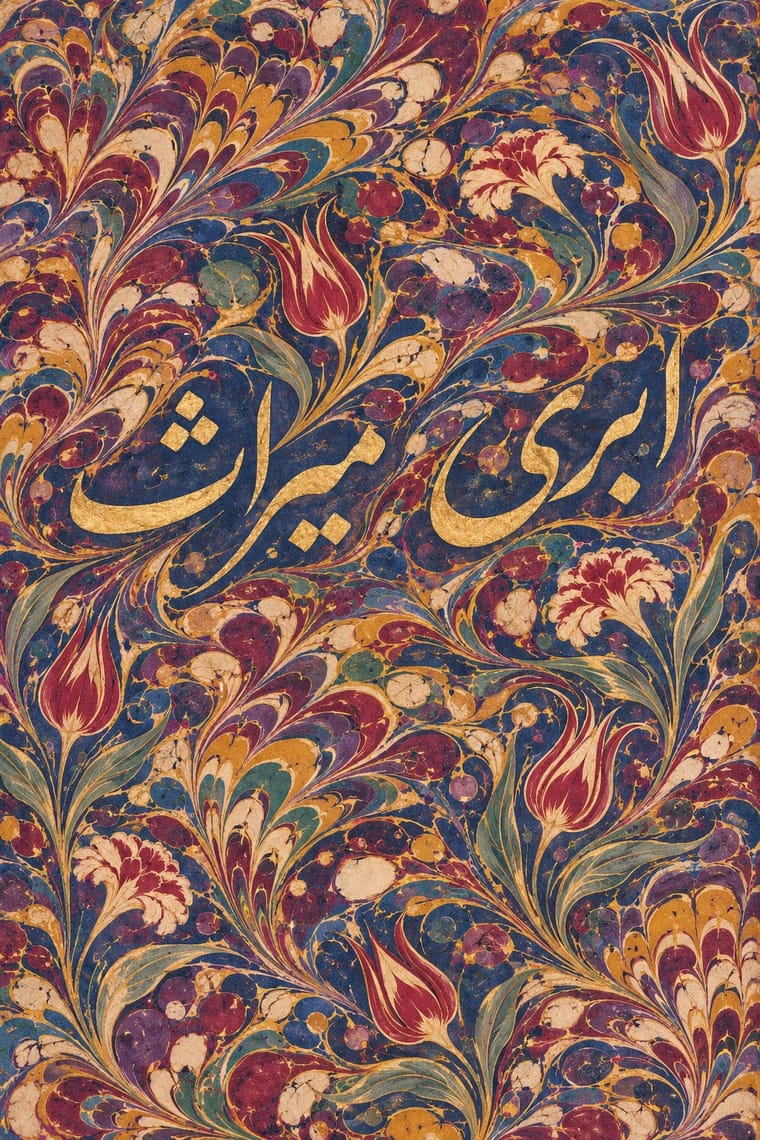
Paper decorated by floating pigments on a viscous size, stirred and combed into flowing, never-repeating veins, then lifted onto a sheet. Used for endpapers, book covers, calligraphy grounds and document margins, it ranges from loose stone and cloud patterns to the motif-built designs credited to Hatip Mehmed Efendi and floral ebru. A living craft inscribed by UNESCO in 2014.
EB Garamond; Ebru and Ottoman Marbled Paper used Dîvânî and celî dîvânî and Sülüs and nesih calligraphy
03
The colours
The ground and leading colours come from Persian Miniature, with a counter-accent from Ebru and Ottoman Marbled Paper. The ink reads on the ground at 4.5:1 or more.
Ebru and Ottoman Marbled Paper Persian Miniature (Ilkhanid, Timurid and Safavid Book Painting)
-
#efe4c8ground · 36% -
#1f3f8fink · 14% -
#c8412caccent · 18% -
#c9a24aaccent · 14% -
#8c2f39accent · 10% -
#d98f86accent · 8%
As CSS
:root {
  --ground: #efe4c8;
  --ink: #1f3f8f;
  --accent-1: #c8412c;
  --accent-2: #c9a24a;
  --accent-3: #8c2f39;
  --accent-4: #d98f86;
  --font-display: "Rakkas", cursive;
  --font-text: "EB Garamond", serif;
}
Use it with care
Ebru and Ottoman Marbled Paper: Ebru is a living craft: UNESCO inscribed it on the Representative List of the Intangible Cultural Heritage of Humanity in 2014 for Turkiye, and it is passed on through master-apprentice training that takes at least two years to reach basic skill, so credit the tradition and its masters, and do not sell a digital swirl filter as 'authentic ebru' or a named master's pattern. Marbled grounds may be paired with calligraphy, including sacred text; if you set Qur'anic verses or divine names, keep them uncropped, unmirrored and off disposable surfaces, and have a fluent reader check every word. The craft is also claimed by Iran (abri) and Central Asia, where it is thought to have emerged by the late 15th century (per the Paper marbling source), so say which tradition you draw on.
Persian Miniature (Ilkhanid, Timurid and Safavid Book Painting): Some histories and poems in this tradition depict the Prophet Muhammad, such as his Night Journey (Miʿraj) on Buraq (a Bustan of Saʿdi folio of c. 1525–35, made probably in Bukhara and Herat rather than in Safavid Iran; Metropolitan Museum of Art, 1974.294.2); after about 1500 Persian painters usually veiled his face, and many Muslims consider any image of him forbidden, so do not adapt or generate such scenes, never supply a face for the Prophet, and keep holy figures off trivial products. Verses, names of God and Qur'anic phrases in the text panels are real texts: have them written or checked by a fluent reader of Persian and Arabic and never fill panels with pseudo-script. Many famous folios are dispersed: George Demotte broke up the Great Mongol Shahnama and altered its pages, and Arthur Houghton gave folios of the Shahnama of Shah Tahmasp to the Metropolitan Museum and sold others one by one before the remains of the manuscript went to Tehran in 1994, so credit each leaf to its manuscript as well as to its present collection. The court tradition declines from the 17th century, which is why the period ends in 1700, but the art of miniature is still practised (Abu'l-Hasan Khan Gaffari in 19th-century Qajar Iran, Mahmoud Farshchian (1930–2025) in our own time); it is living heritage, inscribed on UNESCO's Representative List in 2020 on a joint nomination by Azerbaijan, Iran, Türkiye and Uzbekistan and passed on from master to apprentice, so commission or credit practising painters rather than tracing their work, credit the court and city (Tabriz, Herat, Shiraz, Isfahan) rather than a single modern nation, and never present a generated image as a historical folio.
04
The two styles
05
More combinations
With Ebru and Ottoman Marbled Paper
- Ottoman Tughra & Dîvânî Chancery Calligraphy Pairs well · Marbled paper is a traditional ground for calligraphy; set a commissioned line of calligraphy over or inside a marbled field.
- Islamic Geometric & Calligraphic Tradition Contrasts · Rigid tessellation against drifting liquid pattern: a counterpoint, not an ancestor.
- Batik Pattern Tradition Pairs well · Another craft where resist and fluid colour produce unrepeatable flowing surfaces.
- Psychedelic Poster Contrasts · Swirling fluid colour with the opposite intent: the marbler's inks stay deep, quiet and bookish.
- Ottoman Tezhip & Saz Illumination Pairs well · Marbled end papers and borders sit beside gold illumination in the same book; use ebru for fluid colour and tezhip for fine line.
With Persian Miniature
- Armenian Manuscript Illumination Contrasts · Both frame jewel-coloured paintings with gold and ornament, but Armenian Gospel books build symmetrical arcades, canon tables and bird letters for sacred text, while Persian pages crowd secular epic and lyric scenes into an asymmetric, climbing space; decide whether the frame or the story leads.
- Persian Popular Narrative (Lithographs & Coffeehouse Painting) Pairs well · Its popular heir: the same epics in ruled columns of Nastaʿlīq, but drawn in hatched black ink for lithography; pair a court-style coloured frame with a lithographic line drawing to move between luxury and street register.
- Iranian Modernist Graphic Design Pairs well · Iranian modernists drew on miniature imagery; take one stylised figure, a cloud band or a gold rule from the miniature and set it in the open, single-focus space of a modern poster rather than copying a whole crowded page.
- Rinpa & Saga-bon Contrasts · Another court art of gold and mineral colour, but Rinpa enlarges a few plants on open gold, while the Persian page fills every corner with small figures and flowers; borrow Rinpa's emptiness to calm a crowded miniature-inspired layout.
- International Typographic Style Contrasts · Its opposite: neutral sans, white space and a modular grid against crowded, gilded, figurative pages; a single framed miniature panel can give a strict grid a narrative focal point.
- Kanoon Children's Book Illustration (Iran, 1965 to 1979) Pairs well · A possible visual kinship in framed compartments and ornament; not established by the cited sources.
- Ottoman Tezhip & Saz Illumination Contrasts · Miniatures tell scenes with figures; tezhip frames text with ornament and, in the saz style, mythical beasts rather than narrative scenes. Ottoman illumination grew from Persian practice (Şahkulu trained with Persian artists), so pair them when a book needs both image and frame.
- Baghdad School of Arab Book Painting (Maqamat Illustration) Pairs well · Both are figural book painting; borrow the Persian jewel palette and panel framing, but keep the Arab school's plainer, documentary social types.