Style combination · Contrasts
Egyptian Revolutionary Street Art × Graffiti
Same spray can, opposite priority: New York writing makes the writer's name a letter-sculpture, while Cairo's walls are figurative and commemorative and the lettering is a caption. Decide whether the brief needs a name or a face.
Mix them and make something Egyptian Revolutionary Street Art Graffiti
01
What each style brings
Each part of the design comes from the style with the stronger say in it, and each style gives at least two.
Egyptian Revolutionary Street Art (Mohamed Mahmoud Murals) Graffiti & Hip-Hop Graphics
- Type from Graffiti
- Colour from Egyptian Revolutionary Street Art
- Form from Egyptian Revolutionary Street Art
- Composition from Graffiti
- Surface from Graffiti
02
The type
Open fonts standing in for each style’s own type, which is often hand-drawn or commercial.
Text · Egyptian Revolutionary Street Art
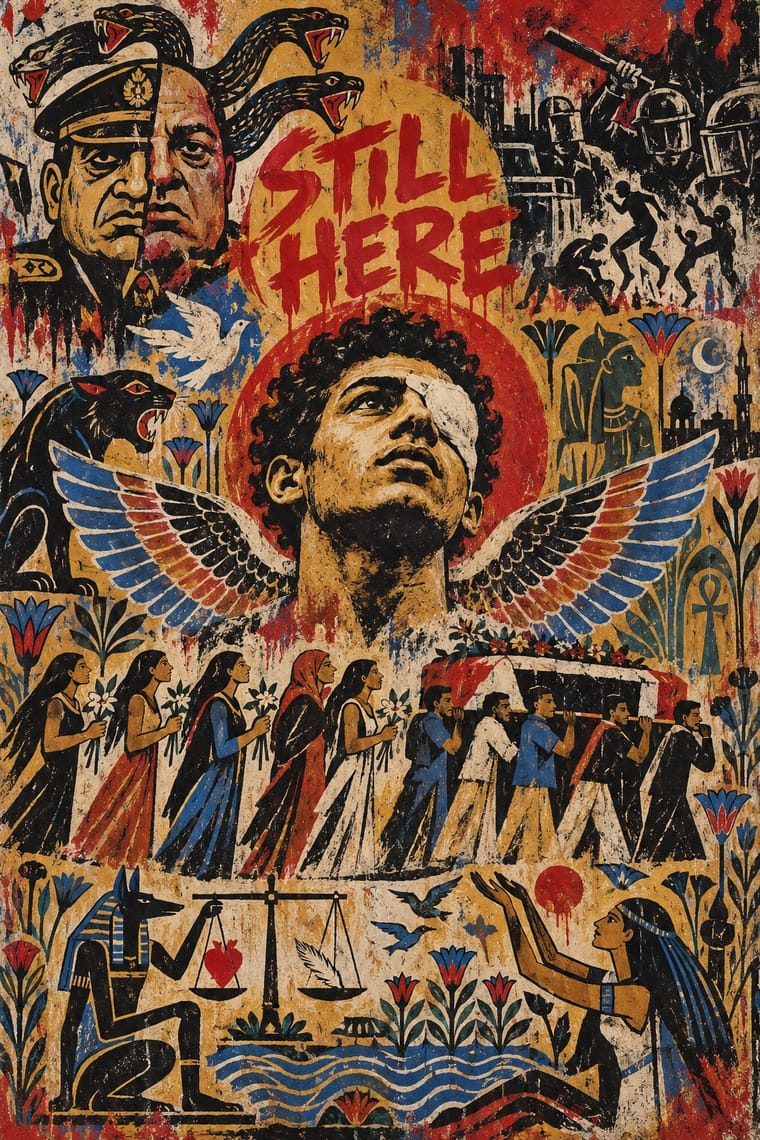
The street art of Egypt's 2011 revolution and the years after it, when Cairo's walls, above all around Tahrir and Mohamed Mahmoud Street, became what Ammar Abo Bakr called a newspaper. Three idioms share them: portraits of martyrs with wings and eye patches; neo-Pharaonic friezes of mourning and marching women by Luxor-trained muralists; and sardonic caricatures, stencils and Arabic slogans against the army, Mubarak and later Morsi. Whitewashed again and again, the walls were repainted in reply.
Newsreader; Egyptian Revolutionary Street Art used Freehand Arabic slogans in spray paint and marker, sometimes with English lines, scrawled beside and over the pictures and Historical lām-alif ('no') forms collected from buildings, mosques, ceramics, textiles and books across the Islamic world, sprayed by Bahia Shehab
03
The colours
The ground and leading colours come from Egyptian Revolutionary Street Art, with a counter-accent from Graffiti. The ink reads on the ground at 4.5:1 or more.
Egyptian Revolutionary Street Art (Mohamed Mahmoud Murals) Graffiti & Hip-Hop Graphics
-
#ede7daground · 36% -
#161616ink · 14% -
#c8102eaccent · 18% -
#c8963eaccent · 14% -
#00a3e0accent · 10% -
#a2482baccent · 8%
As CSS
:root {
  --ground: #ede7da;
  --ink: #161616;
  --accent-1: #c8102e;
  --accent-2: #c8963e;
  --accent-3: #00a3e0;
  --accent-4: #a2482b;
  --font-display: "Sedgwick Ave Display", cursive;
  --font-text: "Newsreader", serif;
}
Use it with care
Egyptian Revolutionary Street Art (Mohamed Mahmoud Murals): These walls commemorate real people killed or maimed in 2011–13, whose families are alive, alongside images of women assaulted by security forces, Qur'anic verses and Coptic and Islamic sacred imagery; do not reuse martyr portraits, eye patches or the 'blue bra' as edgy protest styling for a brand, have every Arabic line read by a fluent reader, and credit the artists and photographers by name. The walls were also religiously contested: Awad painted some of his Pharaonic women nude as a stand against the Wahhabi style of Islam, and Salafists erased some martyr portraits and put Qur'anic verses in their place, so do not pair those figures with Qur'anic verses for effect. After July 2013 the interim government built its own martyrs' memorial in Tahrir, which protesters wrecked, and the Muslim Brotherhood staked its own claim to the revolution's dead, so check whose dead a reused martyr motif would seem to mourn. Political street art remains dangerous in Egypt: Ganzeer was detained in 2011, four graffiti artists were detained for 12 hours in May 2015 after painting a mural, and 400 copies of Walls of Freedom were confiscated in Alexandria for allegedly 'inciting violence', so never put Egyptian artists or collaborators at risk with work attributed to them.
04
The two styles
05
More combinations
With Egyptian Revolutionary Street Art
- Lebanese Civil War Party Poster Contrasts · Beirut's martyr posters were issued by parties marking walls as territory; Cairo's martyrs were painted by artists who said they had nothing to do with any party. Compare them to judge whose voice a commemoration speaks in.
- Stencil Street Art Pairs well · Cairo's stencillers worked in the same cut-and-spray idiom; set one stencilled face and a short slogan beside a brushed mural when a memorial has to be repeated across a city overnight.
- Ancient Egyptian Hieroglyphic & Register Composition Pairs well · In 2012 Luxor-trained muralists such as Alaa Awad recast tomb painting on Cairo's Mohamed Mahmoud Street: profile processions of mourning women, registers, a sarcophagus and the weighing of the heart, brushed in acrylic around the faces of the martyrs. Look there for a living Egyptian use of the register and the procession, credited to its painters, rather than Egyptomania décor.
- Ultras Graphics (Curva Banners and Tifo) Pairs well · The Mohamed Mahmoud murals painted the faces of Port Said's dead, most of them Ultras Ahlawy fans; pair the curva's collective name and colours with memorial portraits when a group mourns its own.
- Chilean Estallido Social Graphics (Revuelta Popular of 2019–20) Contrasts · Cairo and Santiago both put the eye patches of protesters shot in the eye on their walls and answered every whitewash with new work, but Cairo's martyr murals are brushed portraits beside Pharaonic friezes, while Santiago's are layered paper, stencil and punk iconoclasm.
- Syrian Revolution Graphics (Kafranbel Banners & Poster Collectives) Pairs well · Its 2011 neighbour: Cairo painted martyrs and friezes onto walls, Syria made portable sheets for the camera; put a Syrian-style printable slogan beside a mural photograph to join wall and feed.
- Black Lives Matter Street Murals Contrasts · Cairo's murals were painted against the state and erased by it; most Black Lives Matter street murals were painted with city permission, and many are maintained by cities or community groups, though the D.C. original was removed by its own city in 2025. Ask whose voice the paint speaks in before borrowing either.
- Arab Independent Comics (Samandal, TokTok, Lab619, Skefkef) Pairs well · The same Cairo moment on paper and on walls: TokTok appeared two weeks before 25 January 2011, and many of these artists mix caricature, illustration, comics and graffiti. Carry a wall's sardonic caricature and slogan into a sequence of panels.
With Graffiti
- International Typographic Style Contrasts · Put a single tag or throw-up over a strict Swiss grid to stage the clash between institutional order and a street voice.
- Corporate Identity Modernism Contrasts · Use graffiti as the foil to corporate identity: a painted name over a logo makes the ownership of public space visible.
- Pop Art Graphics Pairs well · Pair letter-pieces with Ben-Day comic panels and bold outlines, as 1980s gallery graffiti often did, for a street-meets-gallery look.
- Hype Streetwear Graphics (Box Logo to Quotation Marks) Pairs well · Streetwear grew out of New York hip-hop dress; pair a set geometric wordmark with a hand-drawn graffiti piece for a back print, but keep the logo flat and centred so the tag reads as the decoration and the box as the brand.
- Pixação (São Paulo Tag Reto) Contrasts · Both write names on walls, and Pesquisa FAPESP lists hip-hop among the 1980s influences on pixação, but graffiti builds the letter into a coloured, outlined, three-dimensional piece with characters, while pixação keeps a flat black straight letter in level rows and goes for height. Brazilian law since 2011 tolerates graffiti made with the owner's consent and keeps pichação a crime, so decide which one the brief needs.
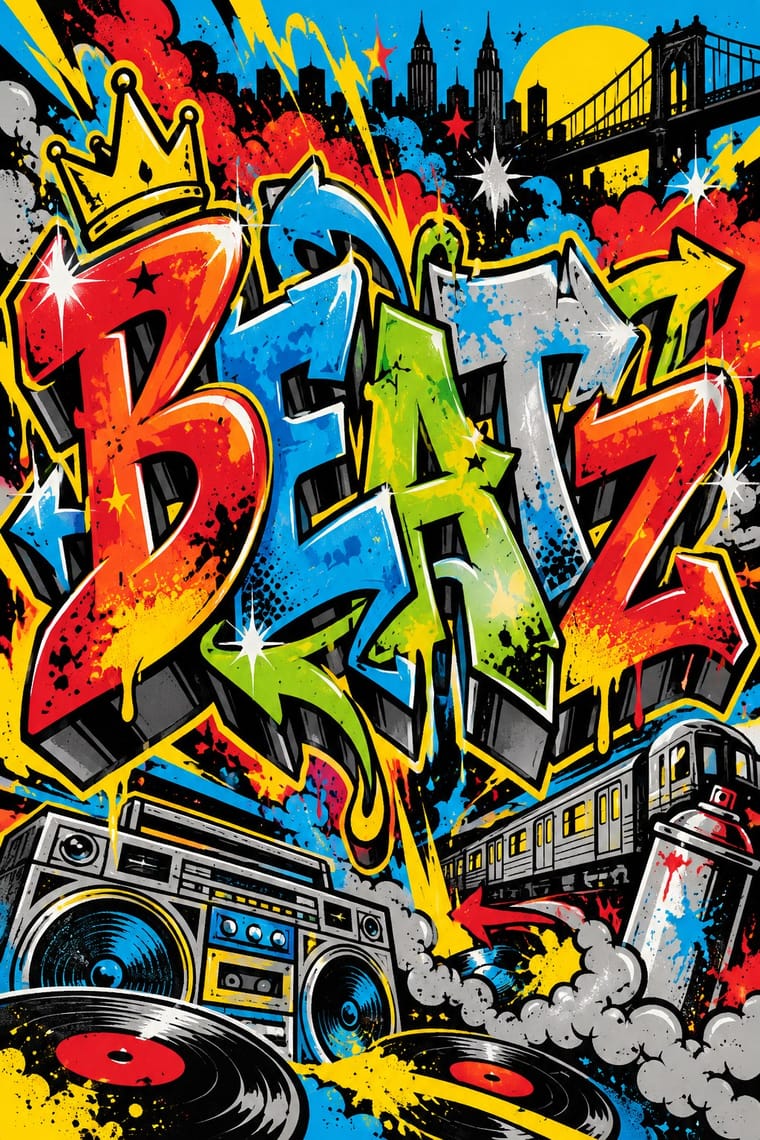
- Stencil Street Art Contrasts · Both use spray paint in the street, but graffiti makes the writer's name a freehand, many-coloured letter-sculpture with 3D blocks and fades; stencil art sprays a reproducible photographic picture in black. Decide which one the brief needs before mixing them.
- Guochao (China-Chic National Trend) Pairs well · Guochao's streetwear wing already borrows hip-hop lockups; treat a brush character as the tag and keep the heritage palette.
- Black Lives Matter Street Murals Contrasts · Graffiti writers paint their own names on walls and trains, uninvited and in letters few outsiders can read; these murals lay one shared, legible slogan on the road, usually with the city's permission. Let a writer fill one letter, as Sam Sneke did in Seattle, without turning the slogan into a piece.