Style combination · Pairs well
Egyptian Revolutionary Street Art × Syrian Revolution Graphics
Its 2011 neighbour: Cairo painted martyrs and friezes onto walls, Syria made portable sheets for the camera; put a Syrian-style printable slogan beside a mural photograph to join wall and feed.
Mix them and make something Egyptian Revolutionary Street Art Syrian Revolution Graphics
01
What each style brings
Each part of the design comes from the style with the stronger say in it, and each style gives at least two.
Egyptian Revolutionary Street Art (Mohamed Mahmoud Murals) Syrian Revolution Graphics (Kafranbel Banners & Poster Collectives)
- Type from Syrian Revolution Graphics
- Colour from Syrian Revolution Graphics
- Form from Egyptian Revolutionary Street Art
- Composition from Syrian Revolution Graphics
- Surface from Egyptian Revolutionary Street Art
02
The type
Open fonts standing in for each style’s own type, which is often hand-drawn or commercial.
Display · Syrian Revolution Graphics
No!
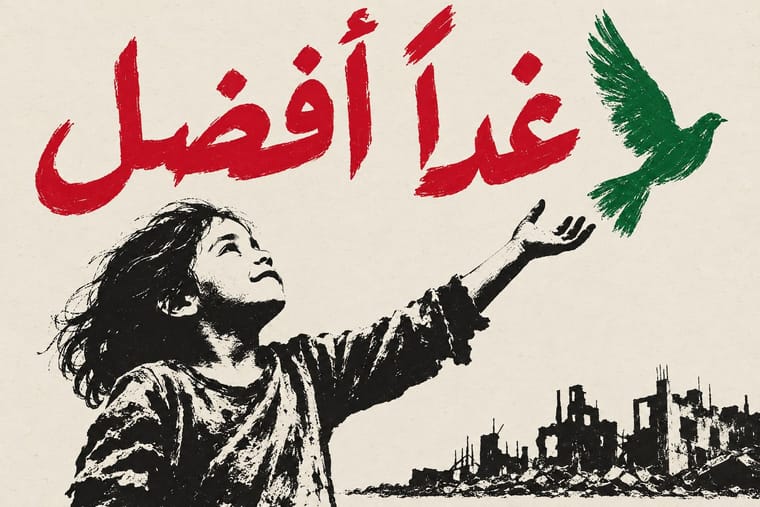
Rakkas, standing in for Freely brushed Arabic calligraphy for one- or two-word slogans, composed for each poster rather than typed in a stock font; one member said he sometimes spent two days designing a single word such as 'freedom' or 'revolution', and that some pieces drew on Persian calligraphy (Al-Safir interview, 2012)
Text · Egyptian Revolutionary Street Art
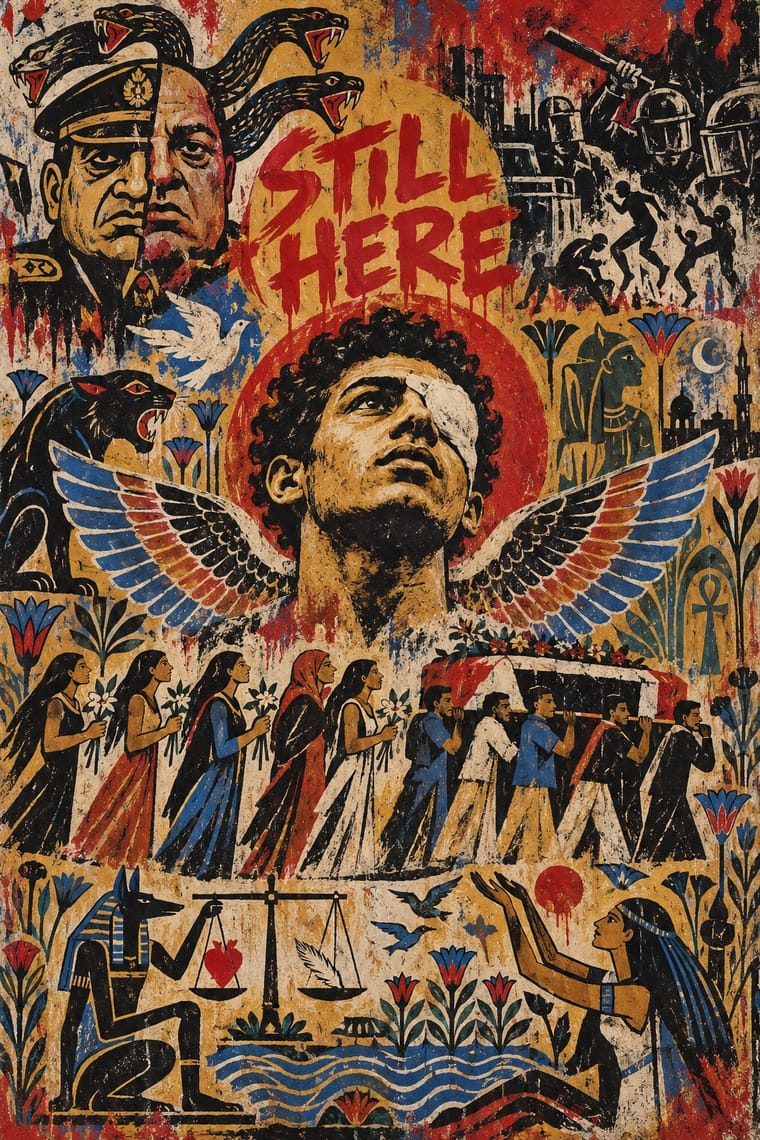
The street art of Egypt's 2011 revolution and the years after it, when Cairo's walls, above all around Tahrir and Mohamed Mahmoud Street, became what Ammar Abo Bakr called a newspaper. Three idioms share them: portraits of martyrs with wings and eye patches; neo-Pharaonic friezes of mourning and marching women by Luxor-trained muralists; and sardonic caricatures, stencils and Arabic slogans against the army, Mubarak and later Morsi. Whitewashed again and again, the walls were repainted in reply.
Newsreader; Egyptian Revolutionary Street Art used Freehand Arabic slogans in spray paint and marker, sometimes with English lines, scrawled beside and over the pictures and Historical lām-alif ('no') forms collected from buildings, mosques, ceramics, textiles and books across the Islamic world, sprayed by Bahia Shehab
03
The colours
The ground and leading colours come from Syrian Revolution Graphics, with a counter-accent from Egyptian Revolutionary Street Art. The ink reads on the ground at 4.5:1 or more.
Egyptian Revolutionary Street Art (Mohamed Mahmoud Murals) Syrian Revolution Graphics (Kafranbel Banners & Poster Collectives)
-
#f1ece0ground · 36% -
#151515ink · 14% -
#c8102eaccent · 18% -
#e0912faccent · 14% -
#007a3daccent · 10% -
#2b4c9baccent · 8%
As CSS
:root {
  --ground: #f1ece0;
  --ink: #151515;
  --accent-1: #c8102e;
  --accent-2: #e0912f;
  --accent-3: #007a3d;
  --accent-4: #2b4c9b;
  --font-display: "Rakkas", cursive;
  --font-text: "Newsreader", serif;
}
Use it with care
Egyptian Revolutionary Street Art (Mohamed Mahmoud Murals): These walls commemorate real people killed or maimed in 2011–13, whose families are alive, alongside images of women assaulted by security forces, Qur'anic verses and Coptic and Islamic sacred imagery; do not reuse martyr portraits, eye patches or the 'blue bra' as edgy protest styling for a brand, have every Arabic line read by a fluent reader, and credit the artists and photographers by name. The walls were also religiously contested: Awad painted some of his Pharaonic women nude as a stand against the Wahhabi style of Islam, and Salafists erased some martyr portraits and put Qur'anic verses in their place, so do not pair those figures with Qur'anic verses for effect. After July 2013 the interim government built its own martyrs' memorial in Tahrir, which protesters wrecked, and the Muslim Brotherhood staked its own claim to the revolution's dead, so check whose dead a reused martyr motif would seem to mourn. Political street art remains dangerous in Egypt: Ganzeer was detained in 2011, four graffiti artists were detained for 12 hours in May 2015 after painting a mural, and 400 copies of Walls of Freedom were confiscated in Alexandria for allegedly 'inciting violence', so never put Egyptian artists or collaborators at risk with work attributed to them.
Syrian Revolution Graphics (Kafranbel Banners & Poster Collectives): These graphics come from an uprising met with massacres, sieges, detention and disappearance, and their makers worked under pseudonyms at real risk: Raed Fares and Hamoud Junaid were shot dead in Kafranbel on 23 November 2018 (local activists blamed Hayat Tahrir al-Sham, which did not claim it), and the collective signed only with its own name, so never attribute a poster to an individual member or expose anyone who made this work. The martyr, siege, bread and Hama motifs refer to real massacres and real dead, not to an edgy 'war poster' look. The collective's posters were released under Creative Commons BY-NC, so do not use them or close pastiches commercially, and credit the collective, Kafranbel and the Creative Memory archive. The three-star flag has been the state flag since the HTS-dominated caretaker government took it up after Assad's fall, so using it, or Kafranbel's banners, as generic 'Syria' branding can imply an alignment their makers never gave. Have every Arabic line read by a fluent reader, never fill a design with pseudo-Arabic, do not mock the broken English of some banners, which was written to be understood abroad, and never present a generated image as a work of the uprising.
04
The two styles
05
More combinations
With Egyptian Revolutionary Street Art
- Lebanese Civil War Party Poster Contrasts · Beirut's martyr posters were issued by parties marking walls as territory; Cairo's martyrs were painted by artists who said they had nothing to do with any party. Compare them to judge whose voice a commemoration speaks in.
- Graffiti & Hip-Hop Graphics Contrasts · Same spray can, opposite priority: New York writing makes the writer's name a letter-sculpture, while Cairo's walls are figurative and commemorative and the lettering is a caption. Decide whether the brief needs a name or a face.
- Stencil Street Art Pairs well · Cairo's stencillers worked in the same cut-and-spray idiom; set one stencilled face and a short slogan beside a brushed mural when a memorial has to be repeated across a city overnight.
- Ancient Egyptian Hieroglyphic & Register Composition Pairs well · In 2012 Luxor-trained muralists such as Alaa Awad recast tomb painting on Cairo's Mohamed Mahmoud Street: profile processions of mourning women, registers, a sarcophagus and the weighing of the heart, brushed in acrylic around the faces of the martyrs. Look there for a living Egyptian use of the register and the procession, credited to its painters, rather than Egyptomania décor.
- Ultras Graphics (Curva Banners and Tifo) Pairs well · The Mohamed Mahmoud murals painted the faces of Port Said's dead, most of them Ultras Ahlawy fans; pair the curva's collective name and colours with memorial portraits when a group mourns its own.
- Chilean Estallido Social Graphics (Revuelta Popular of 2019–20) Contrasts · Cairo and Santiago both put the eye patches of protesters shot in the eye on their walls and answered every whitewash with new work, but Cairo's martyr murals are brushed portraits beside Pharaonic friezes, while Santiago's are layered paper, stencil and punk iconoclasm.
- Black Lives Matter Street Murals Contrasts · Cairo's murals were painted against the state and erased by it; most Black Lives Matter street murals were painted with city permission, and many are maintained by cities or community groups, though the D.C. original was removed by its own city in 2025. Ask whose voice the paint speaks in before borrowing either.
- Arab Independent Comics (Samandal, TokTok, Lab619, Skefkef) Pairs well · The same Cairo moment on paper and on walls: TokTok appeared two weeks before 25 January 2011, and many of these artists mix caricature, illustration, comics and graffiti. Carry a wall's sardonic caricature and slogan into a sequence of panels.
With Syrian Revolution Graphics
- Lebanese Civil War Party Poster Contrasts · Party-branded martyr obituaries with emblems and leaders against irreverent sheets, signed only by a town or a collective, that answer one leader's cult; the contrast shows what a poster without a party looks like.
- Arabic Calligraffiti Pairs well · Scale a brushed slogan from the poster up to a wall with calligraffiti's architectural sweep, keeping the words short and checked by a fluent reader.
- Solidarność & Polish Underground Graphics Contrasts · Both made hand-lettered protest banners and cheap copies and answered force with irony, but Solidarność gathered under one logotype and a union, where these sheets were signed only by a town or a collective, bilingual and made for the feed; set them side by side to weigh one shared mark against many local, dated voices.
- Atelier Populaire (May '68 Screenprint Poster) Pairs well · Both are anonymous collectives that argue out one figure and one punning slogan together; borrow May '68's single flat ink for a Syrian poster that must print cheaply.
- Ukrainian Wartime Graphics (Saint Javelin, War Stamps and Be Brave Like Ukraine) Contrasts · Both were made for the feed in wartime and answer violence with irony, but the Syrian posters came from an unsponsored, pseudonymous collective facing its own regime, while Ukraine's national post and president's office commission and sign theirs; the comparison shows what state backing does to protest graphics.