Style combination · Pairs well
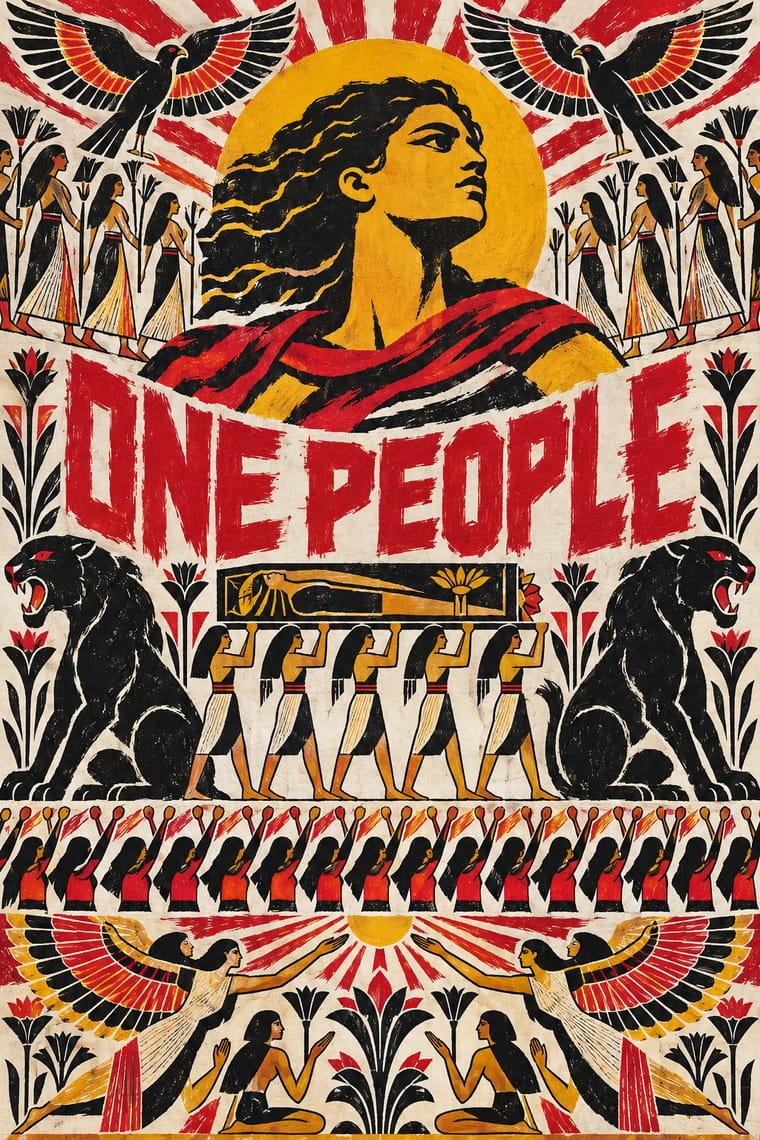
Egyptian Revolutionary Street Art × Ultras Graphics
The Mohamed Mahmoud murals painted the faces of Port Said's dead, most of them Ultras Ahlawy fans; pair the curva's collective name and colours with memorial portraits when a group mourns its own.
Mix them and make something Egyptian Revolutionary Street Art Ultras Graphics
01
What each style brings
Each part of the design comes from the style with the stronger say in it, and each style gives at least two.
Egyptian Revolutionary Street Art (Mohamed Mahmoud Murals) Ultras Graphics (Curva Banners and Tifo)
- Type from Ultras Graphics
- Colour from Ultras Graphics
- Form from Egyptian Revolutionary Street Art
- Composition from Ultras Graphics
- Surface from Egyptian Revolutionary Street Art
02
The type
Open fonts standing in for each style’s own type, which is often hand-drawn or commercial.
Display · Ultras Graphics
Ours
Big Shoulders; Ultras Graphics used The 'Ultras Liberi' genre and Set display faces enlarged and painted by hand
Text · Egyptian Revolutionary Street Art
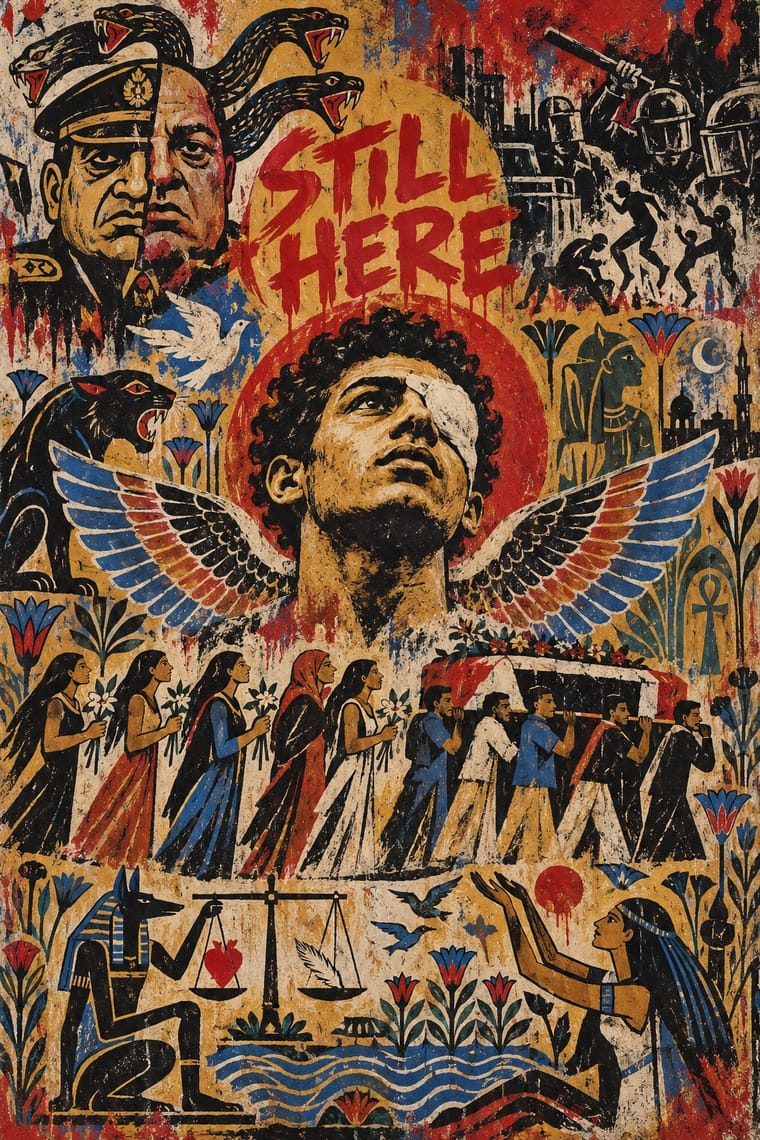
The street art of Egypt's 2011 revolution and the years after it, when Cairo's walls, above all around Tahrir and Mohamed Mahmoud Street, became what Ammar Abo Bakr called a newspaper. Three idioms share them: portraits of martyrs with wings and eye patches; neo-Pharaonic friezes of mourning and marching women by Luxor-trained muralists; and sardonic caricatures, stencils and Arabic slogans against the army, Mubarak and later Morsi. Whitewashed again and again, the walls were repainted in reply.
Newsreader; Egyptian Revolutionary Street Art used Freehand Arabic slogans in spray paint and marker, sometimes with English lines, scrawled beside and over the pictures and Historical lām-alif ('no') forms collected from buildings, mosques, ceramics, textiles and books across the Islamic world, sprayed by Bahia Shehab
03
The colours
The ground and leading colours come from Ultras Graphics, with a counter-accent from Egyptian Revolutionary Street Art. The ink reads on the ground at 4.5:1 or more.
Egyptian Revolutionary Street Art (Mohamed Mahmoud Murals) Ultras Graphics (Curva Banners and Tifo)
-
#f4f1eaground · 36% -
#141414ink · 14% -
#f2b705accent · 18% -
#c8102eaccent · 14% -
#c8963eaccent · 10% -
#1d3c8faccent · 8%
As CSS
:root {
  --ground: #f4f1ea;
  --ink: #141414;
  --accent-1: #f2b705;
  --accent-2: #c8102e;
  --accent-3: #c8963e;
  --accent-4: #1d3c8f;
  --font-display: "Big Shoulders", sans-serif;
  --font-text: "Newsreader", serif;
}
Use it with care
Egyptian Revolutionary Street Art (Mohamed Mahmoud Murals): These walls commemorate real people killed or maimed in 2011–13, whose families are alive, alongside images of women assaulted by security forces, Qur'anic verses and Coptic and Islamic sacred imagery; do not reuse martyr portraits, eye patches or the 'blue bra' as edgy protest styling for a brand, have every Arabic line read by a fluent reader, and credit the artists and photographers by name. The walls were also religiously contested: Awad painted some of his Pharaonic women nude as a stand against the Wahhabi style of Islam, and Salafists erased some martyr portraits and put Qur'anic verses in their place, so do not pair those figures with Qur'anic verses for effect. After July 2013 the interim government built its own martyrs' memorial in Tahrir, which protesters wrecked, and the Muslim Brotherhood staked its own claim to the revolution's dead, so check whose dead a reused martyr motif would seem to mourn. Political street art remains dangerous in Egypt: Ganzeer was detained in 2011, four graffiti artists were detained for 12 hours in May 2015 after painting a mural, and 400 copies of Walls of Freedom were confiscated in Alexandria for allegedly 'inciting violence', so never put Egyptian artists or collaborators at risk with work attributed to them.
Ultras Graphics (Curva Banners and Tifo): Ultras graphics belong to living, often closed supporters' groups whose banner, name and emblem stand for the group itself, so do not lift a real group's name, logo or lettering for a brand, campaign or fashion line as if it were anonymous street style. The language carries the political baggage of both extremes of 1970s street politics: Vice and Scalcione trace the 'Ultras Liberi' lettering to French and Italian far-right lettering, and some curve, such as S.S. Lazio's Ultras (1974), are known for fascist slogans, but group names such as Commando, Brigate and Fedayn were borrowed from political marches, and many 1970s ultras came from the extra-parliamentary left, Lotta Continua above all, so the same sign can mean opposite things in two curve; check what a borrowed symbol or slogan has meant in that curva before using it. Fare's guide to discriminatory practices in European football lists the SS Totenkopf skull, Sig and Odal runes, the Wolfsangel, the Celtic cross (often in place of an 'O') and the code '88' among the far-right symbols seen in stadiums on banners, stickers and shirts: never use them, and keep a borrowed skull clearly apart from the Totenkopf, as the guide does. Nazi symbols are banned by law in Germany, Austria, Poland and other countries, and UEFA fined Germany's football association after its fans showed a neo-Nazi flag at Euro 2012. Memorial displays and murals, for the 74 dead of Port Said in 2012, 72 of them Al Ahly supporters, or the Superga air crash of 1949, are acts of mourning, not decoration. In Egypt a Cairo court banned all ultras groups in May 2015 and members have been arrested since; do not attribute new work to Egyptian ultras groups or their members. Flares and smoke are dangerous and banned in many stadiums; do not present pyrotechnics as a device to imitate.
04
The two styles
05
More combinations
With Egyptian Revolutionary Street Art
- Lebanese Civil War Party Poster Contrasts · Beirut's martyr posters were issued by parties marking walls as territory; Cairo's martyrs were painted by artists who said they had nothing to do with any party. Compare them to judge whose voice a commemoration speaks in.
- Graffiti & Hip-Hop Graphics Contrasts · Same spray can, opposite priority: New York writing makes the writer's name a letter-sculpture, while Cairo's walls are figurative and commemorative and the lettering is a caption. Decide whether the brief needs a name or a face.
- Stencil Street Art Pairs well · Cairo's stencillers worked in the same cut-and-spray idiom; set one stencilled face and a short slogan beside a brushed mural when a memorial has to be repeated across a city overnight.
- Ancient Egyptian Hieroglyphic & Register Composition Pairs well · In 2012 Luxor-trained muralists such as Alaa Awad recast tomb painting on Cairo's Mohamed Mahmoud Street: profile processions of mourning women, registers, a sarcophagus and the weighing of the heart, brushed in acrylic around the faces of the martyrs. Look there for a living Egyptian use of the register and the procession, credited to its painters, rather than Egyptomania décor.
- Chilean Estallido Social Graphics (Revuelta Popular of 2019–20) Contrasts · Cairo and Santiago both put the eye patches of protesters shot in the eye on their walls and answered every whitewash with new work, but Cairo's martyr murals are brushed portraits beside Pharaonic friezes, while Santiago's are layered paper, stencil and punk iconoclasm.
- Syrian Revolution Graphics (Kafranbel Banners & Poster Collectives) Pairs well · Its 2011 neighbour: Cairo painted martyrs and friezes onto walls, Syria made portable sheets for the camera; put a Syrian-style printable slogan beside a mural photograph to join wall and feed.
- Black Lives Matter Street Murals Contrasts · Cairo's murals were painted against the state and erased by it; most Black Lives Matter street murals were painted with city permission, and many are maintained by cities or community groups, though the D.C. original was removed by its own city in 2025. Ask whose voice the paint speaks in before borrowing either.
- Arab Independent Comics (Samandal, TokTok, Lab619, Skefkef) Pairs well · The same Cairo moment on paper and on walls: TokTok appeared two weeks before 25 January 2011, and many of these artists mix caricature, illustration, comics and graffiti. Carry a wall's sardonic caricature and slogan into a sequence of panels.
With Ultras Graphics
- European Heraldry Contrasts · Both raise colours and emblems over a fighting company, but heraldry codifies one bearer's arms by rule, while a curva borrows the city's arms, a skull or a film villain for one afternoon and paints it the size of a stand; choose between a fixed blazon and a crowd-made, temporary emblem.
- Atelier Populaire (May '68 Screenprint Poster) Pairs well · The type designer Alessio D'Ellena, quoted by Vice, places ultras' vernacular letters 'more in the tradition of' the Atelier Populaire's anonymous May '68 posters; borrow their single brushed slogan and anonymous signature for a banner with something to say.
- Fante Asafo Flags (Frankaa) Contrasts · Another fighting group's cloth: the Fante company flag tells a proverb in appliquéd figures for one company, while the ultras banner states one name in painted capitals to a whole stadium.
- Graffiti & Hip-Hop Graphics Pairs well · Ginhoux compares ultras' tag and sticker wars to graffiti crews; add a writer's tags, throw-ups and wall murals to carry a group's name from the banner into the street.