Counterculture · 2011–2014 · Middle East & North Africa
Egyptian Revolutionary Street Art (Mohamed Mahmoud Murals)
Also known as Mohamed Mahmoud graffiti, January 25 Revolution graffiti, Cairo revolutionary murals, Graffiti of the Egyptian revolution
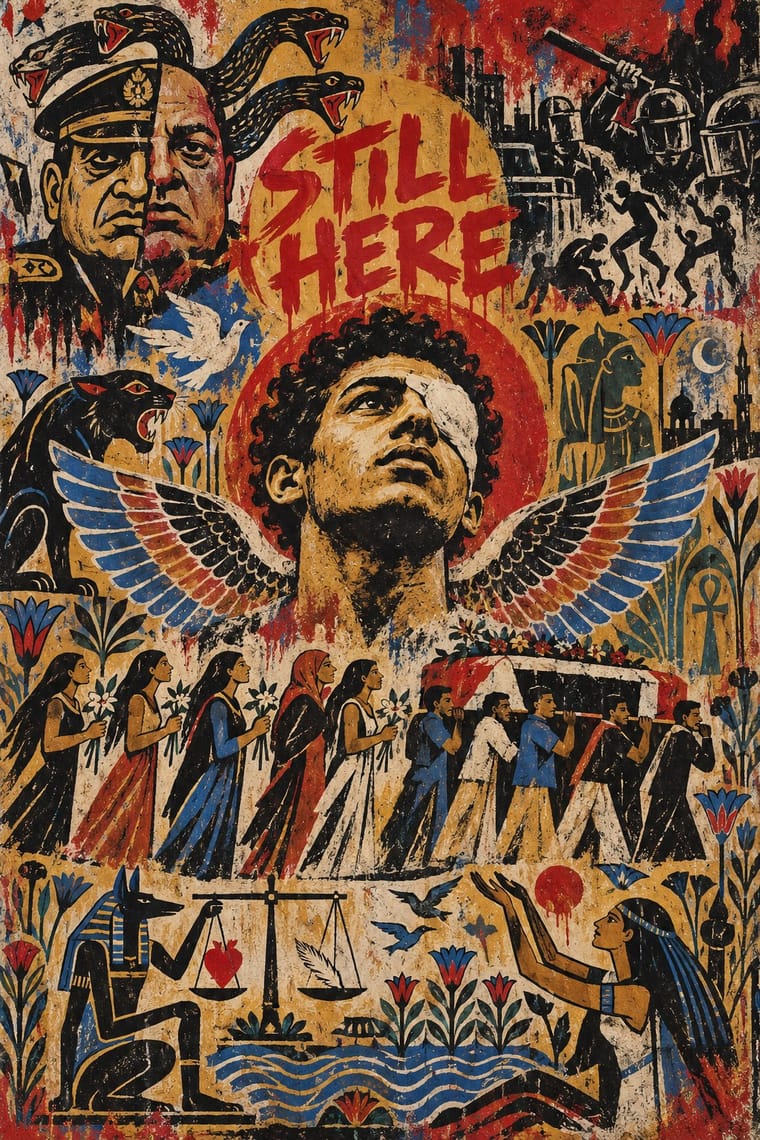
The street art of Egypt's 2011 revolution and the years after it, when Cairo's walls, above all around Tahrir and Mohamed Mahmoud Street, became what Ammar Abo Bakr called a newspaper. Three idioms share them: portraits of martyrs with wings and eye patches; neo-Pharaonic friezes of mourning and marching women by Luxor-trained muralists; and sardonic caricatures, stencils and Arabic slogans against the army, Mubarak and later Morsi. Whitewashed again and again, the walls were repainted in reply.
Make something in this styleGet advice in this styleMix it with another style
Use it with care
These walls commemorate real people killed or maimed in 2011–13, whose families are alive, alongside images of women assaulted by security forces, Qur'anic verses and Coptic and Islamic sacred imagery; do not reuse martyr portraits, eye patches or the 'blue bra' as edgy protest styling for a brand, have every Arabic line read by a fluent reader, and credit the artists and photographers by name. The walls were also religiously contested: Awad painted some of his Pharaonic women nude as a stand against the Wahhabi style of Islam, and Salafists erased some martyr portraits and put Qur'anic verses in their place, so do not pair those figures with Qur'anic verses for effect. After July 2013 the interim government built its own martyrs' memorial in Tahrir, which protesters wrecked, and the Muslim Brotherhood staked its own claim to the revolution's dead, so check whose dead a reused martyr motif would seem to mourn. Political street art remains dangerous in Egypt: Ganzeer was detained in 2011, four graffiti artists were detained for 12 hours in May 2015 after painting a mural, and 400 copies of Walls of Freedom were confiscated in Alexandria for allegedly 'inciting violence', so never put Egyptian artists or collaborators at risk with work attributed to them.
01
How it works
- Paint the dead within days and by name: take the martyr's face from a photograph, add wings, and paint eye patches for the protesters shot in the eye in November 2011, so the wall becomes a memorial where passers-by leave flowers.
- Recast tomb painting for the present: line up figures in profile and in procession, as mourning or marching women, in panels and registers around a central portrait panel; borrow coffin-bearers who stand for the Egyptian people and a sarcophagus, a green man for immortality, a red-eyed black panther for anger, black flowers for sorrow, papyrus-bearing women after a Ramesseum battle relief, the Book of the Dead's weighing of the heart, and winged martyrs rising to heaven; brush them in acrylic rather than spray them, and let Pharaonic, Coptic and Islamic sources share one wall.
- Answer power with sardonic caricature: split the field marshal's face with the ousted president's, turn the military council into a three-headed snake, and let a cartoon witness such as Sad Panda make the violence look absurd.
- Cut cheap stencils anyone can repeat, such as a historical lām-alif 'No' with its target, 'No SCAF' or a martyr's face, and spray short slogans across the city in Arabic and sometimes English.
- Treat every wall as a running conversation: when it is whitewashed, paint again over the ghosts of the last layer, and let tags, slogans, additions and defacements pile up as replies.
- On a barricade, paint the street back: continue the road, the trees and the sky across the concrete blocks in trompe-l'oeil, and fold the street's own violence into the view.
Cairo, from the 18-day occupation of Tahrir Square (25 January to 11 February 2011): the walls of Mohamed Mahmoud Street and the American University in Cairo, the concrete barricades put across downtown streets, and the Zamalek wall under the 6th of October Bridge. Painted by graphic artists such as Ganzeer, stencil and graffiti artists such as Sad Panda and Keizer, muralists trained at the Luxor Faculty of Fine Arts (Ammar Abo Bakr, Alaa Awad), and writers from a pre-2011 graffiti scene in Cairo and Alexandria that had learned from US writers online; Alexandria's walls carried a parallel scene
02
Its design choices
From Stylogeny’s vocabulary of design choices: defining choices make the style, characteristic ones are usual, occasional ones turn up now and then.
- Layout & composition
- Space & hierarchy
- Colour
- Form & shape
- Imagery
- Medium & production
- Tone & intent
- Avoids
- Modular grid, Generous white space, Gloss & highlights, Authoritative & institutional, Luxurious & glamorous, Rational & objective
Palette
#ede7da#161616#c8963e#a2482b#c8102e#2f5f9f
Typefaces
Freehand Arabic slogans in spray paint and marker, sometimes with English lines, scrawled beside and over the pictures
Historical lām-alif ('no') forms collected from buildings, mosques, ceramics, textiles and books across the Islamic world, sprayed by Bahia Shehab
Short stencilled slogans in Arabic or English, such as 'The Revolution will not be Tweeted' beside a Twitter logo, and the DIY anti-SCAF stencils Ganzeer offered online
Brushed Arabic captions, poetry and Qur'anic verses inside murals, such as 'glory to the unidentified' on Abo Bakr's Sayed Khaled portrait, and Sameh Ismael's calligraphy of Ahmed Aboul Hassan's verses, in red, black, yellow and greens, on the Qasr el-Nil mural (June 2013)
Known for
Ganzeer (Mohamed Fahmy), Tank vs. Bike, under the 6th of October Bridge, Zamalek (2011)
a young man carrying a huge tray of bread on his head on a bicycle faces a tank; Sad Panda added his panda within hours, unknown artists added faceless protesters and crushed victims in January 2012, and SCAF loyalists calling themselves Badr Team 1 whitewashed all but the tank in February 2012
Ganzeer, Martyr Murals (2011), and the 'Mask of Freedom' (a mannequin torso in a gimp mask with two small wings), for whose stickers he was detained on 26 May 2011; efforts to remove the martyr murals led to the Mad Graffiti Weekend protest of May 2011
Ammar Abo Bakr, Lost Eyes and Mothers of the Martyrs, Mohamed Mahmoud Street (2011–12), eye-patched protesters and a mother holding the photograph of her dead son
Memorial murals for the Port Said stadium dead, Mohamed Mahmoud Street
(February–March 2012), credited to four artists, Ammar Abo Bakr, Alaa Awad, Hanaa El Degham (also spelled El Deighem and al-Deghem) and Mohamed Khaled: Abo Bakr's central 'Glory to the martyrs' panel, with the faces of the dead, most of them Ultras Ahlawy fans, ringed by Awad's Pharaonic scenes of burial and mourning, among them The Funeral, with grieving women beside a sarcophagus, and winged martyrs ascending to heaven; Awad also described a Port Said mural painted with Abo Bakr and El Degham as present-day women revolutionaries in an 'ancient Egypt style' confronting Mubarak, some of them nude (Lennon), and painted Marching Women after a battle relief on the Ramesseum's first pylon
Field Marshal Tantawi and Hosni Mubarak as two halves of one face
at the corner of Mohamed Mahmoud Street with Qasr al-Aini by Tahrir Square (2012), under the words 'The revolution continues'; attributed to Omar Fathy, who was not working on the neighbouring murals (Egypt Independent, 2012), to Mohamed Fathi (Wikipedia), and with its companion half-portraits to rabitat fanani al-thawrah, the Association of the Artists of the Revolution (Jadaliyya, 2013); erased and repainted at the same size several times, then joined by half-portraits of Amr Moussa and Ahmed Shafiq and, in a smaller repaint of September 2012, of Mohamed Badie
Bahia Shehab, A Thousand Times No (from 2011)
historical lām-alif ('no') forms from Islamic art sprayed on Cairo streets with targets such as 'No to a new pharaoh' and 'No to stripping the people', after the 'girl in the blue bra' assault
'No Walls' campaign (February–March 2012), which Ammar Abo Bakr helped start
trompe-l'oeil continuations of the street painted on the concrete barricades of Yousef al-Guindy and Sheikh Rihan streets
Ammar Abo Bakr, portrait of Sayed Khaled, called the youngest martyr of the revolution, with the words 'glory to the unidentified'
November 2013
03
Make something in this style
Say what you need, and Stylogeny’s image studio draws it from Egyptian Revolutionary Street Art (Mohamed Mahmoud Murals)’s design choices and checks it against them. It takes about a minute, and you get a link to share.
04
Where it comes from, and what it’s close to
Before it
The style it grew out of, and the styles it borrowed from.


After it
The styles that grew out of it.
No later style in the atlas grew out of it yet.
Alike in its design choices
Styles that make many of the same choices, related or not, besides those above.

- Oaxacan Protest Printmaking & Street Graphics (ASARO)67% alike
- Indonesian Woodcut Activism (Taring Padi)63% alike
- Persian Popular Narrative (Lithographs & Coffeehouse Painting)61% alike


05
Sources
- John Lennon, 'Assembling a Revolution: Graffiti, Cairo and the Arab Spring', Cultural Studies Review 20(1), March 2014, pp. 237–75, doi:10.5130/csr.v20i1.3203 (Tank vs. Bike and its additions, Sad Panda and Badr Team 1; the pre-2011 writing scene in Cairo and Alexandria, with Mahmoud Aly learning from cope2, can2 and online black books; Awad's Port Said mural with Abo Bakr and Hanaa El Deighem, Lennon's spelling of El Degham, showing present-day women revolutionaries in an 'ancient Egypt style', some nude in rejection of 'the Whahabi style of Islam'; Abo Bakr painting through the night after Port Said, arguing with Islamists, and 'We have nothing to do with any party or movement'; Salafists replacing martyr portraits with Qur'anic verses (note 51); layered, partly erased walls; the stencilled 'The Revolution will not be Tweeted'; Ganzeer's DIY anti-SCAF stencils; the 'No Walls' murals on Yousef al-Guindy and Sheikh Rihan streets, February–March 2012)
- Basma Hamdy, 'Walls of Freedom: Process and Methodologies', Street Art & Urban Creativity 1(1), 2015, pp. 67–79, doi:10.25765/sauc.v1i1.19 (street art 'ranged from scrawls and scribbles to elaborately painted murals', 'Repeatedly erased and "cleaned" by the state'; Sad Panda stencil whitewashed the next morning; 400 copies confiscated in Alexandria; four graffiti artists detained in May 2015)
- Mona Abaza, 'Walls, Segregating Downtown Cairo and the Mohammed Mahmud Street Graffiti', Theory, Culture & Society 30(1), 2013, pp. 122–39, doi:10.1177/0263276412460062 (abstract: concrete buffer walls, 'sardonic graffiti and epic murals', a memorial space)
- Wikipedia: 'Mohamed Mahmoud graffiti' (the article carries a close-connection banner; used for Lost Eyes, Mothers of the Martyrs, the Tantawi–Mubarak face by Mohamed Fathi, Awad's Funeral with its sarcophagus, the Ultras Ahlawy faces and angel-winged martyrs, and Marching Women, the three-headed snake, the 'No Wall' initiative and the September 2012 whitewashing), 'Ganzeer', 'Ammar Abo Bakr' (Luxor training, 'We used walls as a newspaper', the No Walls campaign), 'Alaa Awad' (neo-Pharaonic style, brush and acrylic rather than stencil and spray, Marching Women after the Ramesseum's first pylon with papyrus in the women's hands), 'Bahia Shehab' (A Thousand Times No and its slogans)
- University of Warwick and AHRC, Politics, Popular Culture and the 2011 Egyptian Revolution (egyptrevolution2011.ac.uk): items 'Eye patches' (258), 'Tank versus Bike' (58), 'Glory to the Unidentified' (79: Ammar Abo Bakr, 1 November 2013, Sayed Khaled with angel wings, 'the youngest martyr of the revolution'), 'Walls of Freedom' (243) and 'Revolution Graffiti: Street Art of the New Egypt' (233)
- Abdel-Rahman Hussein, 'Blog: Martyrs and mourning on Mohamed Mahmoud', Egypt Independent, 7 March 2012 (the street murals by Ammar Abu Bakr, Alaa Awad, Hana al-Deghem and Mohamed Khaled; Abu Bakr's central 'Glory to the martyrs' panel ringed by Awad's Pharaonic scenes of burial and mourning; coffin-bearers as the Egyptian people, the green man for immortality, the red-eyed black panther for anger and black flowers for sorrow; the split-face Tantawi and Mubarak at the Qasr al-Aini corner by Omar Fathy)
- Jadaliyya, 'The Dramaturgy of A Street Corner' (25 January 2013, photographs by Mona Abaza) (the half-Mubarak portraits by rabitat fanani al-thawrah at the Tahrir corner of Mohamed Mahmoud Street, repainted at the same size, with Amr Moussa and Ahmed Shafiq added and a smaller September 2012 repaint with Mohamed Badie)
- Soraya Morayef (Suzee in the City), 'On Codes and Translation: Understanding Alaa Awad' (25 November 2015) (Awad's use of the Book of the Dead's weighing of the heart; his mourning women, painted after the Port Said massacre of February 2012 the same size as the gods and kings in other murals on Mohamed Mahmoud Street)
- Angela Boskovitch, 'Photo Essay: Qasr el-Nil Mural: A Dialogue of Form and Topic', Sada, Carnegie Endowment for International Peace, 30 September 2013 (Sameh Ismael's calligraphy of Ahmed Aboul Hassan's poetry, painted on the nights of 27 and 28 June before the 30 June demonstrations)
- Tarek Radwan, 'Coopting Mohamed Mahmoud', MENASource, Atlantic Council, 18 November 2013 (the interim government's martyrs' memorial in Tahrir, vandalised by revolutionary groups, and the Brotherhood's counterclaims to remembering the revolution's victims)
- Jadaliyya, 'New Texts Out Now: Don Karl and Basma Hamdy, Walls of Freedom: Street Art of the Egyptian Revolution' (25 March 2015), with excerpts by Ahdaf Soueif, Rana Jarbou, Caram Kapp and Basma Hamdy
- TED: Bahia Shehab, 'A thousand times no', TEDGlobal 2012 (June 2012)
- Don Karl and Basma Hamdy (eds.), Walls of Freedom: Street Art of the Egyptian Revolution (Berlin: From Here to Fame, 2014); Mia Gröndahl, Revolution Graffiti: Street Art of the New Egypt (Cairo: AUC Press, 2012; London: Thames & Hudson, 2013)
- Bahia Shehab, Unified multiplicities: Arabic letters between modernity, identity, and abstraction (PhD thesis, Leiden University, 2019) (her research on letterist abstraction, behind the hurufiyya influence)
How Stylogeny researches and checks a style: where the facts come from.