Style combination · Contrasts
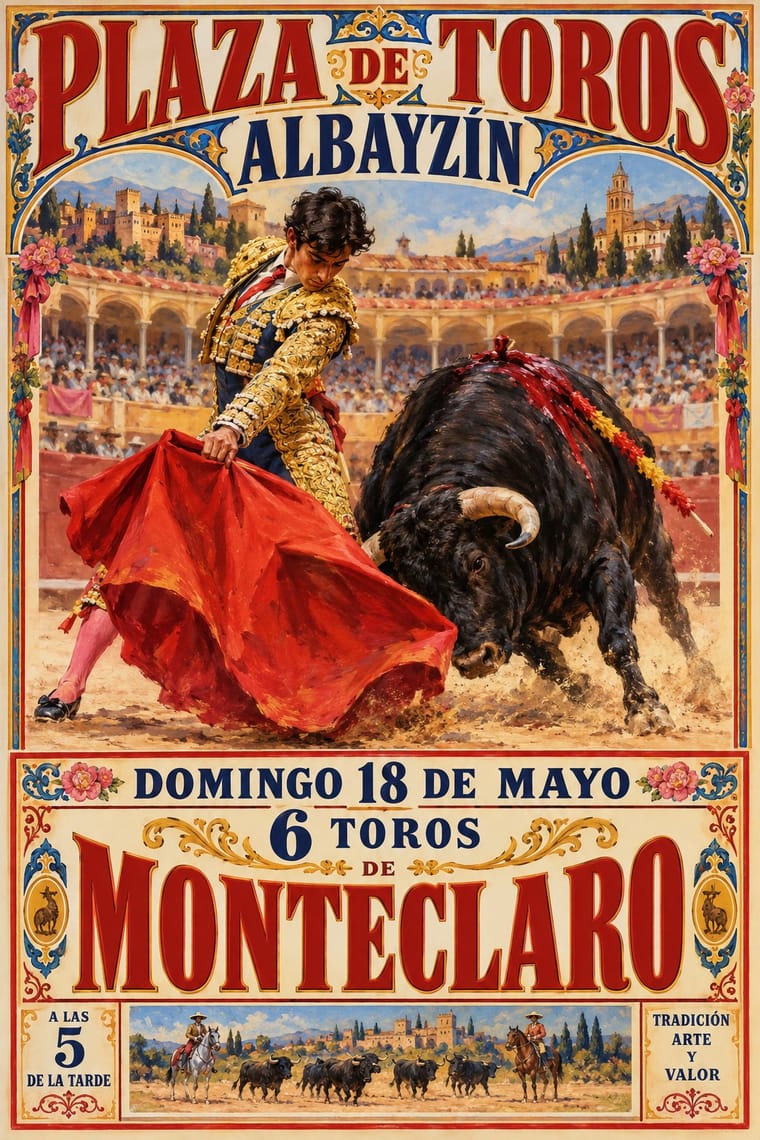
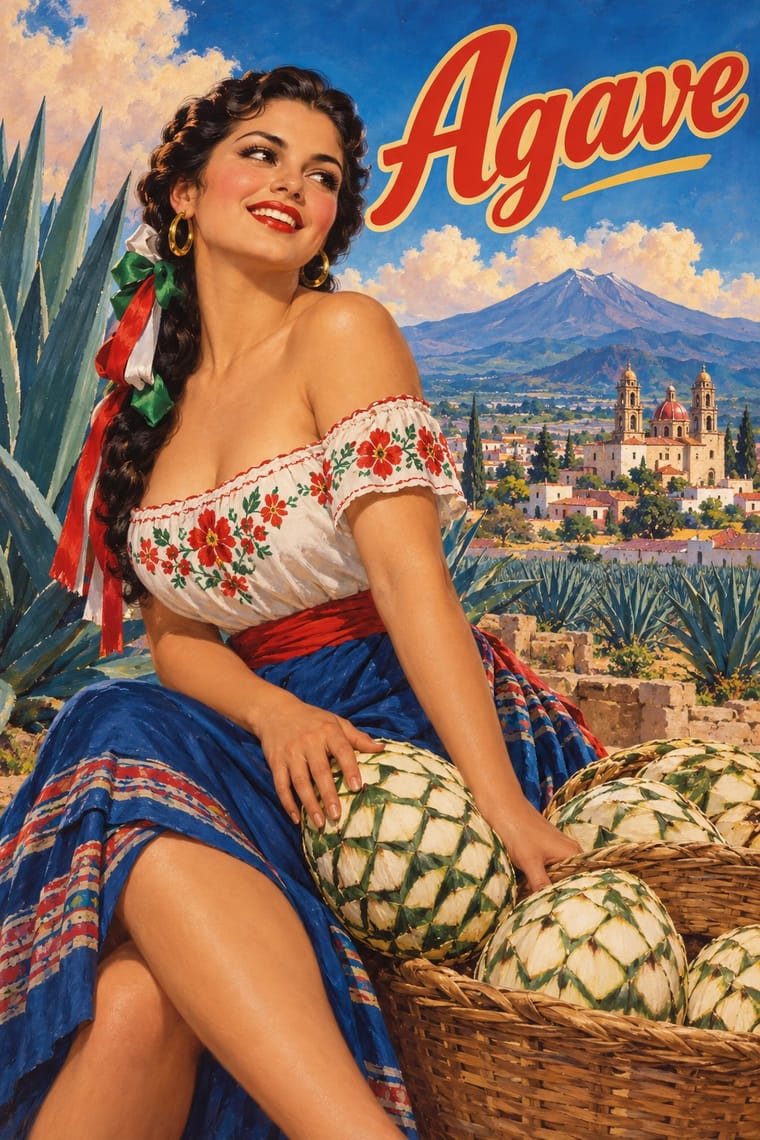
Spanish Bullfight Poster × Mexican Calendar Chromo
Both print a commissioned academic oil in quantity and add text afterwards, but the calendar gives the painting the whole sheet with a sponsor band, while the cartel keeps a full ranked programme of ring, bulls and matadors below it.
Mix them and make something Spanish Bullfight Poster Mexican Calendar Chromo
01
What each style brings
Each part of the design comes from the style with the stronger say in it, and each style gives at least two.
Spanish Bullfight Poster (Cartel Taurino) Mexican Calendar Chromo (Cromos calendáricos)
- Type from Spanish Bullfight Poster
- Colour from Mexican Calendar Chromo
- Form from Spanish Bullfight Poster
- Composition from Mexican Calendar Chromo
- Surface from Spanish Bullfight Poster
02
The type
Open fonts standing in for each style’s own type, which is often hand-drawn or commercial.
Display · Spanish Bullfight Poster
Amour
Anton, standing in for Mecana (even-stroke slab serif) and heavy condensed grotesque capitals for the matadors' names, printed in black, red or blue
Text · Mexican Calendar Chromo
Mexico's give-away advertising calendars, at their height from the 1930s to the late 1960s. Printers led by Galas de México kept studios of painters, among them Jesús Helguera, Eduardo Cataño, Jorge González Camarena and Josep Renau, whose large oil paintings were printed by offset above a sponsor's name and a small calendar pad. In an idealising academic realism touched by Hollywood glamour they staged Aztec legends as melodrama, charros and chinas poblanas, saints, film stars and pin-ups, and hung all year in homes, shops and workshops.
Archivo; Mexican Calendar Chromo used The sponsor's name and address overprinted in the band left blank below the picture and Brand logotypes painted into the picture or carried on the product
03
The colours
The ground and leading colours come from Mexican Calendar Chromo, with a counter-accent from Spanish Bullfight Poster. The ink reads on the ground at 4.5:1 or more.
Spanish Bullfight Poster (Cartel Taurino) Mexican Calendar Chromo (Cromos calendáricos)
-
#f0c4a8ground · 36% -
#1f4e8cink · 14% -
#c8372daccent · 18% -
#dcaa34accent · 14% -
#a8693faccent · 10% -
#3d8b4faccent · 8%
As CSS
:root {
  --ground: #f0c4a8;
  --ink: #1f4e8c;
  --accent-1: #c8372d;
  --accent-2: #dcaa34;
  --accent-3: #a8693f;
  --accent-4: #3d8b4f;
  --font-display: "Anton", sans-serif;
  --font-text: "Archivo", sans-serif;
}
Use it with care
Spanish Bullfight Poster (Cartel Taurino): Bullfighting is a living but contested practice, opposed by animal-welfare campaigners in Spain and abroad, so borrowing its imagery for unrelated products brings that dispute with it; the painted manolas also belong to a folkloric picture of Andalusia rather than a record of it. Ruano Llopis (d. 1950), Roberto Domingo (d. 1956) and Juan Reus (d. 2003) are still in copyright in Spain, so paint new pictures in the manner rather than reprinting their motifs.
Mexican Calendar Chromo (Cromos calendáricos): The Aztec scenes are a nationalist fantasy of the pre-Hispanic past painted by academically trained artists, several of them born or raised in Spain, not Indigenous art: do not present them as Nahua or Mexica tradition or copy their feathered costumes as if they were ethnography. The saints and the Virgin of Guadalupe are devotional images that many owners pray before, so do not parody them, and the pin-ups were painted, as a UNAM study of the Galas archive puts it, to satisfy male longing and promote the sponsors' brands, carrying old and new stereotypes of women. The paintings are still in copyright (Helguera died in 1971) and Grupo Carso holds the rights to the Galas archive, while Alta reported in 2023 that Calendarios Landin owns the rights to Helguera, so paint new pictures in the manner rather than retouching old chromos.
04
The two styles
05
More combinations
With Spanish Bullfight Poster
- Hand-Painted Signage & Vernacular Lettering Pairs well · Pair a painted rótulo for a bar or peña with a cartel-style scene and ranked capitals for a festive, local Spanish look.
- Spanish Civil War Poster Contrasts · Josep Renau learned lithography at Ortega's Valencia works while a student; his generation traded the cartel's naturalistic brushwork and long programme for flat, foreshortened figures, diagonal slogans and photomontage.
- International Typographic Style Contrasts · One grotesque, flush left on a grid, against a centred clamour of mixed faces under a painting: use the pair to decide whether a festival programme needs ceremony or clarity.
- Victorian Letterpress & Wood Type Pairs well · The cartel's lower half is a jobbing printer's bill; set its ranked lines of mixed faces and rules under one painted scene to rebuild the two-zone sheet for any festival programme.
- Cuban Tobacco Lithography (Habilitaciones & Marquillas) Contrasts · Both are lithographic trades of the Spanish-speaking world that print naturalistic paintings, but the Havana label frames allegories, medals and arms in borders within borders around a brand lettered on the stone, while the cartel vignettes one scene and sets a long programme below it in type.
- Belle Époque Lithographic Poster Contrasts · Both are colour lithographs for the street, but the Belle Époque artist drew one animated figure and the lettering together on the stone, while the cartel sets a conservative painted scene above a typeset bill it usually keeps apart; borrow the integrated lettering when the programme is short.
- Egyptian Painted Film Poster Contrasts · Both are painted lithographs that announce star performers, but the Egyptian poster collages star heads under huge calligraphic titles, while the cartel paints one scene and names its matadors in set capitals beneath.
With Mexican Calendar Chromo
- Shanghai Modern & Yuefenpai Contrasts · Both are tobacco-sponsored calendar pictures of beauties, but yuefenpai set softly rubbed watercolour women inside decorative borders with the products alongside, while the Mexican chromo is an oil painting of a whole scene that fills the sheet, with the pad pasted at its foot.
- Egyptian Painted Film Poster Contrasts · Both paint the stars of a national cinema's golden age, but the Egyptian poster collages star heads under huge calligraphic titles, while the chromo paints one unified scene and keeps its lettering to a small band below.
- Socialist Realist Propaganda Poster Contrasts · Both idealise the nation in heroic academic realism, but the Socialist Realist poster adds slogans and marching crowds to mobilise, while the chromo sells beer and cigarettes with romance and nostalgia; borrow its heroic anatomy for a national-history scene and leave the slogan out.
- Mexican Popular Graphics (Posada) Contrasts · Posada's broadsheets are black relief cuts under shouting type, sold for news and satire; the chromo is a full-colour oil painting given away to be admired all year, with the type kept small and out of the picture.
- Lotería Card Imagery (Mexican Lotería) Contrasts · Both are popular Mexican colour prints for everyday use, but the lotería sets one flat, outlined emblem figure per numbered card in a ruled frame, named in capitals at the foot, for a game, while the chromo paints one modelled scene in deep landscape to hang for a year.
- Hand-Painted Signage & Vernacular Lettering Pairs well · Grocery stores, poultry shops and workshops gave the calendars to their customers; pair a painted rótulo for the shop's name with a chromo-style painting for the look of a mid-century Mexican neighbourhood business.
- Taller de Gráfica Popular Contrasts · Both grew out of post-revolutionary Mexico and picture its history, but the TGP cut black-and-white linocuts and woodcuts with bold headlines for popular and anti-fascist struggles, while the calendar painters made saturated oils of an idealised Mexico to sell beer and cigarettes.
- Indian Calendar & Bazaar Art Contrasts · Both are give-away calendars that reproduce commissioned paintings above a sponsor's name, but Indian bazaar art centres a frontal deity in haloes, gold and ornamental frames for worship, while the Mexican chromo stages a secular scene in deep landscape (a legend, a charro, a film star, a pin-up) with no frame around it; its saints are one genre among many.