Style combination · Contrasts
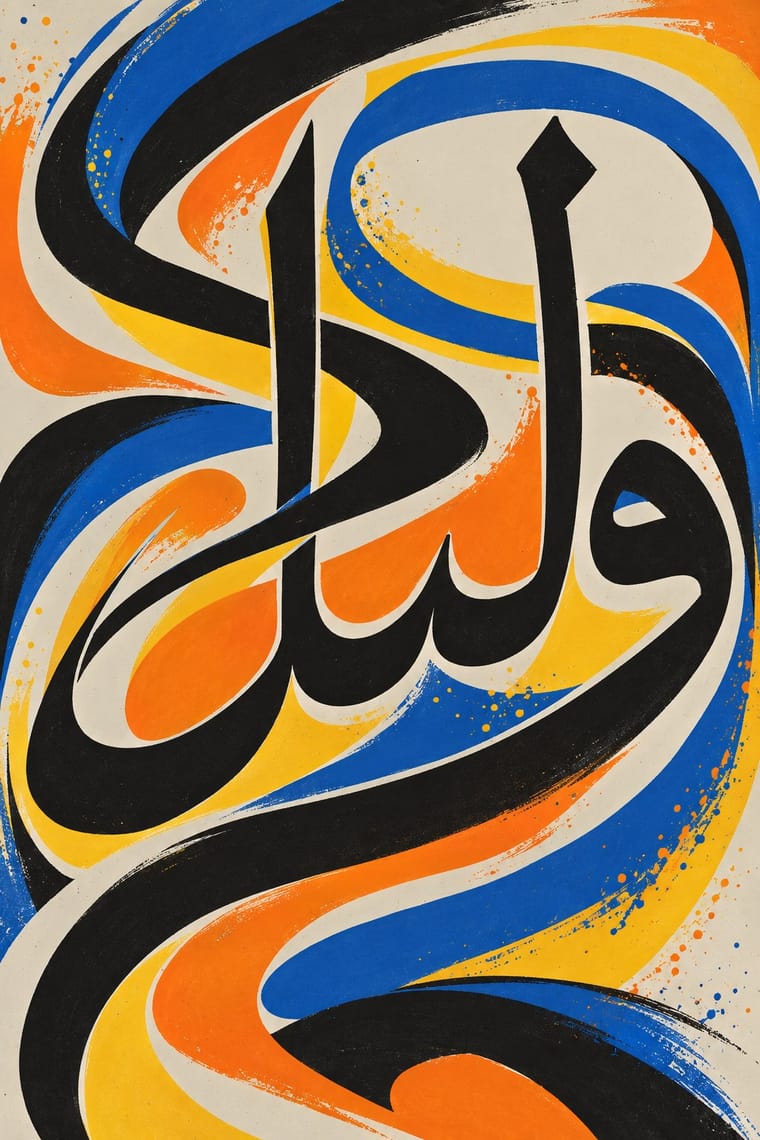
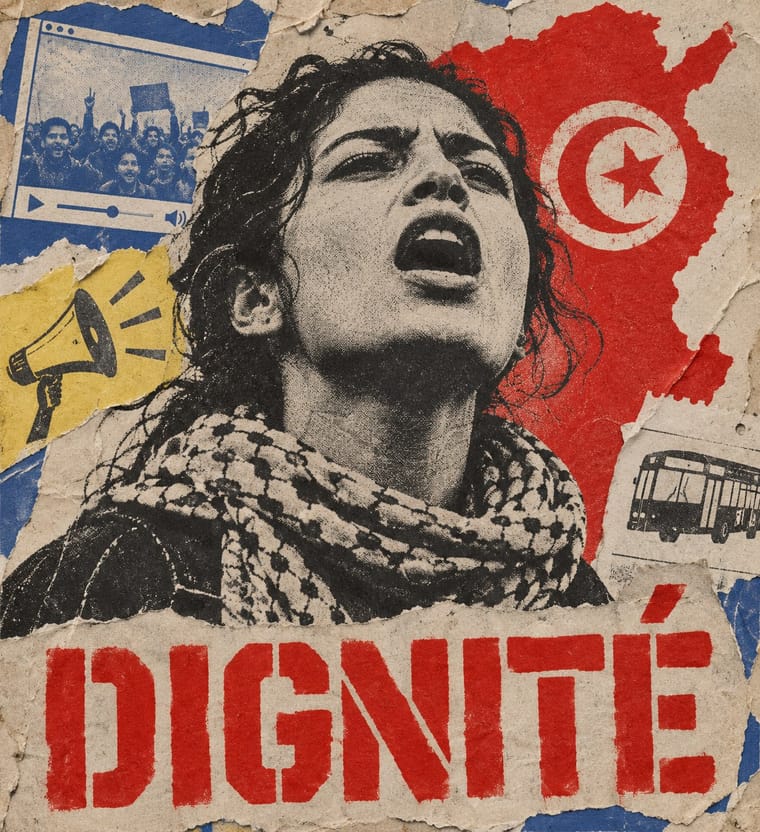
Arabic Calligraffiti × Tunisian Post-Revolution Street Graphics
There the script itself becomes the image; here a slogan captions a picture. Decide whether letters or pictures carry the message.
Mix them and make something Arabic Calligraffiti Tunisian Post-Revolution Street Graphics
01
What each style brings
Each part of the design comes from the style with the stronger say in it, and each style gives at least two.
Arabic Calligraffiti Tunisian Post-Revolution Street Graphics (Ahl El Kahf)
- Type from Arabic Calligraffiti
- Colour from Tunisian Post-Revolution Street Graphics
- Form from Tunisian Post-Revolution Street Graphics
- Composition from Arabic Calligraffiti
- Surface from Arabic Calligraffiti
02
The type
Open fonts standing in for each style’s own type, which is often hand-drawn or commercial.
Display · Arabic Calligraffiti
Ours
Rakkas, standing in for Freehand Arabic script sprayed or painted rather than written with a reed pen, after calligraphy but without its rules or a uniform hand (as the Museum für Islamische Kunst describes eL Seed's work)
Text · Tunisian Post-Revolution Street Graphics
Street graphics that emerged in Tunis in 2011, after Ben Ali's fall, when the Ahl El Kahf collective cut stencils from radiographic film and sprayed them beside the Kasbah sit-ins. Portraits, short slogans, altered commercial labels and painted jokes that exploit the wall's own cracks and stones turn a site into a one-off public argument.
Oswald; Tunisian Post-Revolution Street Graphics used Hand-cut stencil capitals, as in the French-language Essebsi slogan reported by France 24 and Imitated commercial logotypes and label lettering, reworked as a joke
03
The colours
The ground and leading colours come from Tunisian Post-Revolution Street Graphics, with a counter-accent from Arabic Calligraffiti. The ink reads on the ground at 4.5:1 or more.
Arabic Calligraffiti Tunisian Post-Revolution Street Graphics (Ahl El Kahf)
-
#e8d44dground · 39% -
#161616ink · 15% -
#d6281eaccent · 20% -
#f07f1eaccent · 15% -
#2f5fa8accent · 11%
As CSS
:root {
  --ground: #e8d44d;
  --ink: #161616;
  --accent-1: #d6281e;
  --accent-2: #f07f1e;
  --accent-3: #2f5fa8;
  --font-display: "Rakkas", cursive;
  --font-text: "Oswald", sans-serif;
}
Use it with care
Arabic Calligraffiti: Many works carry Qur'anic verses, the names of God or devotional sayings, written on mosques and in religious communities: never use such text as texture or put it on floors, footwear or throwaway items, and have every Arabic or Persian word read and approved by a fluent reader before it is painted or printed. The style stretches and interlaces letters, so put a Qur'anic verse or a name of God into it only when a skilled Arabic-script writer composes it and the mosque or community approves it, as at the Jara Mosque; never digitally warp, crop or mirror existing sacred text. Never fill a design with invented pseudo-Arabic, which image models readily produce; do not ask an image model for eL Seed's Liquid Alphabet or any named writer's hand, and never present a generated wall as their work. The best-known walls rest on the consent of governors, imams, priests and residents, so get the owner's permission (spraying without it is a crime in most places), work with the people of the place, and commission and credit Arabic-script writers rather than faking the script for a brand.
Tunisian Post-Revolution Street Graphics (Ahl El Kahf): A living political protest tradition. Do not imply endorsement by Ahl El Kahf or other real activists, and do not reproduce their works: image licences are unconfirmed. Later commissioned murals and Gaza-related imagery in Tunisia's streets are a separate matter and not covered here.
04
The two styles
05
More combinations
With Arabic Calligraffiti
- International Typographic Style Contrasts · A neutral grotesque on a modular grid is the opposite of one sweeping Arabic gesture; put a small Swiss caption block against a calligraffiti wall for a sharp bilingual identity.
- Contemporary Arabic & Dual-Script Type Design Pairs well · Set names, dates and captions in a dual-script type family beside a calligraffiti wall, so the gesture stays the image and the information stays legible.
- Islamic Geometric & Calligraphic Tradition Pairs well · Run a strict geometric band or tiling behind freely written letters, as Zepha sets Arabic script among geometric shapes, so the piece answers its classical source.
- Baybayin Revival Graphics Pairs well · Kabuay applies calligraphy and graffiti methods to baybayin; borrow calligraffiti's large painted gesture for murals, but keep each glyph legible and correctly spelled.
- Syrian Revolution Graphics (Kafranbel Banners & Poster Collectives) Pairs well · Scale a brushed slogan from the poster up to a wall with calligraffiti's architectural sweep, keeping the words short and checked by a fluent reader.
- Syrian Cassette Cover Vernacular Pairs well · Also builds on Arabic calligraphic lettering, but as street art rather than a commercial sleeve; keep sacred text out of decorative use.
- Gulf Futurism Pairs well · A weak pairing: Arabic lettering on walls could sit beside Gulf Futurism's screens, but calligraffiti is street art and not part of this video-and-installation practice.
With Tunisian Post-Revolution Street Graphics
- Egyptian Revolutionary Street Art (Mohamed Mahmoud Murals) Contrasts · Cairo's walls became epic commemorative murals; Tunis's core is small stencil-and-intervention work. Choose a witty one-liner or a memorial painting, not both.
- Situationist Détournement Graphics Pairs well · An interpretive affinity, not a documented influence (the sources do not mention the Situationists): lift a familiar brand label and alter it to turn it against itself, as in the Enjoy Capitalism piece.
- Stencil Street Art Pairs well · The shared cut-and-spray technique; borrow its single-focal portrait, then add a site-specific hand-painted element.
- Algerian Hirak Humorous Poster and Meme Graphics Contrasts · Tunisian street graphics are site-specific wall interventions; take the portable, photographable sign from Hirak instead.