Style combination · Pairs well
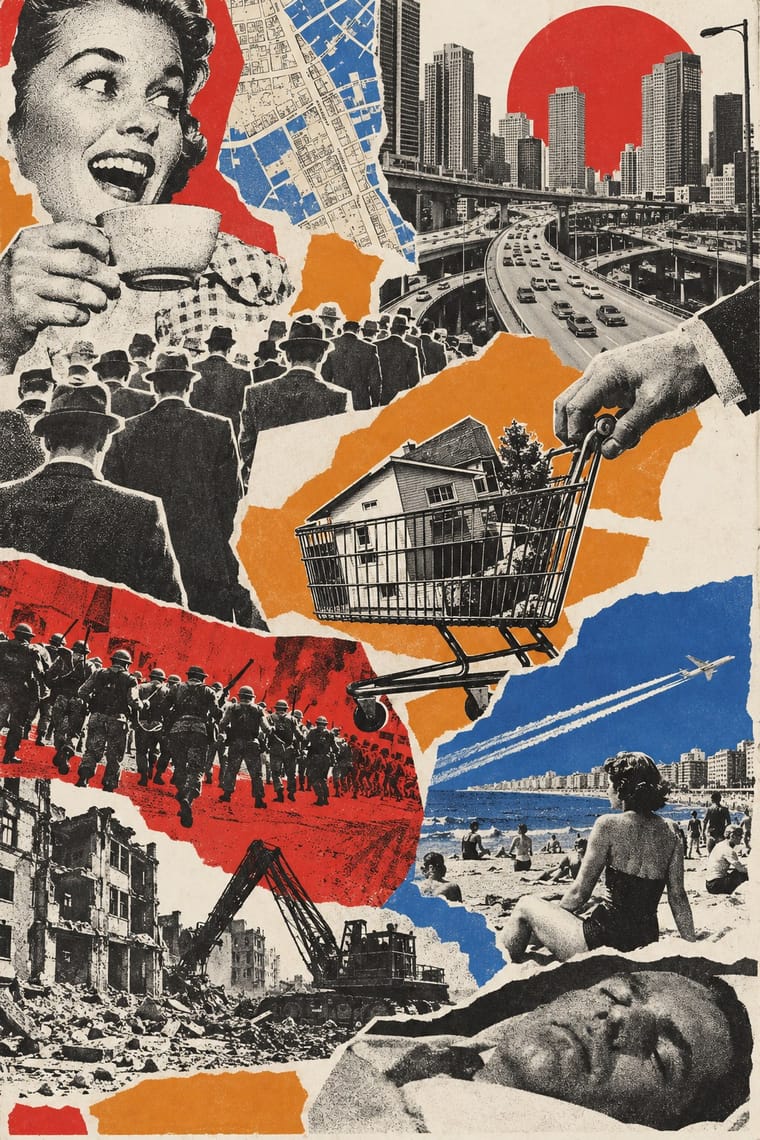
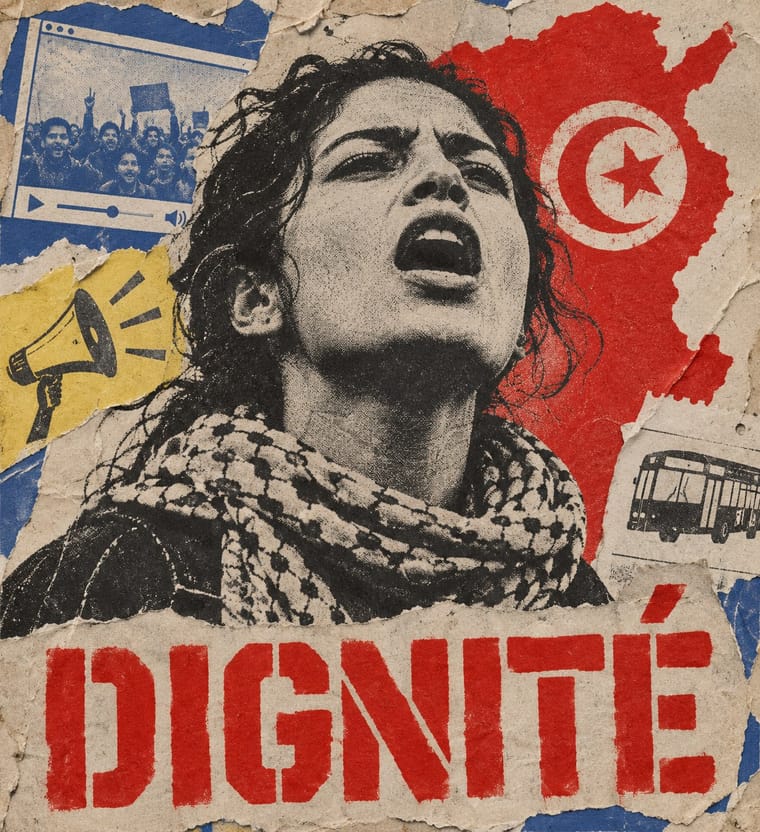
Situationist Détournement Graphics × Tunisian Post-Revolution Street Graphics
An interpretive affinity, not a documented influence (the sources do not mention the Situationists): lift a familiar brand label and alter it to turn it against itself, as in the Enjoy Capitalism piece.
Mix them and make something Situationist Détournement Graphics Tunisian Post-Revolution Street Graphics
01
What each style brings
Each part of the design comes from the style with the stronger say in it, and each style gives at least two.
Situationist Détournement Graphics Tunisian Post-Revolution Street Graphics (Ahl El Kahf)
- Type from Tunisian Post-Revolution Street Graphics
- Colour from Situationist Détournement Graphics
- Form from Tunisian Post-Revolution Street Graphics
- Composition from Situationist Détournement Graphics
- Surface from Situationist Détournement Graphics
02
The type
Open fonts standing in for each style’s own type, which is often hand-drawn or commercial.
Display · Tunisian Post-Revolution Street Graphics
Wow.
Allerta Stencil, standing in for Hand-cut stencil capitals, as in the French-language Essebsi slogan reported by France 24
Text · Situationist Détournement Graphics
Graphics of the Letterist and Situationist Internationals (1956–1972), built on détournement: taking existing words and pictures (comic strips, advertisements, news photographs, city maps, classic texts) and turning them against their source. Debord and Jorn scattered cut press fragments among splashes of coloured ink in the artist's books Fin de Copenhague and Mémoires, and cut the map of Paris into islands linked by red arrows. Strasbourg students and the CMDO refilled comic-strip balloons with theory and pasted the strips up.
Courier Prime; Situationist Détournement Graphics used Caractères Simples, a nineteenth-century French sans serif shown by Deberny, set in lowercase for the title on every issue of Internationale situationniste and Found press type
03
The colours
The ground and leading colours come from Situationist Détournement Graphics, with a counter-accent from Tunisian Post-Revolution Street Graphics. The ink reads on the ground at 4.5:1 or more.
Situationist Détournement Graphics Tunisian Post-Revolution Street Graphics (Ahl El Kahf)
-
#f3f0e8ground · 36% -
#151515ink · 14% -
#e08a2caccent · 18% -
#d6281eaccent · 14% -
#2f5fa8accent · 10% -
#aeb0adaccent · 8%
As CSS
:root {
  --ground: #f3f0e8;
  --ink: #151515;
  --accent-1: #e08a2c;
  --accent-2: #d6281e;
  --accent-3: #2f5fa8;
  --accent-4: #aeb0ad;
  --font-display: "Allerta Stencil", sans-serif;
  --font-text: "Courier Prime", monospace;
}
Use it with care
Tunisian Post-Revolution Street Graphics (Ahl El Kahf): A living political protest tradition. Do not imply endorsement by Ahl El Kahf or other real activists, and do not reproduce their works: image licences are unconfirmed. Later commissioned murals and Gaza-related imagery in Tunisia's streets are a separate matter and not covered here.
04
The two styles
05
More combinations
With Situationist Détournement Graphics
- Punk & DIY Zine Contrasts · Punk reprised the situationist prank in the late 1970s, but it packs torn photocopies and mixed type into crowded pages; détournement keeps a few recognisable fragments and lets each one say the opposite of what it said. Borrow the rewritten balloon when a punk layout needs a sharper argument.
- Fotoromanzo (Italian Photo-Romance) Pairs well · The photo-romance was a raw material René Viénet named in Internationale situationniste no. 11 (1967), calling for photo-romances to be détourned by adding or altering their speech bubbles: keep the photographed lovers and the grid of frames untouched and change only the balloons, so that the melodrama speaks against itself.
- American Four-Colour Comic Book (Golden to Bronze Age) Pairs well · Mass-market comic panels were a favourite raw material of détournement: keep the drawing of an adventure or western panel untouched and rewrite only the balloons to turn it against its own story.
- Internet Ugly & Meme Vernacular Pairs well · Image macros and reaction memes recaption a known picture to say something new, which is détournement by other means; set a situationist rewritten balloon in a meme layout to bring the method online.
- Pop Art Graphics Contrasts · Both took comic panels and advertisements in the same years, but Lichtenstein enlarged a single panel to painting size as a close copy of what it already said, while détournement kept the panel at reading size and rewrote its balloon to argue against its source; the SI's English section called Pop art 'the last ditch attempt to shore up the decomposition of the spectacle' (1967). Enlarge when the source itself is the subject, rewrite when the message must turn on the source.
- Atelier Populaire (May '68 Screenprint Poster) Contrasts · Same Paris spring of 1968, opposite method: the Atelier populaire drew new figures and slogans and screenprinted them flat in one colour, while the situationists reused existing comics, photographs and texts. Draw when the message must read from across the street, détourn when the audience must recognise the source.
- ACT UP & Gran Fury AIDS Activist Graphics Contrasts · Gran Fury placed its work 'in direct line of descent with Situationist questions' and kept the hijacking of mass media, but it copied whole advertising formats (a Benetton campaign, the front page of The New York Times) in professional offset with staged photographs and one-line slogans, where the situationists scattered cut fragments under ink. Copy the format whole when the work must pass for the real thing in public space; cut it up when the reader should see the seams.
- Fluxus Graphics (Maciunas) Contrasts · Contemporaries who both took found pictures, but Maciunas packed them into a tight, deadpan black grid of mixed dry-transfer type, while Debord and Jorn scattered fragments under painted ink and aimed the joke at revolution; choose order or drift.
With Tunisian Post-Revolution Street Graphics
- Egyptian Revolutionary Street Art (Mohamed Mahmoud Murals) Contrasts · Cairo's walls became epic commemorative murals; Tunis's core is small stencil-and-intervention work. Choose a witty one-liner or a memorial painting, not both.
- Arabic Calligraffiti Contrasts · There the script itself becomes the image; here a slogan captions a picture. Decide whether letters or pictures carry the message.
- Stencil Street Art Pairs well · The shared cut-and-spray technique; borrow its single-focal portrait, then add a site-specific hand-painted element.
- Algerian Hirak Humorous Poster and Meme Graphics Contrasts · Tunisian street graphics are site-specific wall interventions; take the portable, photographable sign from Hirak instead.