Style combination · Pairs well
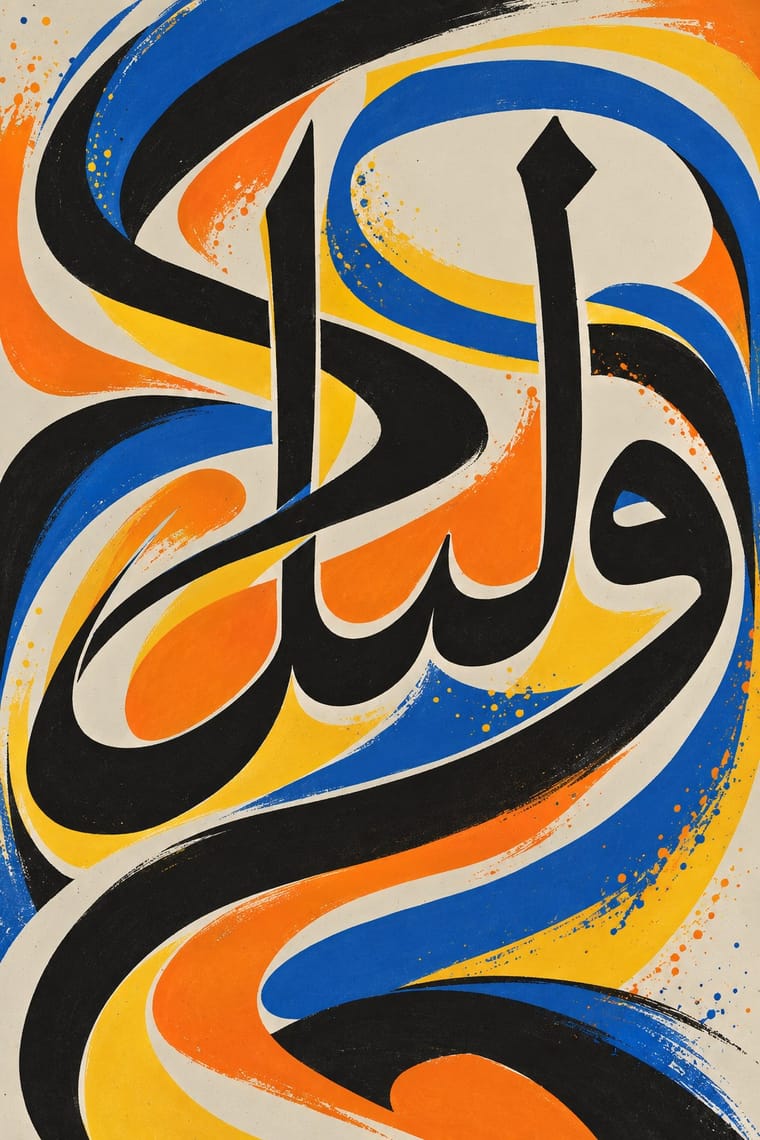
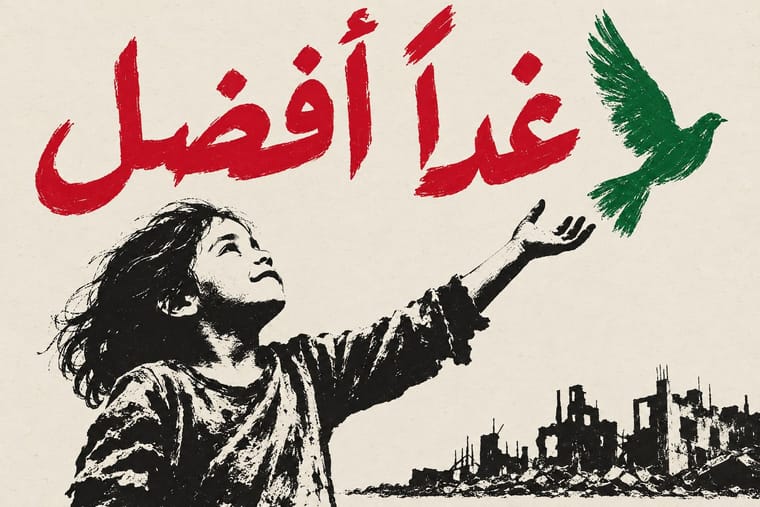
Arabic Calligraffiti × Syrian Revolution Graphics
Scale a brushed slogan from the poster up to a wall with calligraffiti's architectural sweep, keeping the words short and checked by a fluent reader.
Mix them and make something Arabic Calligraffiti Syrian Revolution Graphics
01
What each style brings
Each part of the design comes from the style with the stronger say in it, and each style gives at least two.
Arabic Calligraffiti Syrian Revolution Graphics (Kafranbel Banners & Poster Collectives)
- Type from Syrian Revolution Graphics
- Colour from Syrian Revolution Graphics
- Form from Arabic Calligraffiti
- Composition from Arabic Calligraffiti
- Surface from Arabic Calligraffiti
02
The type
Open fonts standing in for each style’s own type, which is often hand-drawn or commercial.
Display · Syrian Revolution Graphics
Ours
Rakkas, standing in for Freely brushed Arabic calligraphy for one- or two-word slogans, composed for each poster rather than typed in a stock font; one member said he sometimes spent two days designing a single word such as 'freedom' or 'revolution', and that some pieces drew on Persian calligraphy (Al-Safir interview, 2012)
Text · Arabic Calligraffiti
Arabic letters sprayed, rolled and brushed at the scale of buildings. From the early 2000s graffiti writers, many of Arab, Iranian or South Asian background, turned hip-hop wall writing to Arabic script, keeping its outlines and aerosol but dropping Latin tags, bubble letters and cartoon characters. Calligraphic letters freed from the reed-pen rules are stretched, interlaced and stacked into one sweeping gesture across a wall, a tunnel, a minaret or a whole district, spelling a verse, poem or saying chosen for the place, a political comment, or words picked for their shape.
Oswald; Arabic Calligraffiti used Freehand Arabic script sprayed or painted rather than written with a reed pen, after calligraphy but without its rules or a uniform hand and eL Seed's 'Liquid Alphabet'
03
The colours
The ground and leading colours come from Syrian Revolution Graphics, with a counter-accent from Arabic Calligraffiti. The ink reads on the ground at 4.5:1 or more.
Arabic Calligraffiti Syrian Revolution Graphics (Kafranbel Banners & Poster Collectives)
-
#f1ece0ground · 36% -
#151515ink · 14% -
#c8102eaccent · 18% -
#f07f1eaccent · 14% -
#f6c32baccent · 10% -
#007a3daccent · 8%
As CSS
:root {
  --ground: #f1ece0;
  --ink: #151515;
  --accent-1: #c8102e;
  --accent-2: #f07f1e;
  --accent-3: #f6c32b;
  --accent-4: #007a3d;
  --font-display: "Rakkas", cursive;
  --font-text: "Oswald", sans-serif;
}
Use it with care
Arabic Calligraffiti: Many works carry Qur'anic verses, the names of God or devotional sayings, written on mosques and in religious communities: never use such text as texture or put it on floors, footwear or throwaway items, and have every Arabic or Persian word read and approved by a fluent reader before it is painted or printed. The style stretches and interlaces letters, so put a Qur'anic verse or a name of God into it only when a skilled Arabic-script writer composes it and the mosque or community approves it, as at the Jara Mosque; never digitally warp, crop or mirror existing sacred text. Never fill a design with invented pseudo-Arabic, which image models readily produce; do not ask an image model for eL Seed's Liquid Alphabet or any named writer's hand, and never present a generated wall as their work. The best-known walls rest on the consent of governors, imams, priests and residents, so get the owner's permission (spraying without it is a crime in most places), work with the people of the place, and commission and credit Arabic-script writers rather than faking the script for a brand.
Syrian Revolution Graphics (Kafranbel Banners & Poster Collectives): These graphics come from an uprising met with massacres, sieges, detention and disappearance, and their makers worked under pseudonyms at real risk: Raed Fares and Hamoud Junaid were shot dead in Kafranbel on 23 November 2018 (local activists blamed Hayat Tahrir al-Sham, which did not claim it), and the collective signed only with its own name, so never attribute a poster to an individual member or expose anyone who made this work. The martyr, siege, bread and Hama motifs refer to real massacres and real dead, not to an edgy 'war poster' look. The collective's posters were released under Creative Commons BY-NC, so do not use them or close pastiches commercially, and credit the collective, Kafranbel and the Creative Memory archive. The three-star flag has been the state flag since the HTS-dominated caretaker government took it up after Assad's fall, so using it, or Kafranbel's banners, as generic 'Syria' branding can imply an alignment their makers never gave. Have every Arabic line read by a fluent reader, never fill a design with pseudo-Arabic, do not mock the broken English of some banners, which was written to be understood abroad, and never present a generated image as a work of the uprising.
04
The two styles
05
More combinations
With Arabic Calligraffiti
- International Typographic Style Contrasts · A neutral grotesque on a modular grid is the opposite of one sweeping Arabic gesture; put a small Swiss caption block against a calligraffiti wall for a sharp bilingual identity.
- Contemporary Arabic & Dual-Script Type Design Pairs well · Set names, dates and captions in a dual-script type family beside a calligraffiti wall, so the gesture stays the image and the information stays legible.
- Islamic Geometric & Calligraphic Tradition Pairs well · Run a strict geometric band or tiling behind freely written letters, as Zepha sets Arabic script among geometric shapes, so the piece answers its classical source.
- Baybayin Revival Graphics Pairs well · Kabuay applies calligraphy and graffiti methods to baybayin; borrow calligraffiti's large painted gesture for murals, but keep each glyph legible and correctly spelled.
With Syrian Revolution Graphics
- Lebanese Civil War Party Poster Contrasts · Party-branded martyr obituaries with emblems and leaders against irreverent sheets, signed only by a town or a collective, that answer one leader's cult; the contrast shows what a poster without a party looks like.
- Solidarność & Polish Underground Graphics Contrasts · Both made hand-lettered protest banners and cheap copies and answered force with irony, but Solidarność gathered under one logotype and a union, where these sheets were signed only by a town or a collective, bilingual and made for the feed; set them side by side to weigh one shared mark against many local, dated voices.
- Egyptian Revolutionary Street Art (Mohamed Mahmoud Murals) Pairs well · Its 2011 neighbour: Cairo painted martyrs and friezes onto walls, Syria made portable sheets for the camera; put a Syrian-style printable slogan beside a mural photograph to join wall and feed.
- Atelier Populaire (May '68 Screenprint Poster) Pairs well · Both are anonymous collectives that argue out one figure and one punning slogan together; borrow May '68's single flat ink for a Syrian poster that must print cheaply.
- Ukrainian Wartime Graphics (Saint Javelin, War Stamps and Be Brave Like Ukraine) Contrasts · Both were made for the feed in wartime and answer violence with irony, but the Syrian posters came from an unsponsored, pseudonymous collective facing its own regime, while Ukraine's national post and president's office commission and sign theirs; the comparison shows what state backing does to protest graphics.