Traditions & vernacular · c. 960–present · East Asia
Song–Ming Woodblock Book Typography (Songti / Mincho)
Also known as Songti (宋体, Song typeface), Mingti / Minchōtai (明朝体, Ming typeface), Jiangtizi (匠體字, 'craftsman's characters', a literati jibe at the Ming style), Myeongjo / Batang (명조체 / 바탕체), Chinese thread-bound book (xianzhuang) page
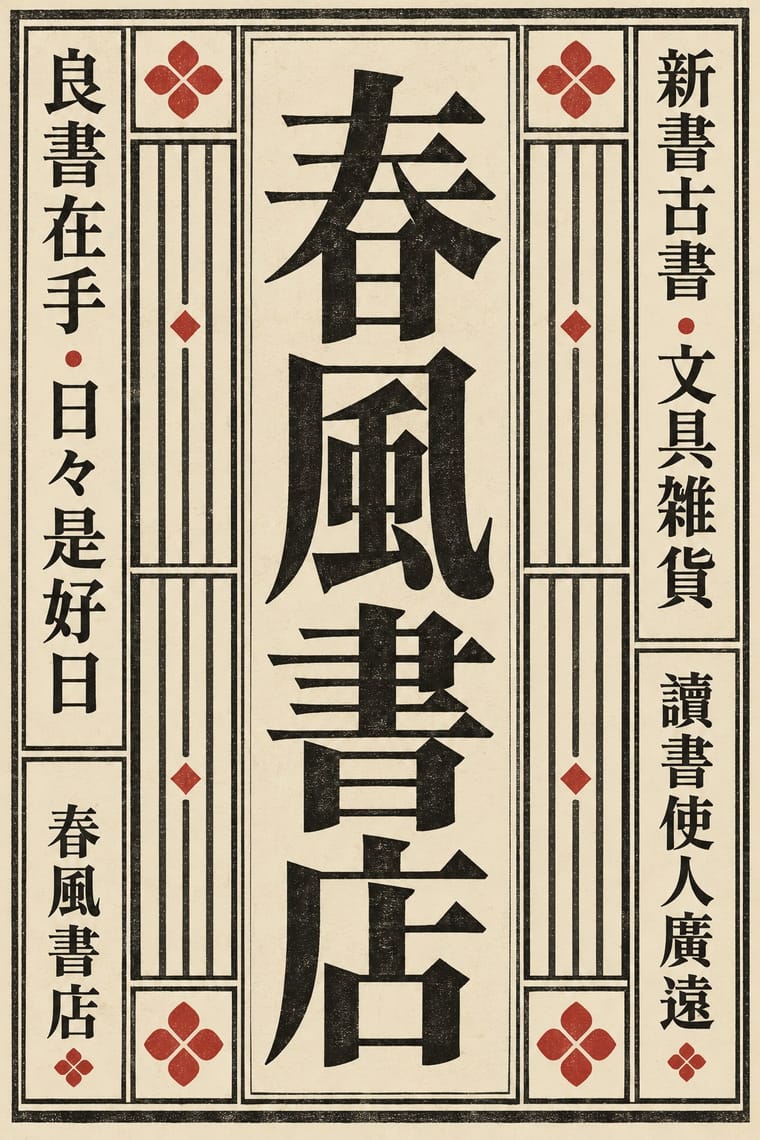
The page and letter of the East Asian book. Song block cutters copied the regular script of Tang masters; from the mid-16th century Ming cutters straightened it into a knife-made letter of thin horizontals, thick verticals and triangular stroke ends. Equal square characters run in right-to-left vertical columns in a ruled frame folded at a central column. As metal type in Shanghai and Nagasaki it became Mincho, Myeongjo and the standard CJK text face. Frame, rules and fold column belong to the woodblock page; type keeps the letter, the square and, in Japan and Taiwan, the vertical column.
Make something in this styleGet advice in this styleMix it with another style
Use it with care
Have any Chinese, Japanese or Korean text set and proofread by a fluent reader: Song, Mincho and Myeongjo fonts draw some characters differently for each locale, and pseudo-characters, mirrored glyphs or random hanzi used as texture read as nonsense or worse. Pages of Buddhist sutras and other scripture carry devotional text; do not crop them into decoration.
01
How it works
- Fit every character, however simple or complex, into the same square cell, and run the cells in vertical columns read from right to left.
- Cut the brush for the knife: keep the regular-script skeleton but make horizontals thin and verticals thick, end horizontals in a small triangle, and cut dots and sweeps to points.
- Enclose the text block in a single or double ruled frame, divide the columns with fine rules, and let a fixed count of columns and characters per column set the page. Print black ink on pale paper: red appears mainly in owners' seals and, from the 1610s, in commentary and punctuation overprinted from separate blocks by Min Qiji and the Ling family of Wuxing.
- Fold each sheet at a central column that carries the title, chapter and leaf number between fish-tail marks, stitch the folded leaves into dark-blue paper covers, and leave a wide upper margin for readers' head-notes.
- Build hierarchy from size and position, not decoration: set commentary in small characters two columns to a line, and keep one face for the body text, while prefaces are sometimes cut from the writer's own hand and title pages may be lettered in seal script.
Song-dynasty block printing in Zhejiang (Lin'an, now Hangzhou), Sichuan and Fujian, where cutters copied the regular script of Tang calligraphers; straightened into the Ming style from the mid-16th century (a 1553 edition of Mozi is an early dated example) and standard by the Wanli era; recast as metal type at the American Presbyterian Mission Press in Shanghai, whose William Gamble taught Motoki Shōzō in Nagasaki in 1869, becoming Japanese Mincho and Korean Myeongjo
02
Its design choices
From Stylogeny’s vocabulary of design choices: defining choices make the style, characteristic ones are usual, occasional ones turn up now and then.
- Layout & composition
- Space & hierarchy
- Typography
- Ornament
- Tone & intent
- Avoids
- Full polychrome, Gradients, Abundant decoration, Diagonal axis, Broken grid, Experimental & distorted, Ornamented display, Visual tension, Grotesque & neo-grotesque
Palette
#f1e9d6#16130f#d6c49c#5b564e#b5342b#2e3d5c
Typefaces
Song block-cut regular script after Ouyang Xun, Yan Zhenqing and Liu Gongquan
Ming-style Songti / Mingti, the straightened 'craftsman's' letter, mature by the Wanli era
Ruanti 'soft-style' regular script (xieke editions), the calligraphic alternative to the Song letter in Qing printing
Juzhen Fangsong imitation-Song type
Ding Fuzhi and Ding Shanzhi, 1915
Tsukiji Mincho and Shūeitai Mincho
DNP Shuei Mincho
Korean Myeongjo / Batang
SimSun and MingLiU
Windows system Song and Ming faces
Source Han Serif / Noto Serif CJK
Known for
Chen Qi's Chen family bookshop (陳宅書籍鋪), Lin'an (Hangzhou), Southern Song
the slender, even regular script later revived as Fangsong
Song regional imprints
Zhejiang editions after Ouyang Xun, Sichuan editions after Yan Zhenqing, Fujian editions after Liu Gongquan
The commercial publishers of Jianyang, Fujian (11th–17th centuries), printing for the retail book market
The 1553 (Jiajing 32) edition of Mozi, an early dated example of the straightened Ming style
Mao Jin's Jiguge (汲古閣), Changshu, late Ming
the Thirteen Classics and Seventeen Histories among more than 600 titles
The Kangxi Dictionary (1716), printed in the Ming style
Joseon woodblocks cut for Confucian academies and clans, mostly scholars' collected works (munjip)
64,226 blocks for 718 titles, inscribed as Confucian Printing Woodblocks in Korea on UNESCO's Memory of the World register in 2015, with the same frame, fold column and fish-tails
Motoki Shōzō's Mincho type, Nagasaki, after William Gamble's 1869 teaching, continued by the Tsukiji Type Foundry
03
Make something in this style
Say what you need, and Stylogeny’s image studio draws it from Song–Ming Woodblock Book Typography (Songti / Mincho)’s design choices and checks it against them. It takes about a minute, and you get a link to share.
04
Where it comes from, and what it’s close to
Before it
The style it grew out of, and the styles it borrowed from.
After it
The styles that grew out of it.
Alike in its design choices
Styles that make many of the same choices, related or not, besides those above.
05
Sources
- https://en.wikipedia.org/wiki/Song_(typeface)
- https://zh.wikipedia.org/wiki/宋体
- https://en.wikipedia.org/wiki/Fangsong
- https://en.wikipedia.org/wiki/Mao_Jin
- https://ko.wikipedia.org/wiki/명조체
- https://www.myfonts.com/fonts/dnp/shueitai/
- Advanced Center for Korean Studies, 'Design of a printing woodblock' (block frame, woodblock centre, fishtails, head notes, rule lines): https://mokpan.ugyo.net/en/overview/design.html
- Ministry of Culture and Tourism of the PRC, 汉文古籍版式描述规范 (The format description for Chinese ancient books), cultural industry standard, 2023: https://zwgk.mct.gov.cn/zfxxgkml/hybz/202309/W020230915558581660492.pdf
- Tsien Tsuen-hsuin, Paper and Printing, Science and Civilisation in China vol. 5 part 1 (Cambridge University Press, 1985)
- Lucille Chia, Printing for Profit: The Commercial Publishers of Jianyang, Fujian (11th–17th Centuries) (Harvard University Asia Center, 2002)
- Joseph P. McDermott, A Social History of the Chinese Book (Hong Kong University Press, 2006)
- Hsu Che-ying (許哲瑛), 古書中的推薦文─以南宋魏了翁雕版書法為中心 (prefaces and colophons cut from the writer's own hand), National Palace Museum Research Quarterly 35:3 (2018): https://www.npm.edu.tw/NewChineseArtDownload.ashx?bid=3914
- Huang Shang (黃裳), 清刻之美 (Qing editions as written-and-cut versus Song-character editions), Dushu 1985 no. 3: https://www.aisixiang.com/data/105695.html
- UBC Library Chinese Rare Books, 尚書古文疏證 (1745, recut 1867): inner title page in seal script, framed half-leaf, single black fish-tail, red collectors' seals: https://open.library.ubc.ca/collections/chineserare/items/1.0365843
- https://zh.wikipedia.org/wiki/閔齊伋
- Grolier Club, Min Qiji's Chunqiu Gongyang zhuan (1621), multi-block colour printing for punctuation and notes: https://grolierclub.omeka.net/items/show/2755
- USC Libraries, Chinese Rare Books, two-colour (zhumo taoyin) editions of 1616 and c.1620: https://scalar.usc.edu/works/chinese-rare-books/two-color.28
- Centre for the Study of Manuscript Cultures, Hamburg, on Chinese collectors' red seals: https://www.csmc.uni-hamburg.de/publications/aom/mom/15-en.html
- https://zh.wikipedia.org/wiki/中式装帧
- https://en.wikipedia.org/wiki/Horizontal_and_vertical_writing_in_East_Asian_scripts
- Advanced Center for Korean Studies, 'History of Korean printing woodblocks': https://mokpan.ugyo.net/en/overview/history.html
- Korea JoongAng Daily on the Confucian Printing Woodblocks in Korea (UNESCO Memory of the World, 2015): https://www.koreajoongangdaily.com/lifestyle/joseon-era-woodblocks-used-to-print-major-literary-collections-are-set-to-return-home/12147759
How Stylogeny researches and checks a style: where the facts come from.