Traditions & vernacular · 1822–1956 · Middle East & North Africa
Bulaq (Amiriyya) Naskh Book Printing
Also known as Bulaq Press style, Matbaʿat Bulaq, al-Matbaʿa al-Amiriyya (Amiriya Press) Naskh, Egyptian state press printing
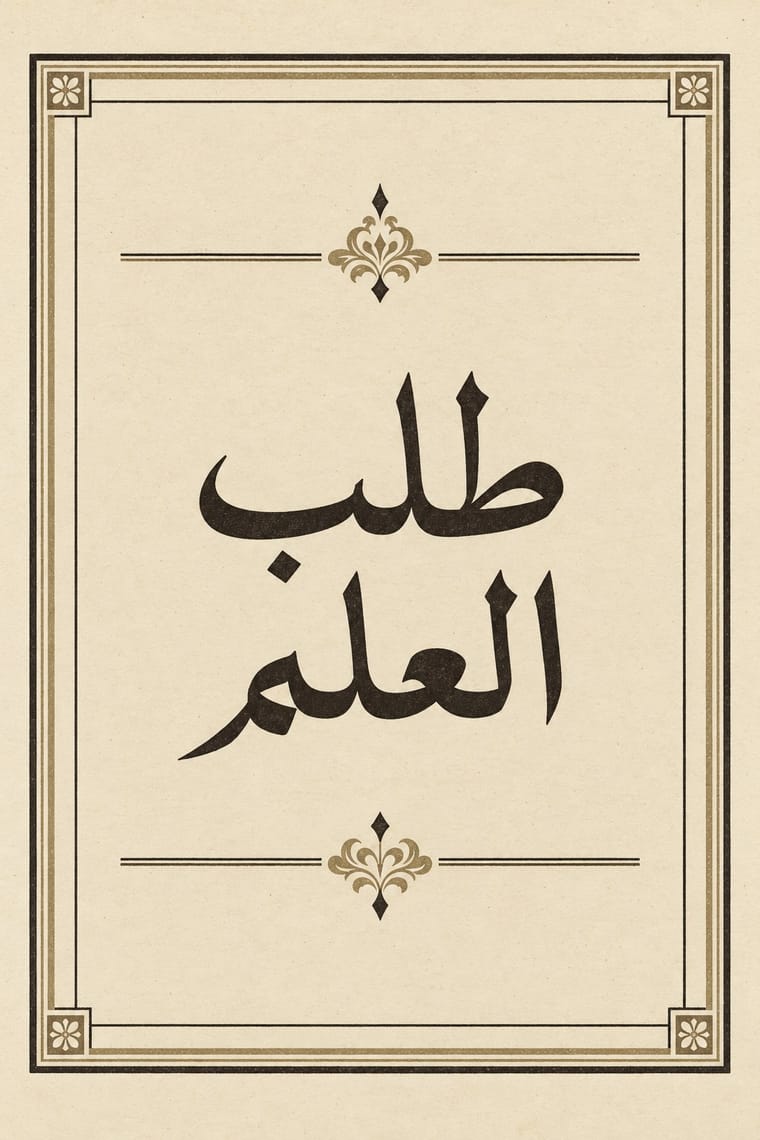
The page of the Arabic printed book as Egypt's state press at Bulaq shaped it from 1822: justified blocks of black Naskh type on pale paper, often boxed in a ruled frame, with an ornamental headpiece on the opening page, headings set larger or in a second script such as Nastaʿlīq, and almost no pictures. It printed army manuals, laws, textbooks, translated science, the Arabic classics and the official gazette. Calligraphers drew its later types, Mirza Sanglakh and then Muhammad Jaʿfar, whose 1905–06 body type was the basis of the 1924 Qur'an and lives on as Khaled Hosny's Amiri.
Make something in this styleGet advice in this styleMix it with another style
Use it with care
The press also set the Qur'an (the 1924 Cairo edition) and hadith collections such as the Sultaniyya Sahih al-Bukhari, and Bulaq-style Naskh and Amiri are still used for Qur'anic and religious text, so never crop, mirror or distort Qur'anic verses or the names of God and the Prophet, use them as texture, or put them on floors, footwear or throwaway packaging. Set Arabic right to left with correct contextual shaping, have every word read by a fluent reader, never fill a layout with pseudo-Arabic, and never present a generated page as a historical Bulaq imprint.
01
How it works
- Draw the text type from a calligrapher's hand, Mirza Sanglakh's in the 19th century and Muhammad Jaʿfar's in 1905–06, and keep the proportions and joins of written Naskh, adding alternate letter forms where they make the line read as written, while accepting the limits of setting by hand from a case of a few hundred sorts (406 in Jaʿfar's type).
- Justify the text into one central block and often box it in a ruled frame, single or double, like the jadwal round the text of a manuscript, with the page number set outside the frame; centre titles and headings on the same axis. Later title pages, such as those of 1883, 1893 and 1914, stand unframed: a centred block of title and author with the press imprint at the foot.
- Mark titles and headings by size and script rather than colour or pictures: a larger Naskh or a Thuluth-like display hand for titles and chapter heads, centred or run into the text and often set off in parentheses or a ruled band, and at times a second script, such as the Nastaʿlīq headings of the 1835 Thousand and One Nights.
- Print black ink on pale paper by letterpress, and limit decoration to rules and a headpiece over the title and basmala on the opening page, an arch or stepped pyramid built of printer's flowers or a scrolled cartouche; keep woodcut or engraved title decoration for showpieces such as the Thousand and One Nights.
- In editions of the classics, set a second text beside the main one and rule it apart: the Sultaniyya Sahih al-Bukhari of the 1890s runs numbered variant readings in a narrow column outside the frame, keyed to small numerals in the fully vowelled text.
- Give the gazette, the law, the textbook, translated science and the Arabic classic the same sober, uniform state edition, and keep lithography, used for the handwritten Jurnal al-Khidiw of 1821–22, as a side practice.
Bulaq, Cairo: Muhammad Ali Pasha sent a mission to Milan in 1815 to learn printing and type-founding; the state press was established in 1820, opened in 1821 and printed its first book, an Italian–Arabic dictionary (Dizionario italiano e arabo) with an Italian title page in centred capitals, in 1822. Its first Naskh types, in three sizes for titles, text and notes, did not follow the rules and look of written Naskh. Muhammad Ali had the Persian calligrapher Mirza Sanglakh design a Naskh and a Nastaʿlīq type for the press (the first book in Nastaʿlīq type was the Persian Golestan of 1833–34), and in 1905–06 the calligrapher Muhammad Jaʿfar Bey made the Naskh body type that became the basis of the 1924 Qur'an. Law 312 of 1956 turned the press into the Amiria Press Authority (the end date is approximate: its type stayed in use).
02
Its design choices
From Stylogeny’s vocabulary of design choices: defining choices make the style, characteristic ones are usual, occasional ones turn up now and then.
- Layout & composition
- Space & hierarchy
- Form & shape
- Surface & texture
- Ornament
- Medium & production
- Tone & intent
- Avoids
- Dynamic asymmetry, Flush left, ragged right, Experimental & distorted, Grotesque & neo-grotesque, Full polychrome, Abundant decoration, Visual tension, Rotated & vertical setting, Modular grid
Palette
#efe6cf#171411#5c544a#cdbb93#7a5236
Typefaces
Bulaq (Amiriyya) Naskh body type, 1905–06, drawn by the calligrapher Muhammad Jaʿfar Bey
sources give 1905 or 1906; 406 sorts
Bulaq Naskh and Nastaʿlīq types by the Persian calligrapher Mirza Sanglakh, made for Muhammad Ali's press
first Nastaʿlīq book: the Persian Golestan, 1833–34
Amiri (Khaled Hosny, Alif Type, SIL Open Font License; regular, bold, slanted and bold slanted), the digital revival of the 1905 type
Naskh calligraphy, the hand the text types follow
Known for
Italian–Arabic dictionary (Dizionario italiano e arabo) by the Syrian priest Anton Zakhur Rafa'il (Rufa'il Zakhur), Bulaq, 1822, the press's first book, with an Italian title page reading 'Bolacco, dalla Stamperia Reale'
Hawashi al-Sayyed Ali al-Motawwal (glosses on Arabic rhetoric), 1241 AH / 1826
the opening text boxed in a double rule under a scrolled cartouche headpiece
al-Waqa'i' al-Misriyya, the official gazette, first issued on 3 December 1828 in about 600 copies
Kitab Alf Layla wa-Layla (the 'Bulaq I' Thousand and One Nights), two volumes, 1835, edited by 'Abd al-Rahman al-Safti al-Sharqawi: Naskh text, Nastaʿlīq headings, a double border round the text of every page and woodcut decoration on the first page
Diya' al-Nayyirayn fi Mudawat al-'Aynayn, a book on ophthalmology, 1256 AH (1840–41)
framed text under an arched headpiece of printer's flowers
Kashf al-Sirr al-Masun fi Tatbiq al-Handasa 'ala al-Funun by Muhammad al-Halawani, Bulaq, 1268 AH / 1851: a stepped headpiece of printer's flowers over the basmala, a double-ruled frame and headings in parentheses
Ibn Manzur, Lisan al-'Arab, 20 volumes, al-Matbaʿa al-Kubra al-Amiriyya, Bulaq, 1883–1890
The Sultaniyya Sahih al-Bukhari, al-Amiriyya press, Bulaq, from 1311 AH (1893), on al-Yunini's copy
vowelled Naskh in a double-ruled frame with numbered variant readings in the outer margin
03
Make something in this style
Say what you need, and Stylogeny’s image studio draws it from Bulaq (Amiriyya) Naskh Book Printing’s design choices and checks it against them. It takes about a minute, and you get a link to share.
04
Where it comes from, and what it’s close to
Before it
The style it grew out of, and the styles it borrowed from.


Alike in its design choices
Styles that make many of the same choices, related or not, besides those above.
- Urdu Katib Lithography74% alike
- Maghrebi Script (Maghribi Calligraphy of al-Andalus and North Africa)66% alike
- German Book Art Movement (Buchkunstbewegung)60% alike


05
Sources
- Wikipedia, 'Bulaq Press' (https://en.wikipedia.org/wiki/Bulaq_Press)
- Ahmed Mansour and Mohamed Hassan, 'Digitizing historical Arabic typography: Bulaq Press contributions', Égypte/Monde arabe (EMA) 22 (2020) (https://journals.openedition.org/ema/13151)
- Khaled Hosny, 'The Amiri typeface', TUGboat 33:1 (2012), p. 12 (https://tug.org/TUGboat/tb33-1/tb103hosny.pdf)
- Alif Type, 'Amiri' (https://aliftype.com/amiri)
- Wikipedia, 'Amiri (typeface)' (https://en.wikipedia.org/wiki/Amiri_(typeface))
- People's Graphic Design Archive, 'Bulaq Press Quranic font CD' (https://peoplesgdarchive.org/item/17121/bulaq-press-quranic-font-cd)
- Wikipedia (German), 'Bulaq I' (https://de.wikipedia.org/wiki/Bulaq_I)
- Wikipedia, '1924 Cairo Quran' (https://en.wikipedia.org/wiki/1924_Cairo_Quran)
- Wikipedia, 'Lisan al-Arab' (https://en.wikipedia.org/wiki/Lisan_al-Arab)
- Bibliotheca Alexandrina, Bulaq Press gallery, captioned scans of Bulaq imprints: the 1822 dictionary (https://www.bibalex.org/BulaqPress/En/Gallery/pages/bulaq45.htm), 1826 (…/bulaq48.htm), 1840–41 (…/bulaq59.htm), 1851 (…/bulaq65.htm), 1864 (…/bulaq50.htm), 1862 Nights title frame (…/bulaq56.htm), 1881 laws (…/bulaq66.htm) and the title pages of 1883, 1893 and 1914 (…/bulaq49.htm, …/bulaq52.htm, …/bulaq67.htm)
- Wikisource (Arabic), scan of the Sultaniyya Sahih al-Bukhari, vol. 1, al-Amiriyya, Bulaq, 1311–1312 AH (https://ar.wikisource.org/wiki/ملف:السلطانية1.pdf)
- Reed College, 'Persian Calligraphy', definition of jadval, the ruled lines round the text (https://reed.edu/persian-calligraphy/en/jafar-baysonghori/1/index.html)
How Stylogeny researches and checks a style: where the facts come from.