Traditions & vernacular · c. 1100–present · East Asia
Kamon (Japanese Family Crests)
Also known as Mon (紋), Kamon (家紋), Japanese heraldry, Montsuki crests
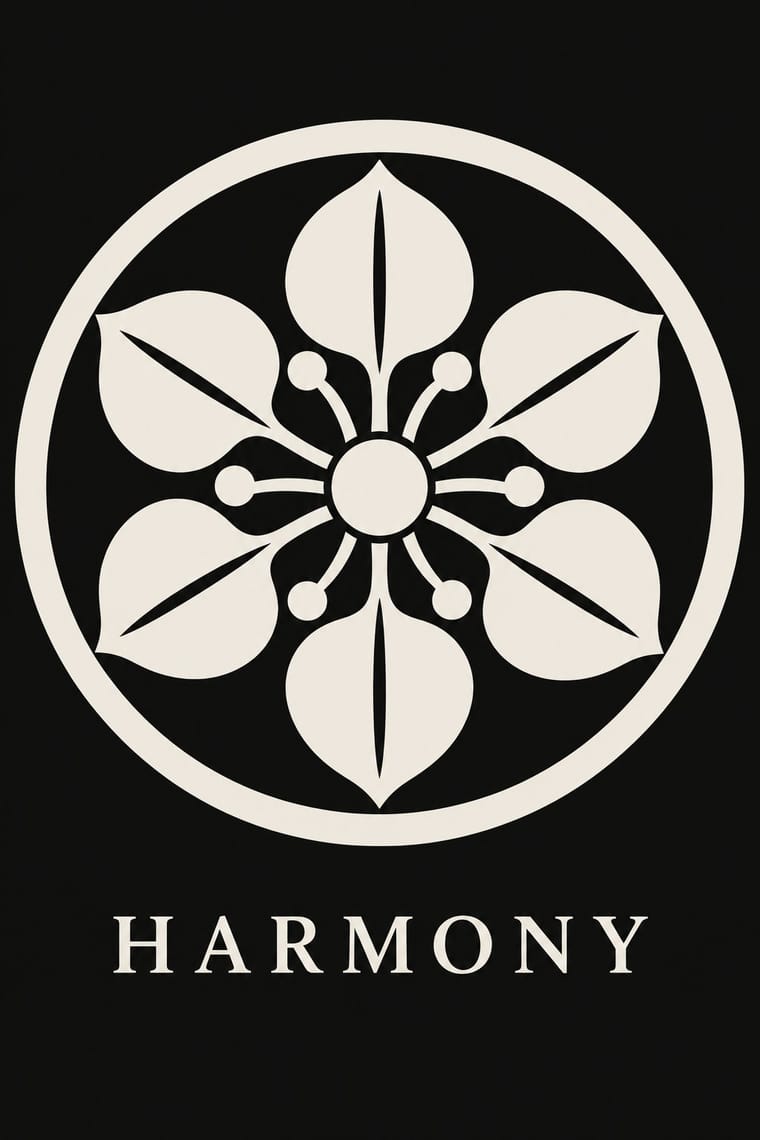
Japan's family crests: small one-colour emblems that reduce a plant, animal, tool or pattern to a flat silhouette, mirrored or repeated around a centre, often ringed and drawn with compass and brush. Begun on Heian court carriages and spread to samurai and all of society, mon are usually inherited, granted or freely chosen rather than designed, varied in small codified ways for branch families, and placed in fixed positions on formal kimono, shop curtains, lacquer and banners. Covers the formal crest (jōmon), not the decorative coloured kaga-mon or pictorial date-mon and share-mon.
Make something in this styleGet advice in this styleMix it with another style
Use it with care
Mon are inherited marks of particular families, shrines, temples and institutions. Only the imperial chrysanthemum is named in Japanese law: the Trademark Act (art. 4(1)(i)) bars registering it or anything like it. The government's paulownia, though the official emblem of the Prime Minister and Cabinet, was never given the same legal restrictions, while famous crests registered as trademarks, such as Mitsubishi's three diamonds, are protected as marks. Do not use the chrysanthemum, the government paulownia, or any identifiable family's, shrine's or temple's crest as decoration or as a brand. Imperial emblems can also recall Japan's wartime empire for audiences in Korea and China. The manji (卍), a standard crest (the Hachisuka clan; the temple crest of Sensō-ji), is read in the West as the Nazi swastika: avoid it outside a Japanese context that explains it. Draw new crests by the tradition's rules instead of borrowing real ones, and commission or credit working monsho uwaeshi, who still draw and paint crests by hand.
01
How it works
- Reduce the motif, whether a leaf, flower, bird, wave, tool or pattern, to one flat silhouette without shading, perspective or texture, and build every curve from compass arcs and straight lines.
- Organise the emblem around its centre: mirror it, or repeat it three, five or sixteen times around the middle, and close it in a ring, lozenge or tortoise-shell hexagon when it needs a boundary.
- Keep the formal crest to one colour so that it survives dyeing, painting, carving and printing alike: reserve it solid in white on a dark ground for formal use (hinata), or draw it in outline (kage) or dark on a light ground for lesser occasions.
- Mark kinship by small codified variations of the senior family's crest (an added ring, a changed number of leaves or petals, an inverted or outlined version) instead of drawing a new emblem.
- Place the crest small and alone in fixed positions, one, three or five on a formal kimono and centred on a curtain, box lid or banner, and let the plain ground around it carry the dignity.
Late Heian Kyoto, where court nobles put their own emblems on their ox-carts (gissha); samurai took mon onto banners, field curtains and clothing, Muromachi merchants onto shop signs, and by the Genroku era (1688–1704) mon were in general use across Japanese society
02
Its design choices
From Stylogeny’s vocabulary of design choices: defining choices make the style, characteristic ones are usual, occasional ones turn up now and then.
- Layout & composition
- Space & hierarchy
- Colour
- Form & shape
- Surface & texture
- Ornament
- Medium & production
- Tone & intent
- Avoids
- Full polychrome, Gradients, Illusion of depth, Naturalistic depiction, Dynamic asymmetry, Painterly brushwork, Straight photography, Abundant decoration
Palette
#121212#f3efe6#1d2b47#b38f3d#8c2d25
Typefaces
Kago-moji, the thick, squared Edo lettering often reversed out in white, for names set beside a crest
Brush-written kaisho (regular-script) kanji for shop names and family names on curtains and lanterns
Mincho (Japanese serif) for crest names and captions in modern printed crest books and catalogues
Known for
Imperial chrysanthemum (kikumon)
a central disc with sixteen front petals and a half-staggered rear row, reserved to the Emperor in the Meiji period, while a single-row sixteen-petal version is on the cover of Japanese passports
Go-shichi no kiri (5-7-5 paulownia)
first a private imperial symbol, then a Toyotomi crest, now the emblem of the Prime Minister, the Cabinet and the Government of Japan
Tokugawa mitsuba aoi (three hollyhock leaves in a ring), barred from general use together with the imperial chrysanthemum
Heiji monogatari emaki (13th century), whose scenes of the Heiji rebellion of 1160 show crests painted on ox-carts
Edo-period bukan, annual directories of daimyo and shogunal officials listing each house's crest
spear marks and banners, settled in form with the Shōhō bukan of 1647 and from the middle of the period published almost exclusively by Suharaya Mohei, against rival editions by the shogunate's official bookseller Izumoji Izuminojō
Man's rinzu silk kimono with three resisted Nabeshima crests across the back shoulders and no other decoration, Kyoto, 1760–1810
V&A, FE.201-2018
Wedding-trousseau letter box decorated in gold lacquer on a nashiji ground with poem cards tied to cherry and plum branches, a crest of six barrels and scattered ginkgo and barrel crests, 1750–1800 (V&A, CIRC.549-1916)
Tsutsugaki futon cover with a flowering plum tree and, at the top, a large omodaka (arrowhead) crest in a ring, Katanose, Fukuoka, 1800–1900 (V&A, T.332-1960)
03
Make something in this style
Say what you need, and Stylogeny’s image studio draws it from Kamon (Japanese Family Crests)’s design choices and checks it against them. It takes about a minute, and you get a link to share.
04
Where it comes from, and what it’s close to
Before it
The style it grew out of, and the styles it borrowed from.
Nothing earlier is recorded: in the atlas it is a starting point.

After it
The styles that grew out of it.
No later style in the atlas grew out of it yet.
Alike in its design choices
Styles that make many of the same choices, related or not, besides those above.


05
Sources
- Wikipedia, 'Mon (emblem)' (https://en.wikipedia.org/wiki/Mon_(emblem))
- Wikipedia (Japanese), '家紋' (https://ja.wikipedia.org/wiki/家紋)
- Wikipedia (Japanese), '紋付' (https://ja.wikipedia.org/wiki/紋付)
- Kotobank, '加賀紋' (Digital Daijisen; Seisenban Nihon kokugo daijiten; Heibonsha Sekai daihyakka jiten, s.v. 紋付) (https://kotobank.jp/word/加賀紋-457951)
- Wikipedia (Japanese), '武鑑' (https://ja.wikipedia.org/wiki/武鑑)
- Wikipedia, 'Imperial Seal of Japan' (https://en.wikipedia.org/wiki/Imperial_Seal_of_Japan)
- Wikipedia, 'Government Seal of Japan' (https://en.wikipedia.org/wiki/Government_Seal_of_Japan)
- Wikipedia, 'Swastika' (https://en.wikipedia.org/wiki/Swastika)
- Wikipedia, 'Edomoji' (https://en.wikipedia.org/wiki/Edomoji)
- Mitsubishi, 'The Three-Diamond Mark' (https://www.mitsubishi.com/en/profile/group/mark/)
- Tokyo Metropolitan Government, Tokyo Updates, 'The Art of Kamon' (https://www.tokyoupdates.metro.tokyo.lg.jp/en/post-293/)
- Victoria and Albert Museum, man's kimono with Nabeshima crests, FE.201-2018 (https://collections.vam.ac.uk/item/O1433369/)
- Victoria and Albert Museum, letter box with mon in gold lacquer, CIRC.549-1916 (https://collections.vam.ac.uk/item/O487734/)
- Victoria and Albert Museum, tsutsugaki futon cover with omodaka mon, T.332-1960 (https://collections.vam.ac.uk/item/O24600/)
- John W. Dower, The Elements of Japanese Design: A Handbook of Family Crests, Heraldry & Symbolism (Walker/Weatherhill, 1971)
- Wikipedia: 'Louis Vuitton' (the Monogram canvas drew on Japanese mon during the vogue for Japonisme)
How Stylogeny researches and checks a style: where the facts come from.