Pictorial & machine age · 1946–1989 · Latin America & Caribbean
Puerto Rican Silkscreen Poster (DIVEDCO & ICP)
Also known as Cartel puertorriqueño, DIVEDCO posters, Puerto Rican poster school
The hand-pulled silkscreen poster of Puerto Rico, begun by Irene Delano's workshop in 1946–47 and grown in the government's Division of Community Education (DIVEDCO, 1949) and the Instituto de Cultura Puertorriqueña's print workshop under Lorenzo Homar (1957–73). DIVEDCO film posters set one carved-line figure from rural life on bare paper above a band for the screening's place and time; posters for the Instituto's theatre festivals, ballet and exhibitions, and for independent galleries and jazz, fuse hand-drawn lettering with the image in flat, saturated inks.
Make something in this styleGet advice in this styleMix it with another style
Use it with care
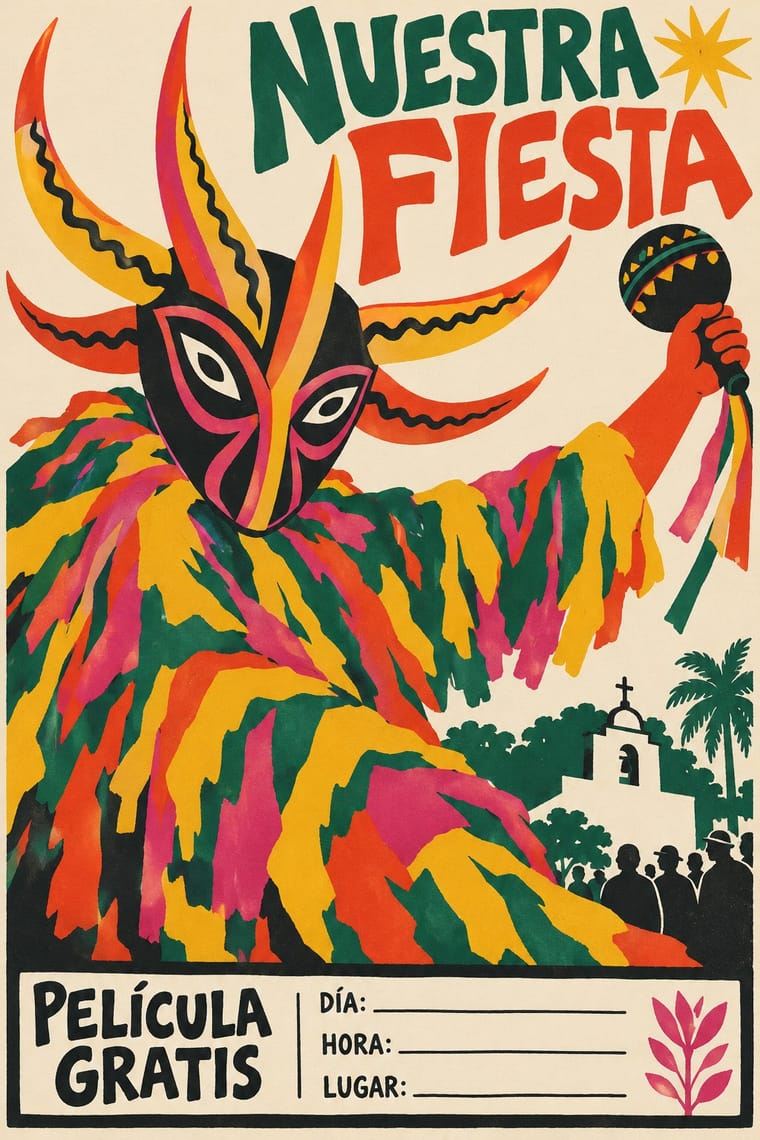
The posters drew on living Puerto Rican traditions, among them the vejigante masks of the Afro-Puerto Rican fiestas de Santiago Apóstol in Loíza and the carved santos of household devotion, and many were public-education posters of the Muñoz Marín government; give these motifs their community and devotional context rather than using them as generic 'tropical' decoration, do not pass pastiches off as DIVEDCO or Instituto originals, and credit or commission Puerto Rican printmakers rather than lifting the look. The Instituto was founded in 1955 amid nationalist sentiment to foster a Puerto Rican identity distinct from that of the United States, and its Spanish hand lettering has been read as a passive resistance to US cultural influence, while DIVEDCO was a product of the governing Popular Democratic Party and its films, which these posters announced, often read as propaganda for it; keep the Spanish and the island subjects, and do not re-letter the look in English for US brands or reduce it to generic 'Latin' flavour.
01
How it works
- Print by hand in silkscreen in a public workshop, one flat opaque ink per stencil, in runs that in the early years were usually limited to 2,000; let the artist who drew the poster pull it too.
- For a community film, give the sheet to one large figure from island life (a mother carrying her child, a boy before Loíza's vejigante masks), drawn with a printmaker's gouged or engraved line on bare paper.
- Reserve a band at the foot with blanks for the screening ('Véala en / Día / Hora') to be filled in by hand in each barrio, and say that it is free ('Gratis').
- Draw the lettering yourself, in Spanish, and make it the picture: a signature becomes the title, an initial becomes a cross, words fill a profile or stack into a whole figure.
- Shape the letters to the event (dancing for ballet, loose and brushed for jazz, brush calligraphy set inside the stage frames of the theatre festival) instead of setting one house typeface.
- Set a few saturated inks, often neighbours on the wheel (vermilion, pink and violet; yellow, orange and red), with a green or grey foil, against black, brown, cream or bare-paper grounds, and let flat fields carry the whole image.
San Juan, Puerto Rico: the silkscreen workshop Irene Delano organised for the Comisión de Parques y Recreo Público (Taller de Cinema y Gráfica, 1946–47), absorbed in 1949 into the Taller de Gráfica of the government's División de Educación de la Comunidad (DIVEDCO, created by law under Governor Luis Muñoz Marín and run until 1989); the Centro de Arte Puertorriqueño (1950); and from 1957 the Taller de Gráfica of the Instituto de Cultura Puertorriqueña under Lorenzo Homar (to 1973), with independent workshops such as Antonio Martorell's Taller Alacrán from the 1960s
02
Its design choices
From Stylogeny’s vocabulary of design choices: defining choices make the style, characteristic ones are usual, occasional ones turn up now and then.
- Layout & composition
- Space & hierarchy
- Typography
- Colour
- Form & shape
- Medium & production
- Tone & intent
- Avoids
- Straight photography, Photomontage, Gradients, Modular grid, Gloss & highlights, Luxurious & glamorous
Palette
#efe8d8#1b1a19#e2472c#f1bf2e#d6427e#1f6a55
Typefaces
Lorenzo Homar's brush-and-pen calligraphy, drawn for each poster and printed as a screen stencil
flowing lower case and swash capitals for festival and exhibition titles, and letters stacked, stepped or bent to build a figure or fill a portrait
Artists' signatures used as titles (Homar's 'Tufiño', 1956) and hand-drawn roman capitals for names and venues
Carlos Raquel Rivera's 'Rafael Tufiño' poster for the Instituto
Bold sans and slab-like display capitals cut for DIVEDCO film titles ('DOÑA JULIA', 'NENEN DE LA RUTA MORA'), with small sans capitals for the credit line 'Película hecha en Puerto Rico por la División de Educación de la Comunidad'
Stencils cut by workshop hands as well as the designers
the Met credits one Torres Martinó poster as 'Cut by José R. Alicea'
Known for
Juan Díaz, poster for the DIVEDCO film 'Doña Julia'
(silkscreen, 1952; Metropolitan Museum 62.555.62; Museo de Historia, Antropología y Arte, UPR, 3.2008.0707.1): a woman walking away with her daughter in her arms, cut in linocut-like line on bare paper, the red title touching her skirt, and a band below with blanks for place, day and time
Carlos Raquel Rivera, poster for the DIVEDCO film 'Nenén de la Ruta Mora'
(silkscreen; dated 1955 by the Met, 62.555.36, and 1956 by the UPR museum, 3.2008.1951.2; reproduced in the International Poster Annual 1956/57, no. 332): vejigante masks of the Santiago Apóstol fiestas of Loíza in flat yellow, red, orange, grey and black, a small boy with a brush, and 'Véala en / Día / Hora / Gratis' at the foot
Lorenzo Homar, poster for the DIVEDCO film 'Modesta' (1956; UPR museum 3.2008.3172), the offset case
the UPR museum records it as printed in offset, not silkscreen, so it stands here for the occasional offset sheet (medium.offset 0.3), not for the screen: a pensive peasant woman in pen line beside a door, a red hand-drawn title touching her hair
Lorenzo Homar, 'Tufiño' (exhibition poster, silkscreen, 1956; UPR museum 3.2008.0838.2; International Poster Annual 1956/57, no. 334)
Rafael Tufiño's signature as the title above a hand holding engraving gouges
Carlos Raquel Rivera, poster for Rafael Tufiño's exhibition at the Instituto de Cultura Puertorriqueña
(silkscreen; exhibition 13 February to 8 March 1958 per the UPR museum, 3.2008.1956.1; dated 1959 by the Met, 62.555.39, gift of Lorenzo Homar, 1962): the T of Tufiño drawn as a cross with a stylised Christ, a black angel breaking a chain, yellow on green
Carlos Raquel Rivera, poster for the 20th anniversary of the Taller de Gráfica Popular, Mexico
(silkscreen, 1957 per the Met, 62.555.34; the UPR museum dates its copy 1952, 3.2008.1949): the letters T, G and P stacked vertically on a grey ground and standing on a woodblock with three gravers, Father Miguel Hidalgo with a torch in the curve of the G, scenes of Mexico's revolutionary history inside the letters, and a greeting signed by twelve Puerto Rican artists at the foot
Lorenzo Homar, season posters for the Instituto's Festival de Teatro Puertorriqueño at the Teatro Tapia
(he designed eleven of them, from 1958 to 1967 and in 1969, per the UPR museum), e.g. the '6to. Festival' (silkscreen, 1963; UPR museum 3.2008.0882.2): comedy and tragedy masks inside concentric pink and violet stage frames on black, the title in brush calligraphy
Rafael Tufiño, posters for the DIVEDCO film 'El Cacique'
(silkscreen; 1959 per the Met, 62.555.20 and 62.555.28, and 1960 per the UPR museum, 3.2008.2318.1): a man seen from behind fills most of the sheet, hands in his pockets, listening to two men talking at a meeting, in only white, black and brown, the title printed across his legs and the place, day and time left to fill in at the foot
03
Make something in this style
Say what you need, and Stylogeny’s image studio draws it from Puerto Rican Silkscreen Poster (DIVEDCO & ICP)’s design choices and checks it against them. It takes about a minute, and you get a link to share.
04
Where it comes from, and what it’s close to
Before it
The style it grew out of, and the styles it borrowed from.


After it
The styles that grew out of it.
No later style in the atlas grew out of it yet.
Alike in its design choices
Styles that make many of the same choices, related or not, besides those above.


05
Sources
- Samuel Dorsky Museum of Art, SUNY New Paltz, 'Puerto Rican Silkscreen Posters: The Historical Context', https://www.newpaltz.edu/museum/exhibitions/puertoricanposters/historicalcontext.html (1946 Taller de Cinema y Gráfica of the Comisión de Parques y Recreo Público, charged with raising awareness of 'health and sanitation, politics, and social relations'; the silkscreen poster used for artistic expression 'as well as for persuasion'; Irene Delano chose silkscreen as the cheapest method; posters printed by hand, often by their designers, with large simple images in flat colours; absorbed into the División de Educación in 1949; the Instituto de Cultura Puertorriqueña founded in 1955 'as a result of the independence movement and the strong nationalist sentiments that it generated', to foster an identity 'as opposed to one derivative of the United States'; Homar directed the División's workshop 1952–57 and the Instituto's 1957–73; Taller Alacrán; government support dwindled, and the essay dates the closing 'of the Instituto de Cultura' (in effect its workshop, since the Instituto itself continues) to 1986 and of the División's Taller de Gráfica to 1989)
- Samuel Dorsky Museum of Art, Lorenzo Homar, '1er Festival de Teatro de Ponce', 1967, https://www.newpaltz.edu/museum/exhibitions/puertoricanposters/WebPage-Info.00006.html, and Rafael Tufiño, 'Felicidades', 1976, https://www.newpaltz.edu/museum/exhibitions/puertoricanposters/WebPage-Info.00033.html (Homar and Tufiño biographies: CAP co-founded 1950; Tufiño studied at the Academia de San Carlos, Mexico City, and worked with the Instituto's workshop from 1957)
- The Metropolitan Museum of Art, Drawings and Prints, Puerto Rican posters given by Lorenzo Homar in 1962 (62.555 and 62.593 series), e.g. Carlos Raquel Rivera, poster for a Rafael Tufiño exhibition at the Instituto de Cultura, 1959, 62.555.39, https://www.metmuseum.org/art/collection/search/936136; Juan Díaz, 'Doña Julia', 1952, 62.555.62, https://www.metmuseum.org/art/collection/search/936320; Rivera, 'Nenén de la Ruta Mora', 1955, 62.555.36, https://www.metmuseum.org/art/collection/search/936345; Rivera, 20th anniversary of the Taller de Gráfica Popular, 1957, 62.555.34, https://www.metmuseum.org/art/collection/search/936344; Tufiño, 'El Cacique', 1959, 62.555.20, https://www.metmuseum.org/art/collection/search/936257; Eduardo Vera Cortés, 'La Carreta', 1961, 62.555.45, https://www.metmuseum.org/art/collection/search/978978; José Antonio Torres Martinó, Galería Campeche poster, ca. 1960, 'Cut by José R. Alicea', 62.593.16, https://www.metmuseum.org/art/collection/search/936356; Homar, fourth Festival de Teatro Puertorriqueño, 1961, printed by the Taller de Gráfica, Instituto de Cultura Puertorriqueña, 62.555.16, https://www.metmuseum.org/art/collection/search/936282
- Museo de Historia, Antropología y Arte, Universidad de Puerto Rico, Río Piedras, poster collection: 'Doña Julia', https://museocoleccion.uprrp.edu/objects/168/dona-julia (DIVEDCO created by law in 1949 under Muñoz Marín, in operation until 1989); 'Nenén de la ruta mora', https://museocoleccion.uprrp.edu/objects/1580/nenen-de-la-ruta-mora; 'Modesta', https://museocoleccion.uprrp.edu/objects/3130/modesta; 'Tufiño', https://museocoleccion.uprrp.edu/objects/642/tufino; Rivera's Tufiño exhibition poster, https://museocoleccion.uprrp.edu/objects/1568; '6to. Festival de Teatro Puertorriqueño', https://museocoleccion.uprrp.edu/objects/712/6to-festival-de-teatro-puertorriqueno; 'The San Juan Jazz Workshop' (performance in the Darlington building penthouse, Río Piedras), https://museocoleccion.uprrp.edu/objects/3020/the-san-juan-jazz-workshop; '2 exposiciones Domingo García', https://museocoleccion.uprrp.edu/objects/3176/2-exposiciones-domingo-garcia; 'Exposición de Alberto Peri', https://museocoleccion.uprrp.edu/objects/791/exposicion-de-alberto-peri; '20 Aniversario TGP', https://museocoleccion.uprrp.edu/objects/1558/20-aniversario-tgp; 'El Cacique', https://museocoleccion.uprrp.edu/objects/1914/el-cacique; Vera Cortés's 'La carreta', https://museocoleccion.uprrp.edu/objects/2056/la-carreta-de-rene-marques; Homar's 'Ballets de San Juan', 1962, https://museocoleccion.uprrp.edu/objects/691/ballets-de-san-juan, and 1955, https://museocoleccion.uprrp.edu/objects/637/ballets-de-san-juan; '1er. Festival de Teatro de Ponce', https://museocoleccion.uprrp.edu/objects/3223/1er-festival-de-teatro-de-ponce
- Enciclopedia de Puerto Rico, 'Irene Delano', https://en.enciclopediapr.org/?p=7017 (organised the first serigraph workshop for the Parks and Recreation Commission in 1947; directed DIVEDCO's graphics section 1949–52 and introduced silkscreen to Homar, Tufiño, Juan Díaz, José Manuel Figueroa, Eduardo Vera, Félix Bonilla Norat and others)
- Raclin Murphy Museum of Art (formerly Snite Museum), University of Notre Dame, 'Art at the Service of the People: Posters and Books from Puerto Rico's Div. of Community Education' (2012), https://raclinmurphymuseum.nd.edu/explore/exhibitions/art-at-the-service-of-the-people-posters-and-books-from-puerto-ricos-div-of-community-education/ (DIVEDCO formed in 1949 as an adaptation of New Deal programmes; posters, books and films on community-building, democracy and public health; made silkscreen the most popular technique in Puerto Rico)
- Poster House, 'Puerto Rico in Print: The Posters of Lorenzo Homar', 13 March to 7 September 2025, curated by Alejandro Anreus, https://posterhouse.org/exhibition/puerto-rico-in-print-the-posters-of-lorenzo-homar/
- Carlos Sangiovanni, 'Cuba, Puerto Rico, República Dominicana: cartel, una técnica, tres países (2/3)', Acento, 31 October 2016, https://acento.com.do/cultura/cuba-puerto-rico-republica-dominicana-cartel-una-tecnica-tres-paises-2-3-8396827.html (from 1946 silkscreen posters for the rural population, print runs usually limited to 2,000 copies)
- Danislady Mazorra, 'El letrismo en el cartel puertorriqueño', Meer, 12 April 2015, https://www.meer.com/es/14022-el-letrismo-en-el-cartel-puertorriqueno (letrismo as the fusion of text and image led by Homar in the Instituto's workshop; the return to Spanish and Hispanic roots in 1950s Puerto Rico as 'un acto de resistencia pasiva' to US influence, and letrismo as a channel for protecting Puerto Rican identity; letters that seem to dance as 'personajes danzantes' in Homar's 'Ballets de San Juan', which she dates 1954; a 'San Juan Jazz Workshop' poster by Tufiño, 1963, built of the word 'Jazz' in yellow and red)
- Wikipedia, 'Puerto Rican Division of Community Education', https://en.wikipedia.org/wiki/Puerto_Rican_Division_of_Community_Education (Muñoz Marín met 'former WPA and FSA employees' Edwin Rosskam, Jack Delano and Irene Delano to plan education based on New Deal cultural policies; established 14 May 1949; a product of the Popular Democratic Party, whose films 'often appear as propaganda' for it; production halted around 1989)
- Further reading: Teresa Tió, El cartel en Puerto Rico (México: Pearson Educación, 2003)
How Stylogeny researches and checks a style: where the facts come from.