Pictorial & machine age · 1947–1986 · Southern Europe
Escuela Bruguera (Spanish Humour Comics)
Also known as Bruguera school, Bruguera tebeos
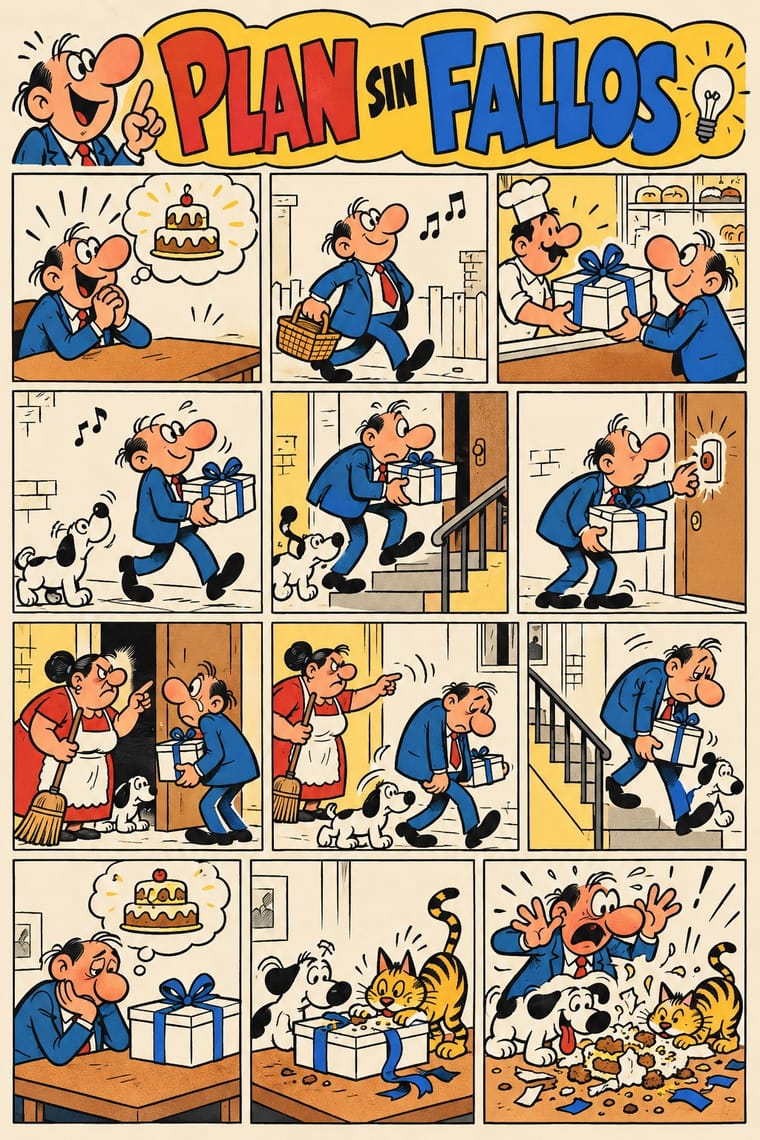
The house style of Editorial Bruguera's humour cartoonists in Barcelona from 1947 to 1986, named the 'Escuela Bruguera' by Terenci Moix in 1968. Grotesque caricatures of everyday Spanish types (a starving tramp, warring spinster sisters, two bungling agents) act out one-page gags in tiers of small panels against barely sketched urban settings, with onomatopoeia and motion symbols, and the gag ends in a blow. Halfway between children's fun and satire of manners, it mirrored postwar hunger and petty tyranny under Franco's censors, who made it soften after the 1955 decree on children's press.
Make something in this styleGet advice in this styleMix it with another style
Use it with care
Mortadelo y Filemón, Zipi y Zape, Carpanta, Superlópez and the other Bruguera characters are still published and adapted by Ediciones B, part of Penguin Random House since 2017 (Bruguera registered characters in its own name, as it did Superlópez, taking them from their authors): draw your own types, mastheads and gags in the shared idiom, never ask an image model for these characters or for a named cartoonist's hand, and do not present a generated page as a vintage tebeo. The humour runs on stock types, violence and humiliation (the spinster hunting a husband, the beaten child): aim the satire at pretension and power, not at people's bodies, sex, class or origin.
01
How it works
- Caricature everyday losers, not heroes: the hungry tramp, the bullied clerk, the pompous father, the spinster sisters, the bungling agent. Swell noses, feet, mouths and gestures so the face and body do all the acting.
- Sketch the setting only as far as the gag needs: a few lines of street, office or flat on white paper, with no researched decor, so the figures carry every panel; hide small extra jokes in the background instead of detail.
- Fill the page with regular tiers of small ruled panels (Mortadelo y Filemón's first one-page gags ran in six rows; the long adventures used five, then four from 1979), or turn the whole page into one cutaway building of simultaneous gags, as in 13, Rue del Percebe.
- Make motion, noise and temper visible: speed lines and other motion symbols, big hand-drawn onomatopoeia, and drawn explosions or symbols in place of curses; from the 1960s type the dialogue in the balloons and keep the hand lettering for sound effects and titles.
- Build every strip on a wish that fails and end it on a blow, physical (a chase, a fall, a beating) or psychological, drawn as the most forceful panel on the page.
- Keep the satire under the slapstick: aim it at hunger, office drudgery, rigid families and pompous official speech, in a prim, parodic language of stock exclamations such as '¡Rayos!', and print it as flat colour or two-colour pages in a cheap weekly.
Barcelona, at Editorial Bruguera (founded by Juan Bruguera in 1910 as El Gato Negro, renamed Editorial Bruguera in 1939). The style formed from 1947, when the weekly Pulgarcito (founded 1921) resumed regular publication under the editor Rafael González Martínez, and spread through the firm's humour weeklies: El DDT (1951–1977), Tío Vivo (1957–1981, published by Bruguera from 1960), Din Dan (1965–1975) and Mortadelo (1970–1983). The writer Terenci Moix named it the 'Escuela Bruguera' in 1968. Bruguera filed for bankruptcy on 7 June 1982; the postwar Pulgarcito ran to February 1981 and was relaunched until 1986; and in 1986 Grupo Zeta bought the firm and turned it into Ediciones B
02
Its design choices
From Stylogeny’s vocabulary of design choices: defining choices make the style, characteristic ones are usual, occasional ones turn up now and then.
- Layout & composition
- Space & hierarchy
- Colour
- Surface & texture
- Ornament
- Medium & production
- Tone & intent
- Avoids
- Naturalistic depiction, Gradients, Straight photography, Photomontage, Abundant decoration, Gloss & highlights, Calm & contemplative, Luxurious & glamorous
Palette
#f5eedb#1b1a19#d63a2f#f3c13a#2f6db5#f2b08c
Typefaces
Hand-lettered pen dialogue in balloons and captions
the pages of the 1940s and 1950s, before the balloons were typed
Typed balloon text from the 1960s
the balloons 'pasaron a ser mecanografiados, lo que limitaba su expresividad', es.wikipedia
Big hand-drawn onomatopoeia and motion symbols drawn into the picture
'se empleaban abundantemente las onomatopeyas y símbolos cinéticos'
Drawn pictures in place of words in angry balloons
explosions and other symbols instead of profanity in Mortadelo y Filemón
Known for
José Escobar, Carpanta (Pulgarcito, 1947)
a starving tramp who lives under a bridge and whose every attempt to eat fails; censors nearly stopped it in the late 1950s, claiming that nobody went hungry in Franco's Spain, and Escobar had him speak of 'apetito' rather than 'hambre'
José Escobar, Zipi y Zape (officially from Pulgarcito no. 57, 1948)
mischievous twins whose father, the pompous professor Don Pantuflo Zapatilla, sends them to the 'cuarto de los ratones'
Manuel Vázquez, Las hermanas Gilda (Pulgarcito, 1949)
the unmarried sisters Hermenegilda and Leovigilda at war, drawn at first 'groseramente caricaturesco' and later 'cada vez más elegante'; Vázquez also drew La familia Cebolleta (1951)
Peñarroya, Don Pío (1947), and Cifré, El repórter Tribulete (1947), from the 'generación del 47' whose 'cinco grandes' were Cifré, Conti, Escobar, Giner and Peñarroya
Francisco Ibáñez, Mortadelo y Filemón, agencia de información (Pulgarcito no. 1394, 20 January 1958)
one-page black-and-white gags in six tiers of panels, then 44-page adventures from El sulfato atómico (Gran Pulgarcito, 1969)
Francisco Ibáñez, 13, Rue del Percebe (Tío Vivo, from 6 March 1961; Ibáñez drew it into 1968, and Joan Bernet Toledano continued it to January 1970): a single-page cutaway apartment block whose rooms are non-sequential gag panels
Jan (Juan López Fernández), Superlópez (1973, at Bruguera from 1974)
born as a parody of Superman, more worried about his office than about supervillains
Bruguera's humour weeklies Pulgarcito (1921–1986), El DDT (1951–1977), Tío Vivo (1957–1981) and Mortadelo
1970–1983
03
Make something in this style
Say what you need, and Stylogeny’s image studio draws it from Escuela Bruguera (Spanish Humour Comics)’s design choices and checks it against them. It takes about a minute, and you get a link to share.
04
Where it comes from, and what it’s close to
Before it
The style it grew out of, and the styles it borrowed from.
Nothing earlier is recorded: in the atlas it is a starting point.

After it
The styles that grew out of it.
No later style in the atlas grew out of it yet.
Alike in its design choices
Styles that make many of the same choices, related or not, besides those above.


05
Sources
- Wikipedia (es): 'Escuela Bruguera' (https://es.wikipedia.org/wiki/Escuela_Bruguera: term coined by Terenci Moix in 1968; the generations of 1947 ('cinco grandes': Cifré, Conti, Escobar, Giner, Peñarroya), 1957 and 1970; the magazines and their dates, Tío Vivo published by D.E.R. in 1957–1960; style 'a medio camino entre el entretenimiento infantil y el costumbrismo satírico', 'fondos apenas esbozados, minimalistas y esquemáticos', abundant 'onomatopeyas y símbolos cinéticos', the ending 'con un golpe, unas veces físico (persecución, golpe, caída), y otras psíquico', 'lenguaje mojigato y paródico', and from the 1960s balloons 'mecanografiados'; characters and years, Carpanta 1947, Zipi y Zape 1948, Don Pío 1947, El repórter Tribulete 1947, Las hermanas Gilda 1949, Mortadelo y Filemón 1958, Superlópez 1973)
- Wikipedia (en): 'Editorial Bruguera' (https://en.wikipedia.org/wiki/Editorial_Bruguera: founded 1910 as El Gato Negro by Juan Bruguera Teixidó, renamed Editorial Bruguera in 1939; the cartoonists under Rafael González Martínez created 'an easily recognisable style' called Escuela Bruguera; bankruptcy filed 7 June 1982; bought by Grupo Zeta in 1986 and turned into Ediciones B; Tío Vivo acquired in 1960; La familia Cebolleta 1951)
- Wikipedia (en): 'Spanish comics' (https://en.wikipedia.org/wiki/Spanish_comics: Bruguera's humour as 'a mixture of comedy of manners and slapstick', influenced by Franco-Belgian authors such as Franquin, starring 'chronic losers'; Mortadelo y Filemón from 1958, the first 44-page long strip in Gran Pulgarcito in 1969)
- Wikipedia (es): 'Pulgarcito (revista)' (https://es.wikipedia.org/wiki/Pulgarcito_(revista): founded 1921; fifth period 1947–1952 under Rafael González Martínez, when 'se inició el auge de la Escuela Bruguera'; more colours from 1951; the decree of 24 June 1955 on children's press 'supuso un aumento de la censura'; sixth period 1952–1981, relaunched by Bruguera on 2 March 1981 (seventh period, to 1985) and relaunched again in December 1985 (eighth period, to 1986), then a ninth period under Ediciones B in 1987)
- Tebeosfera: 'Pulgarcito (1946, Bruguera)' (https://www.tebeosfera.com/colecciones/pulgarcito_1946_bruguera.html: weekly, 20 December 1946 to 16 February 1981; colour covers; interiors 'en blanco y negro' in the fifth period and 'en color y bitono' from no. 1091)
- Tebeosfera: 'Editorial Bruguera' (https://tebeosfera.com/entidades/editorial_bruguera.html: the firm kept the original comic pages and recycled them in thousands of reprints in the 1960s and 1970s; it 'quebró y fue adquirida por Grupo Zeta por un precio simbólico', closing date 1 June 1986)
- CCCB, 'The Bruguera Factory' (exhibition, Centre de Cultura Contemporània de Barcelona, January–April 2005, curated by Carles Santamaria and Jaume Vidal; https://www.cccb.org/en/exhibitions/file/the-bruguera-factory/12971: humour based on local customs with an acid view of Spanish society; self-contained strips whose last frame 'presents the explosive end of the joke'; archetypes from 'thwarted lives' such as Carpanta and Don Pío to 'professional incompetence')
- Wikipedia (es): 'Carpanta' (https://es.wikipedia.org/wiki/Carpanta: José Escobar, Pulgarcito 1947; lives under a bridge; censors' claim that 'en la España de Franco nadie pasa hambre'; 'apetito' instead of 'hambre')
- Wikipedia (es): 'Zipi y Zape' (https://es.wikipedia.org/wiki/Zipi_y_Zape: Escobar, officially from Pulgarcito no. 57, 1948; Don Pantuflo Zapatilla; the 'cuarto de los ratones'; punishments softened after the 1955 decree; Max und Moritz and The Katzenjammer Kids as forerunners) and Lambiek Comiclopedia, 'José Escobar' (https://www.lambiek.net/artists/e/escobar_jose.htm: 22 October 1908 to 31 March 1994; Carpanta and Zipi y Zape launched in Pulgarcito; co-founder of Tío Vivo in 1957; an influence on Ibáñez)
- Wikipedia (es): 'Las hermanas Gilda' (https://es.wikipedia.org/wiki/Las_hermanas_Gilda: Vázquez, Pulgarcito, 1949 (es.wikipedia gives issue no. 49, Lambiek 'issue #96 of the post-war Pulgarcito'); Hermenegilda and Leovigilda; drawing first 'groseramente caricaturesco', then 'cada vez más elegante'; adult tone reduced after the 1955 decree) and Lambiek Comiclopedia, 'Manuel Vázquez' (https://www.lambiek.net/artists/v/vazquez_manuel.htm: Las Hermanas Gilda launched in 1949; 'the publisher's house style, with its schematically drawn characters against limited backgrounds')
- Wikipedia (es): 'Mortadelo y Filemón' (https://es.wikipedia.org/wiki/Mortadelo_y_Filem%C3%B3n: Ibáñez, Pulgarcito no. 1394, 20 January 1958; one-page black-and-white gags in six rows of panels; El sulfato atómico, 1969, 'inusitadamente detallista' with Franquin's influence; five rows in the long adventures of the mature stage, then four from El transformador metabólico (1979); background gags; drawn explosions instead of profanity in angry balloons; '¡rayos!'; Ediciones B bought by Penguin Random House in 2017)
- Wikipedia (es): '13, Rue del Percebe' (https://es.wikipedia.org/wiki/13,_Rue_del_Percebe: Ibáñez, from 6 March 1961 in the first issue of Tío Vivo's second period; a one-page 'macroviñeta' of a cutaway building with 'viñetas no secuenciales'; Ibáñez drew it to 1967 and again in 1968, and Joan Bernet Toledano drew the last 57 instalments up to 26 January 1970) and 'Superlópez' (https://es.wikipedia.org/wiki/Superl%C3%B3pez: Jan, 1973, Euredit; Bruguera from 1974, which registered the character; 'nacida como una parodia de Superman')
- Terenci Moix, Los «cómics»: arte para el consumo y formas «pop» (Barcelona: Llibres de Sinera, 1968), Moix's 1968 book on comics, reissued in 2007 as Historia social del cómic (es.wikipedia dates the coinage of 'Escuela Bruguera' to Moix in 1968, citing Jesús Cuadrado, Atlas español de la cultura popular: De la historieta y su uso 1873–2000 (2000), p. 431, without naming a book); listed in Virginie Giuliana, 'Terenci Moix y el mundo del cómic', Estudios LGBTIQ+, Comunicación y Cultura 3:1 (2023), pp. 25–34 (https://revistas.ucm.es/index.php/ESLG/article/view/85604)
How Stylogeny researches and checks a style: where the facts come from.