Pictorial & machine age · 1967–1973 · Latin America & Caribbean
Chilean Unidad Popular & Nueva Canción Graphics
Also known as Gráfica de la Unidad Popular, Oficina Larrea, Brigada Ramona Parra muralism, Nueva Canción Chilena sleeve art
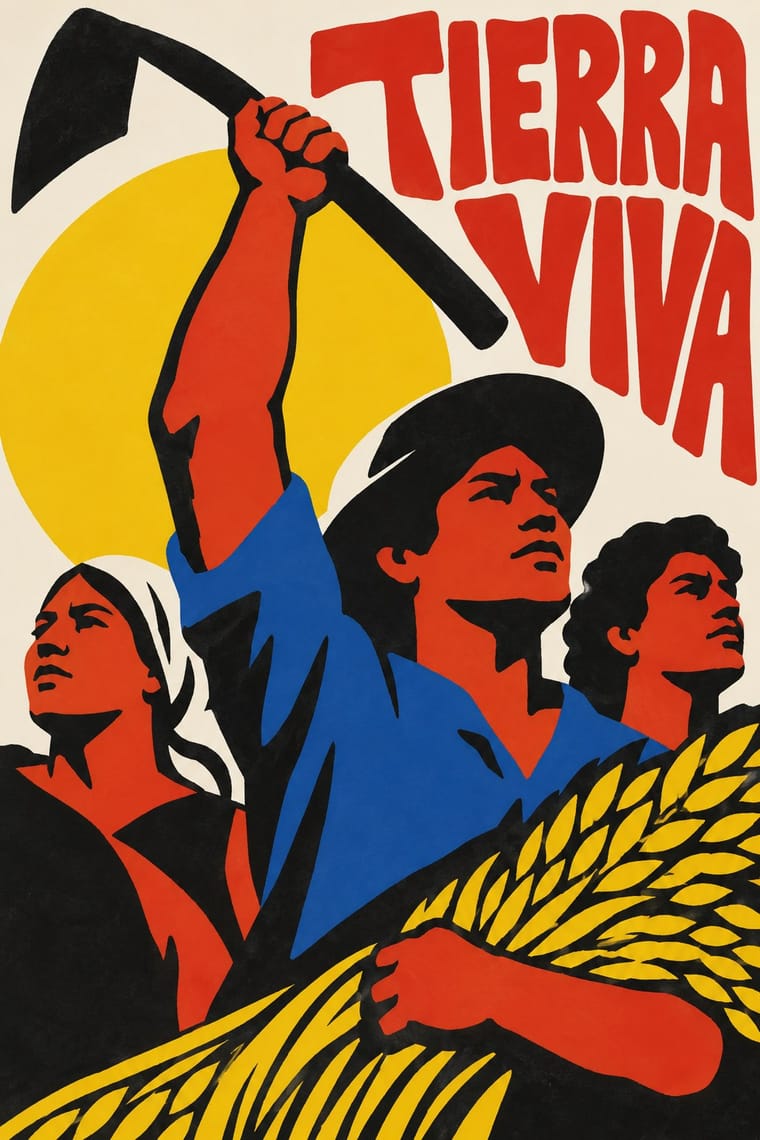
The graphics of the Nueva Canción Chilena and Allende's Unidad Popular, 1967–1973. In the Larrea brothers' office, DICAP record sleeves and posters joined high-contrast photographs, flat inks, closed forms with irregular contours and hand-drawn lettering. On the street, the Brigada Ramona Parra painted slogans, then long murals of fists, stars, birds, workers and faces in basic flat colours bounded by thick black strokes. The 1973 coup closed DICAP and erased the murals. The brigades returned to the streets before the 1988 plebiscite and still paint; the Larrea office worked into the 2020s.
Make something in this styleGet advice in this styleMix it with another style
Use it with care
The Brigada Ramona Parra still paints and remains closely tied to Chile's Communist Youth and Communist Party, and the Larrea office's posters and sleeves are living designers' work: Vicente Larrea publicly called the 2022 Rechazo campaign's reuse of 'La felicidad de Chile comienza por los niños' a plagiarism. Víctor Jara was killed after the 1973 coup and brigade members were persecuted. Credit the makers and ask the brigade or the office before quoting their work, rather than stripping it into generic retro-revolutionary styling.
01
How it works
- Reduce photographs to hard black and white with high-contrast darkroom work (contratipo), keeping just enough detail to recognise a face.
- Print in flat, unmodulated inks and cut every shape as a closed form with an irregular, hand-made contour.
- Draw the lettering by hand as part of the picture rather than setting it in type.
- On a record sleeve, put the song and the cause ahead of the singer's portrait.
- On a wall, letter the slogan first in big, clear characters, fill the ground and the letters with basic colours, then reinforce every contour with a thick black line.
- Keep a small stock of easily repeated emblems (the fist, the star, the ear of wheat, birds, workers' and Indigenous faces) so any brigade can paint them in minutes.
Santiago, Chile: the Larrea brothers' design office (from 1967), the Communist Youth record label DICAP (1967) and the Brigada Ramona Parra mural brigades (named in 1968)
02
Its design choices
From Stylogeny’s vocabulary of design choices: defining choices make the style, characteristic ones are usual, occasional ones turn up now and then.
- Layout & composition
- Space & hierarchy
- Typography
- Colour
- Ornament
- Imagery
- Medium & production
- Tone & intent
- Avoids
- Naturalistic depiction, Gradients, Pastel, Fluorescent & neon, Gloss & highlights, Modular grid, Luxurious & glamorous, Ironic & self-aware
Palette
#f2ede1#141414#d52b1e#1f4fa3#f5c518
Typefaces
Hand-drawn closed-form lettering of the Larrea office
sleeves, posters and the DICAP seal
Brigada Ramona Parra painted slogan letters
big, clear, easy-to-write characters whose contours are reinforced in black
Known for
Vicente Larrea
office in central Santiago from 1967; cover of the first Víctor Jara + Quilapayún record
Antonio Larrea
with Vicente 1968–1977; known for his command of the contratipo
Luis Albornoz, 'La felicidad de Chile comienza por los niños'
poster from an idea by Vicente Larrea, early in Allende's government
'¡A trabajar! Trabajo voluntario verano '72'
Antonio and Vicente Larrea, offset poster, 1972; Biblioteca Nacional de Chile, MC0061447
DICAP seal
Discoteca del Cantar Popular, designed by the Larrea office
Quilapayún, X Viet-Nam (1968), held in the Biblioteca Nacional's digitised DICAP set, whose original covers the library credits to Antonio and Vicente Larrea
Brigada Ramona Parra
named in 1968 after Ramona Parra, killed by police in Santiago in 1946; co-founder Danilo Bahamondes
Alejandro 'Mono' González
founding member of the Brigada Ramona Parra
03
Make something in this style
Say what you need, and Stylogeny’s image studio draws it from Chilean Unidad Popular & Nueva Canción Graphics’s design choices and checks it against them. It takes about a minute, and you get a link to share.
04
Where it comes from, and what it’s close to
Before it
The style it grew out of, and the styles it borrowed from.


After it
The styles that grew out of it.
No later style in the atlas grew out of it yet.
Alike in its design choices
Styles that make many of the same choices, related or not, besides those above.
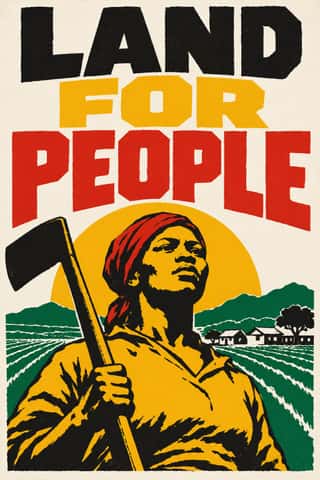
- Ethiopian Revolutionary Poster (Derg Era)69% alike
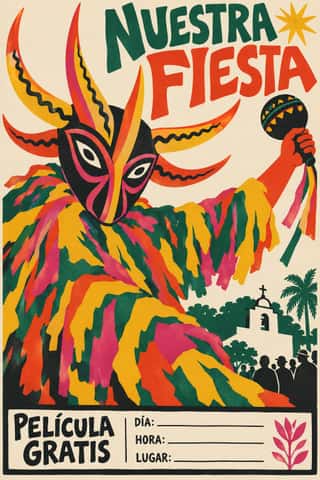
- Woman, Life, Freedom Protest Graphics (Iran and the Diaspora)67% alike
- Ultras Graphics (Curva Banners and Tifo)67% alike


05
Sources
- Memoria Chilena (Biblioteca Nacional de Chile), 'Taller de los hermanos Larrea': https://www.memoriachilena.gob.cl/602/w3-article-93233.html
- Memoria Chilena, 'a trabajar! trabajo voluntario verano, 1972' (poster record: Antonio and Vicente Larrea, offset, 1972, BN code MC0061447): https://www.memoriachilena.gob.cl/602/w3-article-63579.html
- Memoria Chilena, 'Discoteca del cantar popular (DICAP)': https://www.memoriachilena.gob.cl/602/w3-article-348769.html
- Memoria Chilena, 'DICAP: 23 álbumes de la Nueva Canción Chilena ya están disponibles en la Biblioteca Nacional Digital' (the digitised albums 'incluyen las carátulas originales diseñadas por Antonio y Vicente Larrea'; names X Viet-Nám without crediting that sleeve): https://www.memoriachilena.gob.cl/602/w3-article-687594.html
- Wikipedia, 'X Vietnam' (Quilapayún, 1968, 'among the first albums to be released under the DICAP label'; no cover credit): https://en.wikipedia.org/wiki/X_Vietnam
- Memoria Chilena, 'Brigadas Ramona Parra (BRP)' (calls the origins unclear: the 1968 Communist Youth congress or the 1969 march for Vietnam; close ties to the Juventudes Comunistas and the Communist Party; return to the streets on the eve of the 1988 plebiscite): https://www.memoriachilena.gob.cl/602/w3-article-100581.html
- Craig Doughty, 'The Brigada Ramona Parra and the Art of Muralising Protest During the Pinochet Regime', Street Art & Urban Creativity 5:1 (2019), doi:10.25765/sauc.v5i1.162
- Tricontinental: Institute for Social Research, 'Boletín de arte: muralismo chileno': https://thetricontinental.org/es/boletin-de-arte-muralismo-chileno/
- El Desconcierto, 'El tarro y la brocha: la historia de la Brigada Ramona Parra' (2018; founding resolution at the 1968 Communist Youth congress, public debut July 1969): https://eldesconcierto.cl/2018/10/19/el-tarro-y-la-brocha-la-historia-de-la-brigada-ramona-parra/
- El Desconcierto, on Mauricio Vico & Juan Carlos Lepe, Oficina Larrea, 60 años diseñando afiches y marcas: 1964–2022 (2023) (Vicente Larrea names hippie graphics, Cuban and Polish posters, Ben Shahn and Saul Bass as influences, the grounds for psychedelic, polish-poster-school and, through Bass, american-modernism; Shahn has no atlas style. The book counts the office from 1964, Memoria Chilena from 1967): https://eldesconcierto.cl/2023/08/22/fotos-oficina-larrea-libro-homenaje-a-la-firma-grafica-de-la-nueva-cancion-chilena/
- El Desconcierto (EFE), 'Dicap, la discográfica que grabó la música de Víctor Jara y que la dictadura silenció' (16 Sept 2023; covers by the Larrea brothers, 'inspirados por el muralismo latinoamericano y el cartelismo cubano'; says the first records came out under the Jota-Jota brand, the first of them on sale in June 1969, before the DICAP name; Memoria Chilena dates DICAP's founding to 1967): https://eldesconcierto.cl/2023/09/16/dicap-la-discografica-que-grabo-la-musica-de-victor-jara-y-que-la-dictadura-silencio
- BBC Mundo, 'Los muralistas chilenos que desafiaron a Pinochet' (2013), reprinted by The Clinic: https://www.theclinic.cl/2013/09/08/bbc-mundo-los-muralistas-chilenos-que-desafiaron-a-pinochet/
- El Mostrador, 'Campaña del Rechazo usa icónico cartel de la Unidad Popular' (2022): https://www.elmostrador.cl/cultura/destacados-cultura/2022/07/03/campana-del-rechazo-usa-iconico-cartel-de-la-unidad-popular/
- El Mostrador (EFE), 'Brigada Ramona Parra revive con miras a campaña presidencial' (11 Nov 2025; the brigade sketching one of its murals in Barrio Yungay, Santiago, under national leader Ignacio Barría): https://www.elmostrador.cl/cultura/2025/11/11/brigada-ramona-parra-revive-con-miras-a-campana-presidencial/
How Stylogeny researches and checks a style: where the facts come from.