Style combination · Pairs well
Ghanaian Funeral Poster × African Wax
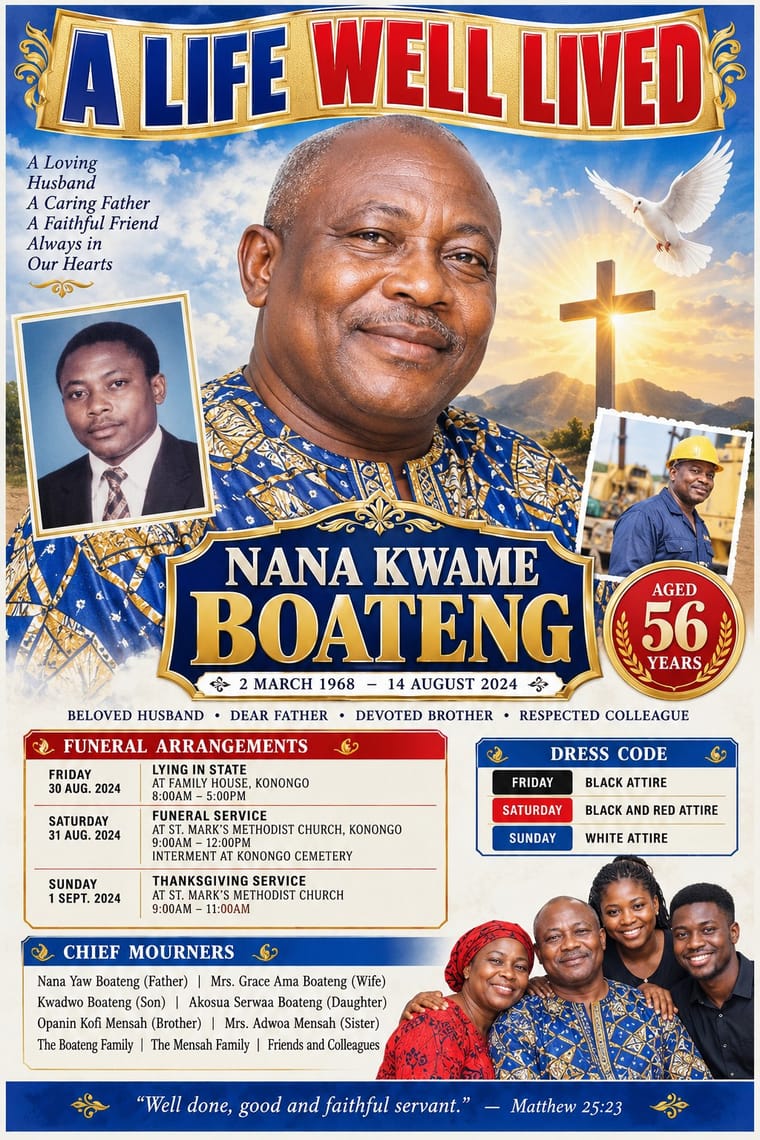
Bredenbröker lists commemorative T-shirts, mugs and handkerchiefs beside the posters and banners as popular items that commemorate the dead in public, and wax print's one-sided fancy prints already serve as commemorative cloth with portraits; pair a funeral poster's photograph, name and age badge with a fancy-print repeat for a commemorative textile, keeping real people's faces and names out of new work.
Mix them and make something Ghanaian Funeral Poster African Wax
01
What each style brings
Each part of the design comes from the style with the stronger say in it, and each style gives at least two.
Ghanaian Funeral Poster & Banner African Wax & Fancy Print
- Type from Ghanaian Funeral Poster
- Colour from African Wax
- Form from Ghanaian Funeral Poster
- Composition from Ghanaian Funeral Poster
- Surface from African Wax
02
The type
Open fonts standing in for each style’s own type, which is often hand-drawn or commercial.
Display · Ghanaian Funeral Poster
Together
Archivo Black, standing in for Connected script for first names and titles (a first name or a title with initials) over the surname in heavy sans-serif capitals, often outlined and set in white, red, navy or yellow
Text · African Wax
Industrially printed cotton made for West and Central African markets, first by Dutch and British mills that imitated Javanese batik with resin resist, and later by African mills. Giant emblematic motifs, an indigo key with offset colours and crackle veining repeat across the cloth, and traders name designs after proverbs and events. Cheaper one-sided fancy prints turn the cloth into commemorative media with portraits, emblems and slogans.
Bodoni Moda; African Wax used Selvedge captions and Bold capitals in ribbon banners for slogans and dates on commemorative fancy cloth
03
The colours
The ground and leading colours come from African Wax, with a counter-accent from Ghanaian Funeral Poster. The ink reads on the ground at 4.5:1 or more.
Ghanaian Funeral Poster & Banner African Wax & Fancy Print
-
#141414ground · 36% -
#f3ead6ink · 14% -
#f2b705accent · 18% -
#c3161caccent · 14% -
#d4a52aaccent · 10% -
#1b7f4aaccent · 8%
As CSS
:root {
  --ground: #141414;
  --ink: #f3ead6;
  --accent-1: #f2b705;
  --accent-2: #c3161c;
  --accent-3: #d4a52a;
  --accent-4: #1b7f4a;
  --font-display: "Archivo Black", sans-serif;
  --font-text: "Bodoni Moda", serif;
}
Use it with care
Ghanaian Funeral Poster & Banner: These posters and banners show real, recently dead people and name their living relatives, and families pay for them as part of a funeral the community judges closely. Funeral posters are usually made for Christians and followers of traditional African religions (Adotey 2018), so do not present them as the funeral custom of all Ghanaians. Do not lift a real poster's photograph, names or lists into new work, and do not use the headlines and colour code as a gag or a generic 'African' texture: 'What a Shock' and a red ground mark a death as sudden or untimely, and relatives often find a banner on their own house painful to live with. The ranked lists of chief mourners can also carry live disputes over kinship and chieftaincy, as when the Tefle Traditional Council formally protested in 2009 against its omission from the poster of a Sokpoe paramount chief. Commission and credit Ghanaian designers and print shops for work in this idiom.
African Wax & Fancy Print: Wax print is shared popular culture, but its designs carry names and messages given by African traders and wearers, and commemorative cloths carry political and religious portraits. Learn a design's name and meaning before reusing it, do not use commemorative portraits or party emblems out of context, and credit African designers, mills and traders rather than presenting a European brand or a generic 'African print' as the source.
04
The two styles
05
More combinations
With Ghanaian Funeral Poster
- Ghanaian Movie Poster Contrasts · They share the walls of Ghanaian towns, but the movie poster is painted by hand on flour sacks with invented, lurid scenes, while the funeral poster is typeset on a computer around a real photograph; set one painted, exaggerated figure against a funeral poster's sober portrait for a deliberate clash of registers.
- Adinkra & Kente Symbol Systems Pairs well · A multicoloured strip border like kente's already frames some funeral banners; frame a portrait with a woven-strip border or a single adinkra sign whose proverb suits a death, learning its meaning first and keeping sacred signs out of trivial use.
- Lebanese Civil War Party Poster Contrasts · Both are public obituaries pasted on walls, with a straight photograph of the dead, the name and the dates, but a martyr poster is issued in series by a party under its emblem and slogans to claim a quarter, while a Ghanaian funeral poster is commissioned by one family to invite mourners and rank its kin; take the portrait-and-header format without the partisan voice.
- South African Vernacular Design (Ijusi) Pairs well · Both work in the street-level commercial vernacular of outlined lettering, badges and many typefaces at once, but Ijusi collages township signage as a designer's quotation while the funeral poster is that vernacular in use; pair the funeral poster's photographic portrait and ranked lists with Ijusi's collage for a layered, local announcement.
With African Wax
- Adinkra & Kente Symbol Systems Pairs well · Ghanaian wax and fancy prints already carry adinkra signs; pair the two to combine factory repeat with named Akan symbols, used for what they mean.
- Minimalist Graphic Design Contrasts · A single giant wax motif against a minimal white layout gives maximum impact; the full repeat is the opposite of minimal restraint.
- Batik Pattern Tradition Pairs well · Set hand-drawn Javanese batik beside its industrial descendant to show resist turning into mass repeat, crackle and giant scale.
- Pop Art Graphics Pairs well · Commemorative portrait medallions and off-register colour meet pop's serial portraits; combine them for celebratory, mass-produced portraiture.
- Finnish Bold Print (Marimekko Modernism) Contrasts · Both are industrially printed cotton that dresses bodies and rooms, but wax print crowds the cloth with misregistered emblems that traders and wearers name after proverbs and events, while Marimekko enlarges one shape on open white under a title its designer gives; compare them when a pattern must speak or simply be bold.
- Taiwan Floral Cloth (Huabu) Contrasts · Both are cheap industrial cotton that became a people's emblem, but wax print enlarges named emblems in an indigo key with offset colour, while Taiwan floral cloth crowds lush, nearly real peonies on a vermilion or sky-blue ground and carries nostalgia rather than proverbs.
- Kanga (Swahili Message Cloth) Contrasts · Both are factory-printed cotton wrappers, and the atlas's wax and fancy print already includes commemorative fancy cloth with portrait medallions, flags and ribbon slogans. But wax and fancy print is yardage repeated along the bolt and named by traders by word of mouth, carrying a slogan only on commemorative designs, while every kanga, commemorative or not, is one bordered, symmetrical piece sold in pairs that prints its own sentence in a box at the foot.