Style combination · Pairs well
Adinkra × African Wax
Ghanaian wax and fancy prints already carry adinkra signs; pair the two to combine factory repeat with named Akan symbols, used for what they mean.
01
What each style brings
Each part of the design comes from the style with the stronger say in it, and each style gives at least two.
Adinkra & Kente Symbol Systems African Wax & Fancy Print
- Type from African Wax
-
- Colour from Adinkra
- Form from Adinkra
- Composition from Adinkra
- Surface from African Wax
02
The type
Open fonts standing in for each style’s own type, which is often hand-drawn or commercial.
Display · African Wax
Ours
Agbalumo; African Wax used Selvedge captions and Bold capitals in ribbon banners for slogans and dates on commemorative fancy cloth
Text · Adinkra
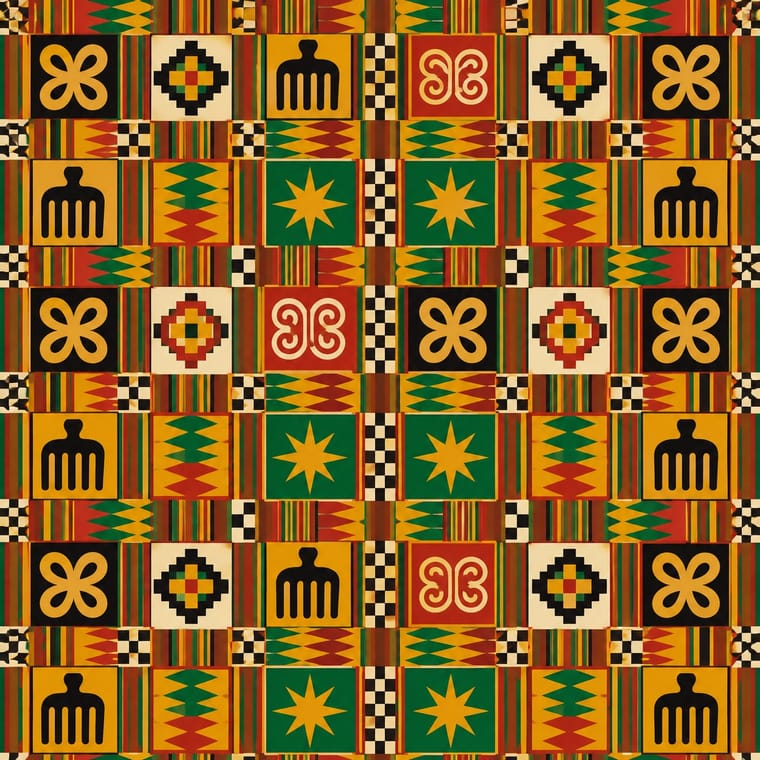
The Akan textile languages of Ghana. In adinkra, named symbols carrying proverbs (Gye Nyame, Sankofa, Dwennimmen) are stamped in black with carved calabash stamps on cloth ruled into squares; kente is narrow-strip cloth woven in named warp-faced blocks of gold, green, red and blue and sewn into checkerboards. Pattern is a vocabulary: each motif and colour is chosen for its meaning.
Archivo; Adinkra used Adinkra stamped glyphs as a pictographic set and Ghanaian hand-painted sign lettering for accompanying text
03
The colours
The ground and leading colours come from Adinkra, with a counter-accent from African Wax. The ink reads on the ground at 4.5:1 or more.
Adinkra & Kente Symbol Systems African Wax & Fancy Print
-
#efe2c4ground · 36% -
#151412ink · 14% -
#e3a51caccent · 18% -
#b52a1faccent · 14% -
#7d3a1faccent · 10% -
#1d7a3caccent · 8%
As CSS
:root {
  --ground: #efe2c4;
  --ink: #151412;
  --accent-1: #e3a51c;
  --accent-2: #b52a1f;
  --accent-3: #7d3a1f;
  --accent-4: #1d7a3c;
  --font-display: "Agbalumo", cursive;
  --font-text: "Archivo", sans-serif;
}
Use it with care
Adinkra & Kente Symbol Systems: Adinkra symbols and kente patterns are named, proverb-bearing Akan heritage, and some kente designs were historically reserved for the Asantehene and royal lineages. Learn each symbol's meaning before use, keep sacred signs such as Gye Nyame out of trivial or demeaning contexts, and commission or credit Ghanaian stampers and weavers (for example in Ntonso and Bonwire) rather than printing faux kente.
African Wax & Fancy Print: Wax print is shared popular culture, but its designs carry names and messages given by African traders and wearers, and commemorative cloths carry political and religious portraits. Learn a design's name and meaning before reusing it, do not use commemorative portraits or party emblems out of context, and credit African designers, mills and traders rather than presenting a European brand or a generic 'African print' as the source.
04
The two styles
05
More combinations
With Adinkra
- International Typographic Style Pairs well · A modular grid holds adinkra squares naturally; pair them with a neutral grotesque for contemporary Ghanaian institutional work.
- Bògòlanfini Mud Cloth Pairs well · Adinkra stamps dark signs on light cloth while bògòlan leaves light signs in a dark mud-dyed ground; use the reversal for a light and dark pattern pair, with each motif's meaning and makers credited.
- Ma & Wabi-sabi Aesthetics Contrasts · Saturated, meaning-dense repetition versus quiet emptiness: decide whether your message needs abundance or a single sign.
- Isotype Pictorial Statistics Pairs well · Treat adinkra as a consistent icon family on a strict grid, as Isotype did with pictograms, for wayfinding or data with local voice.
- Afrofuturist Design Pairs well · Afrofuturist identities draw on adinkra; render named symbols as glowing or metallic glyphs while keeping their meanings intact.
- Amazigh Sign System & Tifinagh Contrasts · Both are sign systems that carry meaning, but adinkra stamps named symbols into a ruled grid of squares. Amazigh weavers and tattooists vary the size and spacing of their signs by hand within bands and lattices, and share them with a script.
- Andean Woven Graphic Systems Contrasts · Adinkra stamps named symbols into ruled squares and kente joins woven strips, whereas Andean cells are woven into one garment and distorted toward its edges; keep the two languages distinct.
- Pacific Barkcloth (Tapa) Design Pairs well · Both are gridded ceremonial cloths of named motifs; borrow their shared square-by-square logic for a layout, while keeping each motif tied to its own culture and meaning.
With African Wax
- Minimalist Graphic Design Contrasts · A single giant wax motif against a minimal white layout gives maximum impact; the full repeat is the opposite of minimal restraint.
- Batik Pattern Tradition Pairs well · Set hand-drawn Javanese batik beside its industrial descendant to show resist turning into mass repeat, crackle and giant scale.
- Pop Art Graphics Pairs well · Commemorative portrait medallions and off-register colour meet pop's serial portraits; combine them for celebratory, mass-produced portraiture.
- Finnish Bold Print (Marimekko Modernism) Contrasts · Both are industrially printed cotton that dresses bodies and rooms, but wax print crowds the cloth with misregistered emblems that traders and wearers name after proverbs and events, while Marimekko enlarges one shape on open white under a title its designer gives; compare them when a pattern must speak or simply be bold.
- Taiwan Floral Cloth (Huabu) Contrasts · Both are cheap industrial cotton that became a people's emblem, but wax print enlarges named emblems in an indigo key with offset colour, while Taiwan floral cloth crowds lush, nearly real peonies on a vermilion or sky-blue ground and carries nostalgia rather than proverbs.
- Kanga (Swahili Message Cloth) Contrasts · Both are factory-printed cotton wrappers, and the atlas's wax and fancy print already includes commemorative fancy cloth with portrait medallions, flags and ribbon slogans. But wax and fancy print is yardage repeated along the bolt and named by traders by word of mouth, carrying a slogan only on commemorative designs, while every kanga, commemorative or not, is one bordered, symmetrical piece sold in pairs that prints its own sentence in a box at the foot.
- Ghanaian Funeral Poster & Banner Pairs well · Bredenbröker lists commemorative T-shirts, mugs and handkerchiefs beside the posters and banners as popular items that commemorate the dead in public, and wax print's one-sided fancy prints already serve as commemorative cloth with portraits; pair a funeral poster's photograph, name and age badge with a fancy-print repeat for a commemorative textile, keeping real people's faces and names out of new work.