Style combination · Contrasts
Sani and Swahili Humour-Magazine Comics × Tingatinga Painting
Tanzanian too, but painted, flat and image-led; narrative panels and dialogue govern reading here.
Mix them and make something Sani and Swahili Humour-Magazine Comics Tingatinga Painting
01
What each style brings
Each part of the design comes from the style with the stronger say in it, and each style gives at least two.
Sani and Swahili Humour-Magazine Comics Tingatinga Painting
- Type from Sani and Swahili Humour-Magazine Comics
- Colour from Tingatinga Painting
- Form from Sani and Swahili Humour-Magazine Comics
- Composition from Sani and Swahili Humour-Magazine Comics
- Surface from Tingatinga Painting
-
Sani and Swahili Humour-Magazine Comics avoids gloss & highlights: this is where the two pull against each other, which is the point of the contrast.
02
The type
Open fonts standing in for each style’s own type, which is often hand-drawn or commercial.
Display · Sani and Swahili Humour-Magazine Comics
Wow
Agbalumo; Sani and Swahili Humour-Magazine Comics used Hand-lettered Swahili balloon capitals and Hand-drawn comic title lettering
Text · Tingatinga Painting
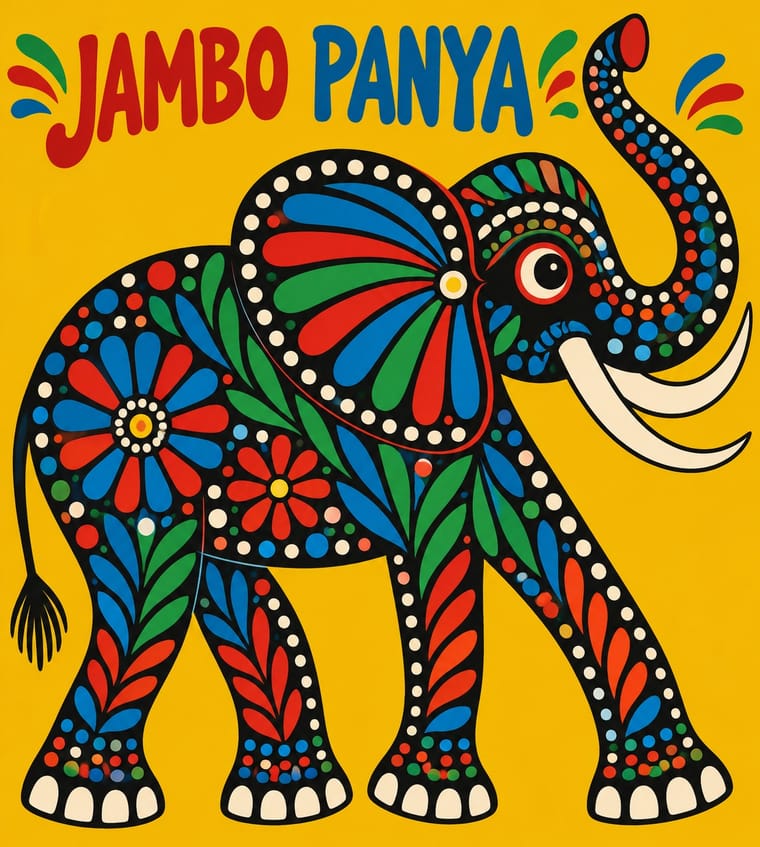
A Tanzanian popular painting school begun in Dar es Salaam by Edward Tingatinga (1932–1972), who from 1968 painted animals, birds and village scenes in glossy bicycle enamel on square hardboard ceiling boards for residents and tourists. One flat ground colour carries black-outlined, caricatural animals with patterned bodies. Its roots are debated: Makua and Makonde hut-wall painting, Congolese pictures sold in the city. Relatives and pupils carried it on, moving to canvas from 1989, organising as the Tingatinga Arts Cooperative Society in 1990 and adding crowded city scenes and spirit themes.
Space Grotesk; Tingatinga Painting used Enamel-painted block-capital artist's signatures along the lower edge of the panel and Irregular hand-painted capitals for any Swahili or English title or caption that must accompany Tingatinga-derived graphics
03
The colours
The ground and leading colours come from Tingatinga Painting, with a counter-accent from Sani and Swahili Humour-Magazine Comics. The ink reads on the ground at 4.5:1 or more.
Sani and Swahili Humour-Magazine Comics Tingatinga Painting
-
#f5f1e6ground · 36% -
#111111ink · 14% -
#f2b705accent · 18% -
#e3b23caccent · 14% -
#d7261eaccent · 10% -
#1c75bcaccent · 8%
As CSS
:root {
  --ground: #f5f1e6;
  --ink: #111111;
  --accent-1: #f2b705;
  --accent-2: #e3b23c;
  --accent-3: #d7261e;
  --accent-4: #1c75bc;
  --font-display: "Agbalumo", cursive;
  --font-text: "Space Grotesk", sans-serif;
}
Use it with care
Sani and Swahili Humour-Magazine Comics: Caricature of rural and ethnic types and of gender carries stereotypes that should be audited, not copied as a cultural signature; this is a living commercial comic culture whose artists' rights are uncleared, so credit the makers and do not reproduce their characters without permission.
Tingatinga Painting: Tingatinga is the living livelihood of named Tanzanian painters, many in the Tingatinga Arts Cooperative Society in Dar es Salaam, and its market has long been undercut by fakes: copies of the founder's lion, peacock, leopard and buffalo were sold signed 'E. S. Tingatinga'. Never add Tingatinga's or any painter's signature, or a cooperative name, to generated work, and never present it as an original painting; commission, buy from or credit the painters by name instead. Do not call it generic 'African' or 'tribal' art, or dismiss it as 'airport art'. Its roots are debated, so do not present it as rootless or as a mere copy of Makua and Makonde hut-wall painting, and do not repeat the disputed claim that Tingatinga was Mozambican, which his family and the cooperative reject. Shetani and witchcraft scenes draw on Makua and Makonde belief; picture them as the brief's community understands them, not as spooky decoration.
04
The two styles
05
More combinations
With Sani and Swahili Humour-Magazine Comics
- Escuela Bruguera (Spanish Humour Comics) Pairs well · Another humour-magazine comic tradition of framed panels and caricature; Sani differs in language, social types and its serial reworking of a Franco-Belgian model.
- Congolese Bande Dessinée (Kinshasa Comics Scene) Pairs well · Both are African urban comic lineages; borrow its page craft but do not assume Sani shares its format.
With Tingatinga Painting
- Đông Hồ & Hàng Trống Folk Prints Pairs well · Both are cheap popular pictures of plump, joking animals on a plain ground; combine them for a children's or folk-humour series across two continents.
- Kanga (Swahili Message Cloth) Pairs well · Both belong to the Swahili coast of Dar es Salaam; frame a Tingatinga animal in a kanga border with a real, checked Swahili saying for an East African identity that feels local rather than safari-generic.
- West African Barbershop & Hair Salon Signs Pairs well · Both are hand-painted enamel on board for a street market; borrow the sign painter's outlined capitals to give Tingatinga figures a title or shop name.
- Rorke's Drift Linocut Contrasts · Rorke's Drift cuts dense black-and-white narrative bands; Tingatinga floats a few glossy, many-coloured animals on one ground. Use the contrast between carved monochrome story and painted colour field.
- Kinshasa Popular Painting Contrasts · Both are African urban popular painting in bright, outlined colour, and Congolese paintings sold in Dar es Salaam may have spurred Tingatinga; but Kinshasa painting argues in painted titles, captions and speech balloons, while Tingatinga floats near-wordless animals on one glossy ground.