Style combination · Contrasts
Rorke's Drift Linocut × Tingatinga Painting
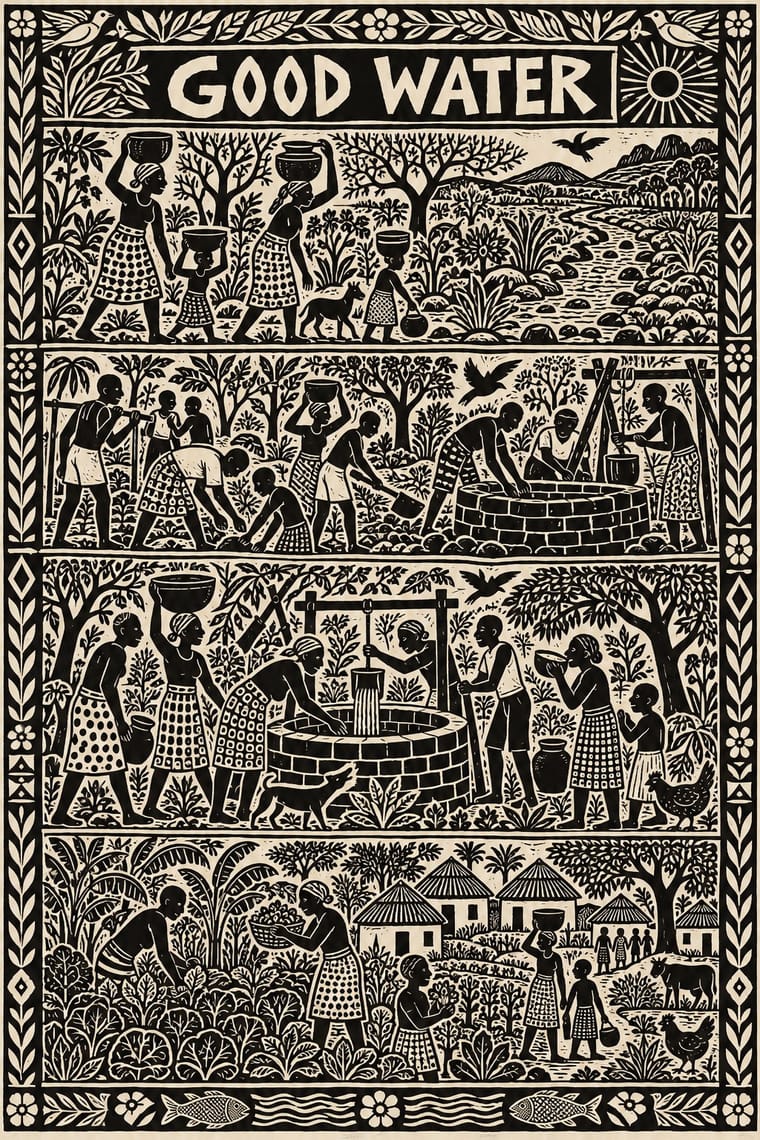
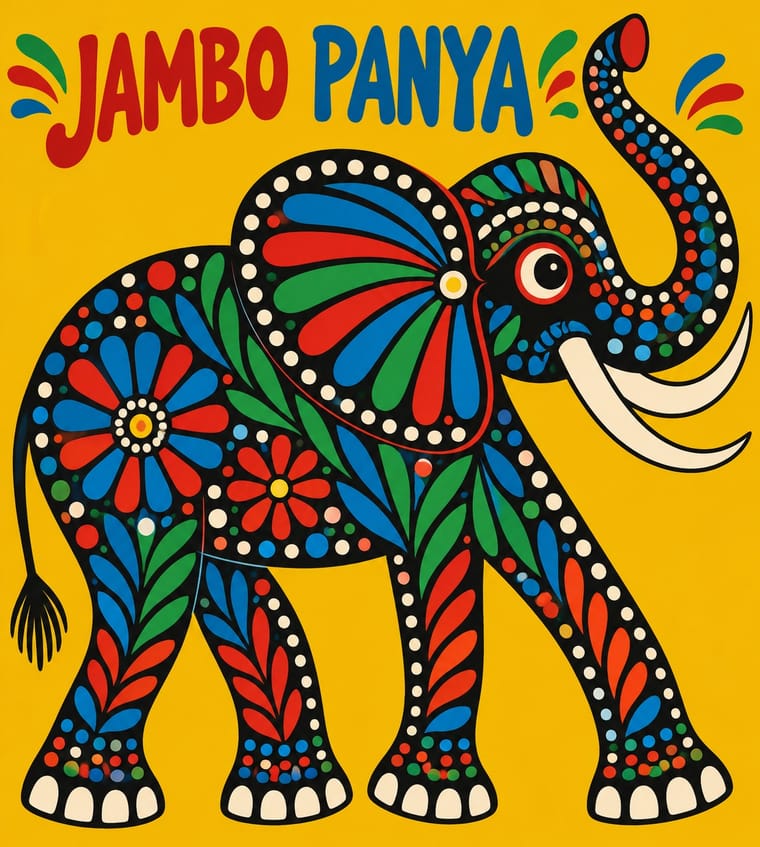
Rorke's Drift cuts dense black-and-white narrative bands; Tingatinga floats a few glossy, many-coloured animals on one ground. Use the contrast between carved monochrome story and painted colour field.
Mix them and make something Rorke's Drift Linocut Tingatinga Painting
01
What each style brings
Each part of the design comes from the style with the stronger say in it, and each style gives at least two.
Rorke's Drift Linocut Tingatinga Painting
- Type from Rorke's Drift Linocut
- Colour from Tingatinga Painting
-
Rorke's Drift Linocut avoids full polychrome: this is where the two pull against each other, which is the point of the contrast.
- Form from Tingatinga Painting
- Composition from Rorke's Drift Linocut
- Surface from Rorke's Drift Linocut
02
The type
Open fonts standing in for each style’s own type, which is often hand-drawn or commercial.
Display · Rorke's Drift Linocut
Light
Agbalumo; Rorke's Drift Linocut used Hand-cut title in the block and Hand-cut captions and slogans
Text · Tingatinga Painting
A Tanzanian popular painting school begun in Dar es Salaam by Edward Tingatinga (1932–1972), who from 1968 painted animals, birds and village scenes in glossy bicycle enamel on square hardboard ceiling boards for residents and tourists. One flat ground colour carries black-outlined, caricatural animals with patterned bodies. Its roots are debated: Makua and Makonde hut-wall painting, Congolese pictures sold in the city. Relatives and pupils carried it on, moving to canvas from 1989, organising as the Tingatinga Arts Cooperative Society in 1990 and adding crowded city scenes and spirit themes.
Space Grotesk; Tingatinga Painting used Enamel-painted block-capital artist's signatures along the lower edge of the panel and Irregular hand-painted capitals for any Swahili or English title or caption that must accompany Tingatinga-derived graphics
03
The colours
The ground and leading colours come from Tingatinga Painting, with a counter-accent from Rorke's Drift Linocut. The ink reads on the ground at 4.5:1 or more.
Rorke's Drift Linocut Tingatinga Painting
-
#f5f1e6ground · 36% -
#111111ink · 14% -
#f2b705accent · 18% -
#d9cfb8accent · 14% -
#d7261eaccent · 10% -
#1c75bcaccent · 8%
As CSS
:root {
  --ground: #f5f1e6;
  --ink: #111111;
  --accent-1: #f2b705;
  --accent-2: #d9cfb8;
  --accent-3: #d7261e;
  --accent-4: #1c75bc;
  --font-display: "Agbalumo", cursive;
  --font-text: "Space Grotesk", sans-serif;
}
Use it with care
Rorke's Drift Linocut: These prints are the work of named Black South African and Namibian artists, many still in copyright with the artists or their estates, made under apartheid at a Lutheran mission centre. Rankin and Hobbs call the 'typical' Rorke's Drift print a construct that the market pushed artists to comply with; the centre also made etchings, aquatints, colour relief prints and screenprints, so treat this banded black-and-white linocut as one face of a diverse school, not the whole of it. Borrow the system (hand-cut black-and-white relief, banded narrative, words in the block), not a particular print, a named artist's figures or Muafangejo's lettering hand. Do not label generated work 'naive' or 'tribal' African art: when Clement Greenberg judged Art South Africa Today in 1975, Rorke's Drift artists were displayed in a 'catch all' section for representational and 'naive' works. Do not invent Zulu or Kwanyama ritual, Christian scenes or struggle martyrs as decoration: picture the subject the brief supplies in its own community's terms. Never add an artist's signature, edition number or a Rorke's Drift or ELC inscription to generated work, and never present a generated image as a Rorke's Drift print.
Tingatinga Painting: Tingatinga is the living livelihood of named Tanzanian painters, many in the Tingatinga Arts Cooperative Society in Dar es Salaam, and its market has long been undercut by fakes: copies of the founder's lion, peacock, leopard and buffalo were sold signed 'E. S. Tingatinga'. Never add Tingatinga's or any painter's signature, or a cooperative name, to generated work, and never present it as an original painting; commission, buy from or credit the painters by name instead. Do not call it generic 'African' or 'tribal' art, or dismiss it as 'airport art'. Its roots are debated, so do not present it as rootless or as a mere copy of Makua and Makonde hut-wall painting, and do not repeat the disputed claim that Tingatinga was Mozambican, which his family and the cooperative reject. Shetani and witchcraft scenes draw on Makua and Makonde belief; picture them as the brief's community understands them, not as spooky decoration.
04
The two styles
05
More combinations
With Rorke's Drift Linocut
- South African Resistance Poster Contrasts · Same country, overlapping and then following it (1978–1994): screenprinted slogans and emblems for mass protest against small, hand-printed editions that tell a story; use the poster to mobilise and the linocut to bear witness.
- Expressionist Woodcut Graphics Contrasts · Both gouge black relief prints, but the Brücke woodcut distorts one anguished figure on tilted axes, while Rorke's Drift spreads a whole story across calm, packed bands; pick by whether the image should confess or narrate.
- Ethiopian Ge'ez Manuscript & Haräg Illumination Pairs well · Another African Christian narrative art told in stacked registers; compare the two to set a Bible story in an African world, keeping Rorke's Drift to one ink and the carved line.
- Literatura de Cordel Woodcut Pairs well · Two traditions of small black relief pictures of devotional and popular stories; add cordel's letterpress title block when a banded Rorke's Drift-style narrative must sit on a booklet cover.
- Lubok Popular Print Pairs well · Close to it in the atlas, after cordel: the Russian popular print also cuts words and pictures into one block and tells devotional and folk stories; take lubok's hand colouring when a Rorke's Drift-style narrative needs warmth beyond black and white.
- Taller de Gráfica Popular Pairs well · Both made the black-and-white relief print a workshop art of social witness; borrow TGP's single legible image when a Rorke's Drift-style band of scenes needs one headline picture.
- Kinngait (Cape Dorset) Inuit Printmaking Contrasts · Two mid-century workshops where a community with no printmaking tradition began cutting blocks with an outside teacher: Rorke's Drift crowds a black-and-white story into banded scenes, Kinngait usually isolates one figure in colour on open paper; choose by whether the image should narrate or present.
- Torres Strait Islander Linocut Contrasts · Both pack a black linocut to the edges and grew from a teaching studio, but Rorke's Drift stacks Bible and history scenes in horizontal bands, while Torres Strait prints let sea beings and stars interlock in one field of minaral; pick bands to narrate in order, the open field to show a cosmos.
With Tingatinga Painting
- Đông Hồ & Hàng Trống Folk Prints Pairs well · Both are cheap popular pictures of plump, joking animals on a plain ground; combine them for a children's or folk-humour series across two continents.
- Kanga (Swahili Message Cloth) Pairs well · Both belong to the Swahili coast of Dar es Salaam; frame a Tingatinga animal in a kanga border with a real, checked Swahili saying for an East African identity that feels local rather than safari-generic.
- West African Barbershop & Hair Salon Signs Pairs well · Both are hand-painted enamel on board for a street market; borrow the sign painter's outlined capitals to give Tingatinga figures a title or shop name.
- Kinshasa Popular Painting Contrasts · Both are African urban popular painting in bright, outlined colour, and Congolese paintings sold in Dar es Salaam may have spurred Tingatinga; but Kinshasa painting argues in painted titles, captions and speech balloons, while Tingatinga floats near-wordless animals on one glossy ground.