Style combination · Pairs well
Đông Hồ × Tingatinga Painting
Both are cheap popular pictures of plump, joking animals on a plain ground; combine them for a children's or folk-humour series across two continents.
01
What each style brings
Each part of the design comes from the style with the stronger say in it, and each style gives at least two.
Đông Hồ & Hàng Trống Folk Prints Tingatinga Painting
- Type from Đông Hồ
- Colour from Tingatinga Painting
- Form from Đông Hồ
- Composition from Tingatinga Painting
- Surface from Đông Hồ
02
The type
Open fonts standing in for each style’s own type, which is often hand-drawn or commercial.
Display · Đông Hồ
Pop
Cinzel, standing in for Chữ Nôm inscriptions on older prints (many later removed or lost in recutting)
Text · Tingatinga Painting
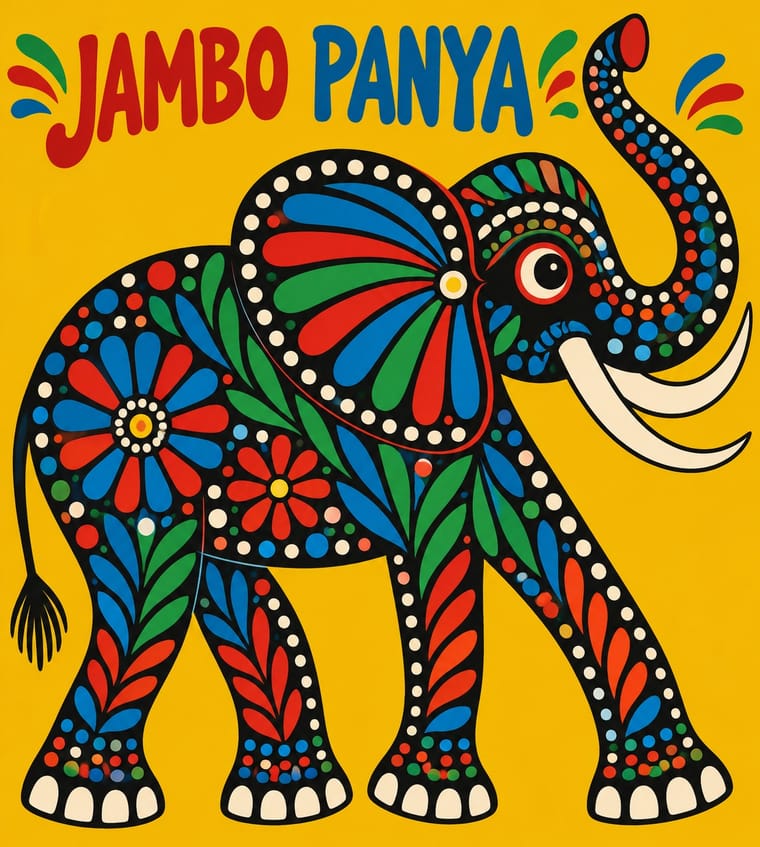
A Tanzanian popular painting school begun in Dar es Salaam by Edward Tingatinga (1932–1972), who from 1968 painted animals, birds and village scenes in glossy bicycle enamel on square hardboard ceiling boards for residents and tourists. One flat ground colour carries black-outlined, caricatural animals with patterned bodies. Its roots are debated: Makua and Makonde hut-wall painting, Congolese pictures sold in the city. Relatives and pupils carried it on, moving to canvas from 1989, organising as the Tingatinga Arts Cooperative Society in 1990 and adding crowded city scenes and spirit themes.
Space Grotesk; Tingatinga Painting used Enamel-painted block-capital artist's signatures along the lower edge of the panel and Irregular hand-painted capitals for any Swahili or English title or caption that must accompany Tingatinga-derived graphics
03
The colours
The ground and leading colours come from Tingatinga Painting, with a counter-accent from Đông Hồ. The ink reads on the ground at 4.5:1 or more.
Đông Hồ & Hàng Trống Folk Prints Tingatinga Painting
-
#f5f1e6ground · 36% -
#111111ink · 14% -
#f2b705accent · 18% -
#d8a63aaccent · 14% -
#d7261eaccent · 10% -
#b2412eaccent · 8%
As CSS
:root {
  --ground: #f5f1e6;
  --ink: #111111;
  --accent-1: #f2b705;
  --accent-2: #d8a63a;
  --accent-3: #d7261e;
  --accent-4: #b2412e;
  --font-display: "Cinzel", serif;
  --font-text: "Space Grotesk", sans-serif;
}
Use it with care
Đông Hồ & Hàng Trống Folk Prints: Đông Hồ printing is a living family craft. In 2025 UNESCO inscribed it on its List of Intangible Cultural Heritage in Need of Urgent Safeguarding, noting that only a small number of families continue it and that their carved blocks are heirlooms; Vietnamese press counts about three households. Machine-printed fakes also undercut the workshops, so commission, buy from or credit the Đông Hồ workshops rather than tracing their designs. Do not invent pseudo-Hán captions or strip the real ones for decoration; the carved inscriptions state each print's meaning. Treat worship prints, including Hàng Trống images for the Mother Goddess cult and for temples, as devotional objects rather than decor, and keep Vietnamese diacritics intact.
Tingatinga Painting: Tingatinga is the living livelihood of named Tanzanian painters, many in the Tingatinga Arts Cooperative Society in Dar es Salaam, and its market has long been undercut by fakes: copies of the founder's lion, peacock, leopard and buffalo were sold signed 'E. S. Tingatinga'. Never add Tingatinga's or any painter's signature, or a cooperative name, to generated work, and never present it as an original painting; commission, buy from or credit the painters by name instead. Do not call it generic 'African' or 'tribal' art, or dismiss it as 'airport art'. Its roots are debated, so do not present it as rootless or as a mere copy of Makua and Makonde hut-wall painting, and do not repeat the disputed claim that Tingatinga was Mozambican, which his family and the cooperative reject. Shetani and witchcraft scenes draw on Makua and Makonde belief; picture them as the brief's community understands them, not as spooky decoration.
04
The two styles
05
More combinations
With Đông Hồ
- Vietnamese Propaganda Poster (Tranh cổ động) Pairs well · Give Đông Hồ's plump figures and earth palette hand-painted Quốc ngữ capitals from the poster tradition for a Vietnamese campaign that feels festive rather than martial.
- Lubok Popular Print Pairs well · Lubok's Mice Burying the Cat and Đông Hồ's Rats' Wedding tell the same joke about power; pair them for a folk-satire series or exhibition identity.
- Kalighat Pat & Battala Bazaar Prints Pairs well · Both are cheap bazaar pictures that set a single figure on bare paper and mix devotion with satire; combine their quiet grounds and comic social types.
- Risograph & Indie Print Culture Pairs well · Both lay down one flat colour at a time; print Đông Hồ-style motifs on riso with muted inks and a pearly stock for a contemporary Tết zine.
- Nianhua & Chinese Folk Print Contrasts · Its Chinese cousin shares the New Year function; set a sparse Đông Hồ sow on shell-white ground beside a crowded, saturated door-god pair to contrast emptiness with abundance.
- Serizawa Katazome and Mingei Stencil-Dye Graphics Pairs well · Another East Asian folk picture on handmade paper in earth colours; compare the woodblock's carved line with the stencil's cut field.
With Tingatinga Painting
- Kanga (Swahili Message Cloth) Pairs well · Both belong to the Swahili coast of Dar es Salaam; frame a Tingatinga animal in a kanga border with a real, checked Swahili saying for an East African identity that feels local rather than safari-generic.
- West African Barbershop & Hair Salon Signs Pairs well · Both are hand-painted enamel on board for a street market; borrow the sign painter's outlined capitals to give Tingatinga figures a title or shop name.
- Rorke's Drift Linocut Contrasts · Rorke's Drift cuts dense black-and-white narrative bands; Tingatinga floats a few glossy, many-coloured animals on one ground. Use the contrast between carved monochrome story and painted colour field.
- Kinshasa Popular Painting Contrasts · Both are African urban popular painting in bright, outlined colour, and Congolese paintings sold in Dar es Salaam may have spurred Tingatinga; but Kinshasa painting argues in painted titles, captions and speech balloons, while Tingatinga floats near-wordless animals on one glossy ground.