Style combination · Contrasts
Nianhua × Ten Bamboo Studio Colour Woodblock
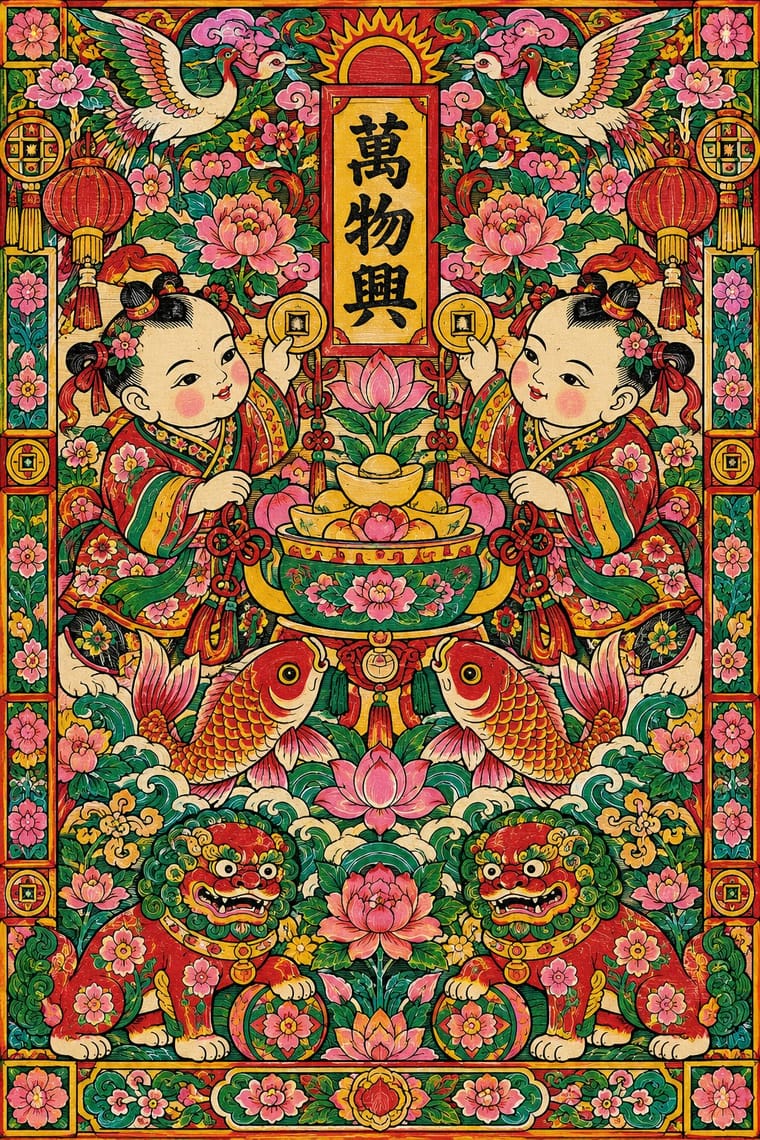
Both are Chinese colour woodblocks, but New Year prints are outlined, saturated, symmetrical and crowded with auspicious figures for every household, while the literati leaf is pale, sparse and made for the scholar's desk.
Mix them and make something Nianhua Ten Bamboo Studio Colour Woodblock
01
What each style brings
Each part of the design comes from the style with the stronger say in it, and each style gives at least two.
Nianhua & Chinese Folk Print Ten Bamboo Studio Colour Woodblock (Douban & Gonghua)
- Type from Ten Bamboo Studio Colour Woodblock
- Colour from Nianhua
-
Ten Bamboo Studio Colour Woodblock avoids full polychrome and flat fields: this is where the two pull against each other, which is the point of the contrast.
- Form from Nianhua
- Composition from Nianhua
-
Ten Bamboo Studio Colour Woodblock avoids horror vacui: this is where the two pull against each other, which is the point of the contrast.
- Surface from Ten Bamboo Studio Colour Woodblock
02
The type
Open fonts standing in for each style’s own type, which is often hand-drawn or commercial.
Display · Ten Bamboo Studio Colour Woodblock
Tide
Kaushan Script, standing in for Brush calligraphy cut into the block: the poems and titles written for the 1633 Collection by about 120 poet-calligraphers, printed so that the print keeps the written stroke
Text · Nianhua
Woodblock pictures bought each New Year and pasted on doors, walls and kitchen shrines to invite luck and ward off harm: paired door gods, plump babies with carp, the Kitchen God, opera scenes and auspicious rebuses. A black keyline block is overprinted or hand-coloured in saturated red, green, yellow and pink, and compositions are dense, frontal and often mirrored in pairs.
Shippori Mincho; Nianhua used Kaishu and Lishu (clerical script) for auspicious couplets
03
The colours
The ground and leading colours come from Nianhua, with a counter-accent from Ten Bamboo Studio Colour Woodblock. The ink reads on the ground at 4.5:1 or more.
Nianhua & Chinese Folk Print Ten Bamboo Studio Colour Woodblock (Douban & Gonghua)
-
#f1e6cfground · 36% -
#1a1a1aink · 14% -
#f2c230accent · 18% -
#b8352daccent · 14% -
#d27a7faccent · 10% -
#2f8a4eaccent · 8%
As CSS
:root {
  --ground: #f1e6cf;
  --ink: #1a1a1a;
  --accent-1: #f2c230;
  --accent-2: #b8352d;
  --accent-3: #d27a7f;
  --accent-4: #2f8a4e;
  --font-display: "Kaushan Script", cursive;
  --font-text: "Shippori Mincho", serif;
}
Use it with care
Ten Bamboo Studio Colour Woodblock (Douban & Gonghua): Woodblock printing in watercolour (muban shuiyin) of this kind is still practised by studios such as Duoyunxuan in Shanghai and Rong Bao Zhai in Beijing and is on China's national list of intangible cultural heritage (木版水印技艺, VIII-77: Rong Bao Zhai 2006, Duoyunxuan 2008 and the Hangzhou Shizhuzhai Art Museum 2014): commission or credit their carvers and printers rather than passing off a digital imitation as a hand-printed edition, and never present a generated image as a leaf of the 1633 Collection, the 1644 Letter Papers or the Mustard Seed Garden manual. Have every inscription written or checked by a fluent reader, because image models invent pseudo-characters, and never make up a seal bearing a real painter's, collector's or studio's name.
04
The two styles
05
More combinations
With Nianhua
- Shanghai Modern & Yuefenpai Pairs well · Yuefenpai calendar posters grew from nianhua; mix its auspicious symbols with Shanghai's airbrushed modern figures.
- Indian Calendar & Bazaar Art Pairs well · Both are devotional bazaar prints; share frontal deities, saturated colour and decorative frames across a festive campaign.
- Socialist Realist Propaganda Poster Pairs well · The 1950s 'new New Year pictures' show how nianhua symmetry and colour can carry a contemporary message without losing folk warmth.
- Lubok Popular Print Pairs well · Russia's lubok is nianhua's closest counterpart, a hand-coloured market woodblock with captions and satire; share flat folk figures and rhymed text across a festive print series.
- Minimalist Graphic Design Contrasts · Isolate a single nianhua motif, such as a carp, on a blank minimalist ground to turn abundance into an emblem.
- Guochao (China-Chic National Trend) Pairs well · Redraw door gods, carp and auspicious babies as clean vector characters for limited-edition packaging, keeping each rebus's meaning intact.
- Tibetan Woodblock Print Culture (Pecha & Prayer Flags) Contrasts · Both are popular devotional woodblock prints pasted or hung for good fortune. Nianhua floods the paper with saturated figure scenes, whereas the Tibetan print keeps to one ink and lets the dyed cloth or the lines of script carry the effect.
- Taiwan Floral Cloth (Huabu) Pairs well · Both use saturated red, pink and green and the same auspicious peony, phoenix and treasure vocabulary; set a nianhua-style figure or couplet on a plain panel over a floral-cloth ground for festive New Year packaging.
With Ten Bamboo Studio Colour Woodblock
- Song–Ming Woodblock Book Typography (Songti / Mincho) Pairs well · The same Nanjing book trade cut both: put a ruled Song-style text page opposite a graded colour leaf, as an album or a book with plates.
- Hong Kong East–West Graphic Modernism Pairs well · From the 1980s Hong Kong designers such as Kan Tai-keung staged ink washes and brush strokes in wide modernist white space; a single graded bamboo or plum spray on a clean field works the same way on packaging or a poster.
- Ukiyo-e Woodblock Prints Contrasts · Japanese colour prints fill flat colours into a carved black key line; the Ten Bamboo leaf drops the key line and grades each colour inside its block. The 1633 manual was reprinted in Japan and foreshadowed nishiki-e, yet the choice is between a graphic outline and a print that passes for a wash painting.
- Rinpa & Saga-bon Pairs well · Kōetsu's poems written over printed and painted papers are a Japanese cousin of the decorated letter paper: pair a faint printed motif with brushed text that runs over it.
- Ma & Wabi-sabi Aesthetics Pairs well · Both make the empty ground do the work; borrow wabi-sabi's earthy, rough materials to give a Ten Bamboo-style motif a humbler surface, or its quiet asymmetry to place it.
- Contemporary Chinese Book Design ('Most Beautiful Books of China') Pairs well · The late-Ming letter papers pressed uninked blocks into paper (gonghua); use the same blind relief for a title or motif that shows only in raking light, as the colourless debossed title of the 2018 award book Ti'ang: Bai Ming de guodu does.