Style combination · Pairs well
Mir iskusstva Book Art × Nordic Fairy-Tale and Troll Illustration
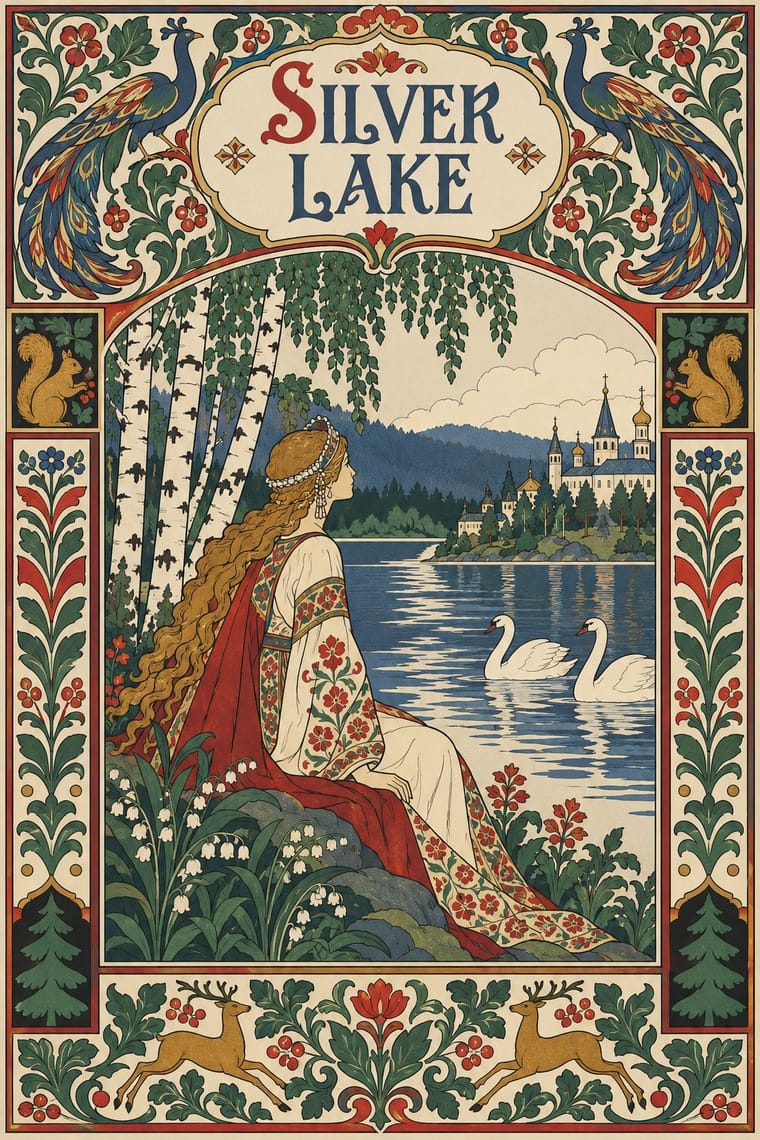
Bilibin's Russian fairy tales are its eastern neighbour; take Bilibin's framed page and lettering and fill it with a Bauer-like deep forest for a northern storybook, keeping Norse and Russian sources distinct.
Mix them and make something Mir iskusstva Book Art Nordic Fairy-Tale and Troll Illustration
01
What each style brings
Each part of the design comes from the style with the stronger say in it, and each style gives at least two.
Mir iskusstva Book Art Nordic Fairy-Tale and Troll Illustration (Werenskiold, Kittelsen, Bauer)
- Type from Mir iskusstva Book Art
- Colour from Nordic Fairy-Tale and Troll Illustration
- Form from Mir iskusstva Book Art
-
Nordic Fairy-Tale and Troll Illustration avoids stylised figuration: this is where the two pull against each other.
- Composition from Nordic Fairy-Tale and Troll Illustration
- Surface from Nordic Fairy-Tale and Troll Illustration
02
The type
Open fonts standing in for each style’s own type, which is often hand-drawn or commercial.
Display · Mir iskusstva Book Art
Rose
Federant; Mir iskusstva Book Art used Ivan Bilibin's hand-drawn cover titles and illuminated initials in an Old Russian manner, drawn as part of the page and Typeset Cyrillic text in a single block inside an ornamental border, opened by an illuminated initial and closed by a tailpiece
Text · Nordic Fairy-Tale and Troll Illustration
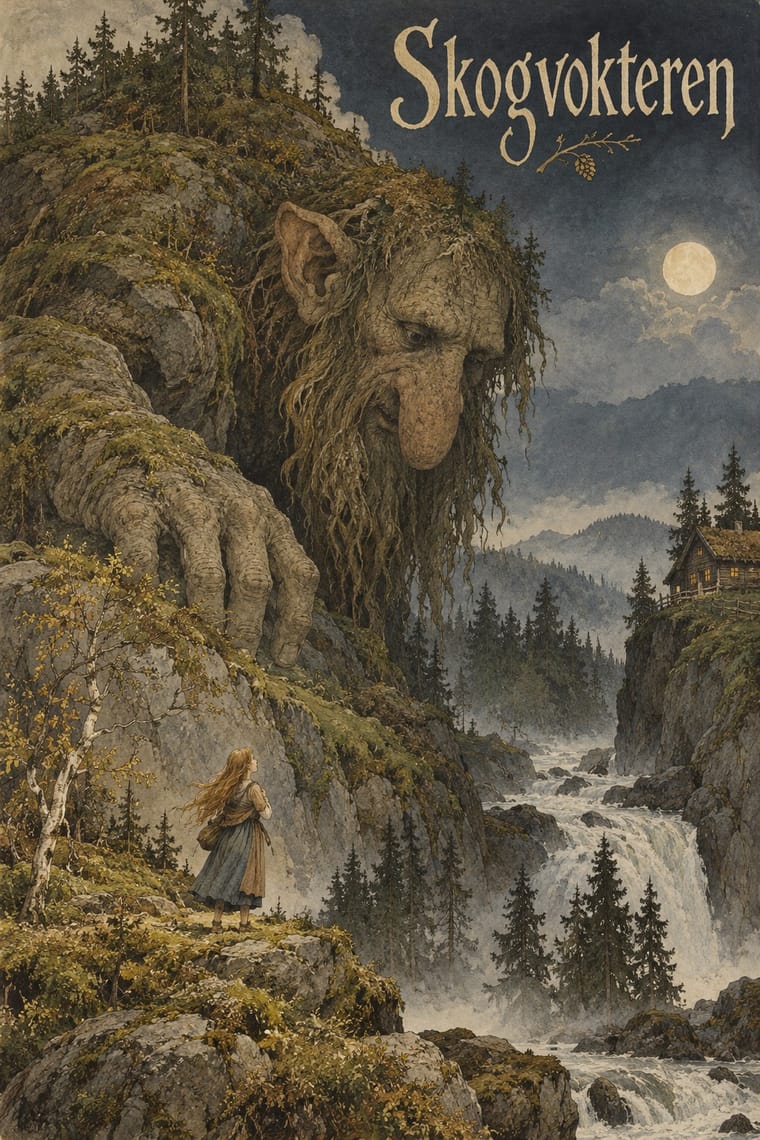
Norwegian and Swedish folk-tale illustration in which trolls, nøkken and huldra live in a real, observed northern landscape of forest, mountain, bog and farm. Werenskiold invented the forest troll type for Asbjørnsen and Moe in 1879, Kittelsen made it grow out of rock, root and water in hatched pen and wash, and Bauer, in muted watercolour plates for Bland tomtar och troll, set small, still princesses among towering firs and lumbering trolls.
EB Garamond; Nordic Fairy-Tale and Troll Illustration used Fraktur text and caption type in the Copenhagen Eventyrbog for Børn (1883–87), e.g. the caption '„Hutetu!" sagde Troldet. Tegning af E. Werenskiold.' under a full-page drawing in vol. 2 (1884) and Ornamented fantasy display lettering in red on a gilt panel, with nisser (gnomes), a cat and a porridge pot above it, on the publisher's binding of Eventyrbog for Børn vol. 1 (1883), drawn by Gotfred Albert Hartvig and engraved by J. C. S. Danielsen
03
The colours
The ground and leading colours come from Nordic Fairy-Tale and Troll Illustration, with a counter-accent from Mir iskusstva Book Art. The ink reads on the ground at 4.5:1 or more.
Mir iskusstva Book Art Nordic Fairy-Tale and Troll Illustration (Werenskiold, Kittelsen, Bauer)
-
#e9e0c9ground · 36% -
#1f1e1aink · 14% -
#c4a04eaccent · 18% -
#6b5238accent · 14% -
#b8342aaccent · 10% -
#50606eaccent · 8%
As CSS
:root {
  --ground: #e9e0c9;
  --ink: #1f1e1a;
  --accent-1: #c4a04e;
  --accent-2: #6b5238;
  --accent-3: #b8342a;
  --accent-4: #50606e;
  --font-display: "Federant", sans-serif;
  --font-text: "EB Garamond", serif;
}
Use it with care
Mir iskusstva Book Art: This 'Russian' folk look is a refined, partly state-commissioned idiom of the imperial capital, assembled by professional artists from northern peasant crafts, lubki and icons: do not present it as timeless ethnic Russian folk art or as a neutral emblem of the Russian state, and keep icon-derived holy figures out of trivial uses. Its makers were not all Russian: Heorhiy Narbut, for example, became rector of the Ukrainian Academy of Arts and designed the Ukrainian People's Republic's banknotes and stamps, so credit artists by their own identities. Benois (d. 1960) and Dobuzhinsky (d. 1957) remain in copyright in the EU and Russia (life plus 70 years, so at least until 2031 and 2028), while Bilibin (d. 1942), Somov (d. 1939) and Narbut (d. 1920) are in the public domain there: draw new borders, figures and lettering rather than reproducing their pages. Somov's Le Livre de la Marquise is explicitly erotic, above all the 1918 edition, so keep its plates out of children's or general-audience pastiche.
Nordic Fairy-Tale and Troll Illustration (Werenskiold, Kittelsen, Bauer): Bauer took bent knives, shoes, spears, pots and belts from his 1904 sketches of Sámi life and made them part of his trolls' clothes and ornament: do not dress trolls or other monsters in Sámi gáktis, duodji or tools, or cast the Sámi, a living Indigenous people, as fairy-tale creatures of the northern wilderness. Kittelsen's pictures have also been reused by Norwegian black metal, including on Filosofem by Varg Vikernes, a neo-Nazi, so keep this imagery away from ethnic-nationalist and 'pure North' framings.
04
The two styles
05
More combinations
With Mir iskusstva Book Art
- Leningrad Avant-Garde Picture Book Contrasts · Lebedev's Leningrad books dropped the frame, the ornament and the fairy-tale past, floating a few flat planes on bare paper; set them side by side to decide between a bordered, retrospective page and an open, modern one.
- Vienna Secession Contrasts · Both enclose pictures in symmetrical frames, but Vienna squared the frame into grids and bars while the Russian book filled a wide border with folk and rococo motifs; pick geometric order or narrative ornament.
- Bezalel School Pairs well · In the same years both used Art Nouveau's ornamental frame to build a national book art from older ornament; set Bilibin's folk borders beside Raban's filigree frames to compare two revivals, or combine their framed, lettered pages.
- Ligne Claire (Franco-Belgian Clear Line) Pairs well · Both draw an even black contour and fill it with flat colour; give a clear-line page Bilibin's ornamental border and headpiece for a storybook with a heritage frame.
- Russian Futurist Book Contrasts · Both drew on the lubok, but the Futurists kept its crude cut, rough paper and handwriting while the World of Art refined it into a polished, bordered ensemble; choose between raw and ennobled folk sources.
- Celtic Revival Illumination & Lettering Pairs well · A parallel national revival of the same decades: both turned medieval and folk ornament into the borders and initials of a modern book; combine for a heritage storybook framed in old ornament.
- Vyaz (Ornamental Slavonic Lettering) Pairs well · Bilibin's circle drew titles and initials in an Old Russian manner into bordered fairy-tale books; put a newly drawn vyaz title under a folk-ornament headpiece for a Russian Revival page rather than copying a liturgical heading.
- Norwegian and Finnish National Romantic Graphics (Munthe & Karelianism) Pairs well · A parallel national revival of the same years: Bilibin framed Russian fairy tales in Old Russian borders as Munthe framed the sagas; combine for a northern storybook, but keep the Norse and Russian sources distinct.
With Nordic Fairy-Tale and Troll Illustration
- Black Metal Graphics Contrasts · Burzum's Filosofem (1996) put Kittelsen's 'Op under Fjeldet toner en Lur' on its cover; mind the caution before borrowing that framing, and keep the folk-tale humour and tenderness the sleeves leave out.
- Finnish Bold Print (Marimekko Modernism) Contrasts · Nordic flat, abstract repeat printing of the 1950s against this tonal, figurative forest; set a single troll silhouette into a bold flat field to bridge them.
- Norwegian and Finnish National Romantic Graphics (Munthe & Karelianism) Contrasts · The same decades and some of the same artists (Werenskiold led the illustrators of the 1899 Kongesagaer), but flat, frontal and ornamental where this is deep, tonal and atmospheric; frame one deep troll forest with a Munthe-style flat border to show the two branches side by side.
- Victorian Colour Toy Books (Evans, Crane, Caldecott and Greenaway) Contrasts · Both are children's picture books of the same era, but the toy book's bright flat key-block colour and nursery cheer stand against this dusky, modelled and uncanny northern mood.