Style combination · Pairs well
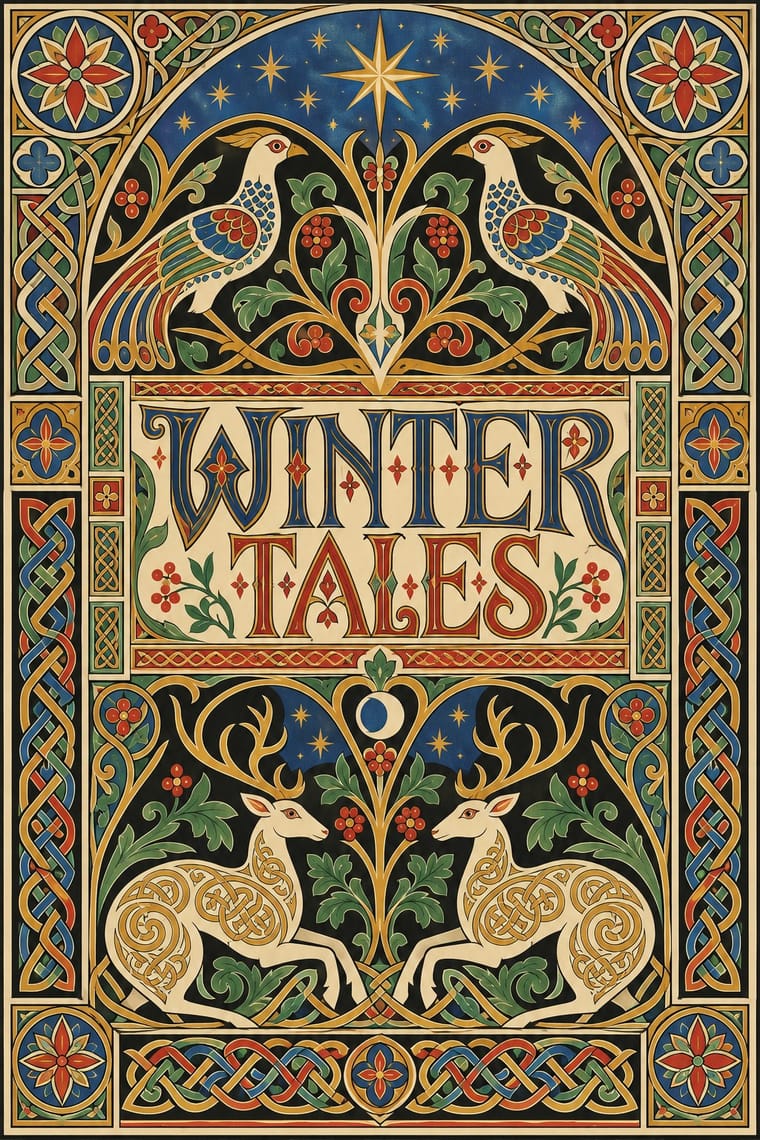
Celtic Revival Illumination × Mir iskusstva Book Art
A parallel national revival of the same decades: both turned medieval and folk ornament into the borders and initials of a modern book; combine for a heritage storybook framed in old ornament.
Mix them and make something Celtic Revival Illumination Mir iskusstva Book Art
01
What each style brings
Each part of the design comes from the style with the stronger say in it, and each style gives at least two.
Celtic Revival Illumination & Lettering Mir iskusstva Book Art
- Type from Mir iskusstva Book Art
- Colour from Mir iskusstva Book Art
- Form from Celtic Revival Illumination
- Composition from Celtic Revival Illumination
- Surface from Celtic Revival Illumination
02
The type
Open fonts standing in for each style’s own type, which is often hand-drawn or commercial.
Display · Mir iskusstva Book Art
Souvenir
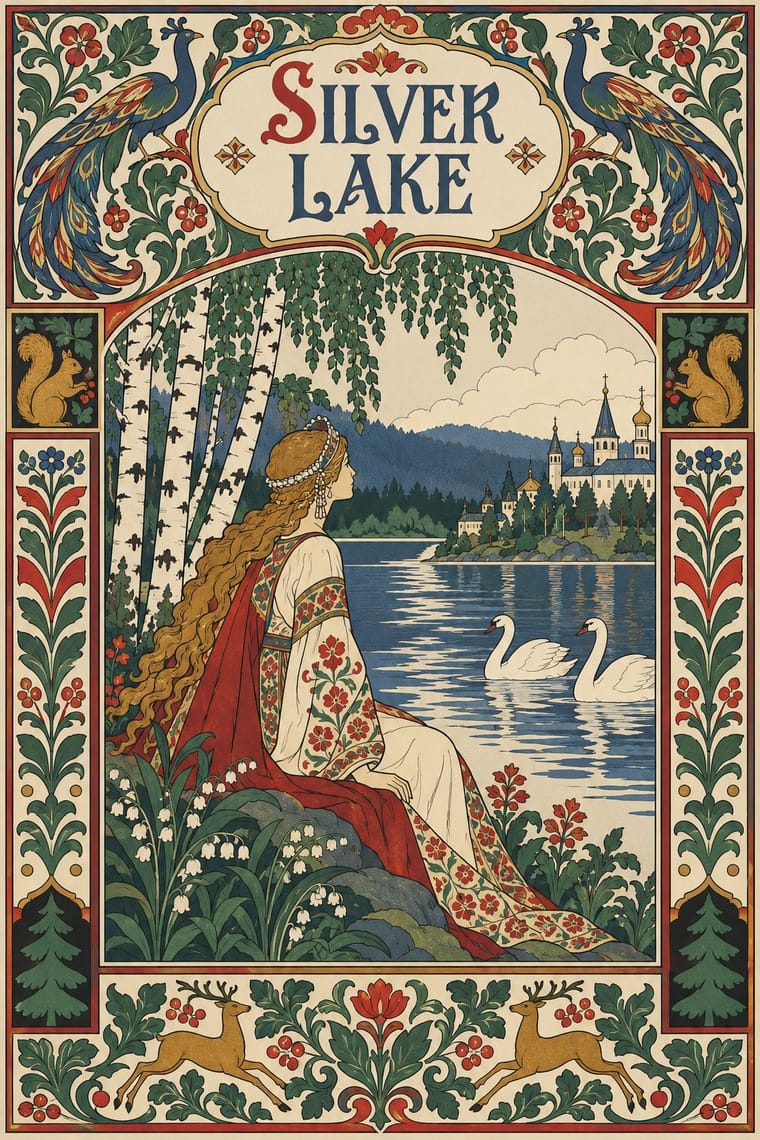
Federant; Mir iskusstva Book Art used Ivan Bilibin's hand-drawn cover titles and illuminated initials in an Old Russian manner, drawn as part of the page and Typeset Cyrillic text in a single block inside an ornamental border, opened by an illuminated initial and closed by a tailpiece
Text · Celtic Revival Illumination
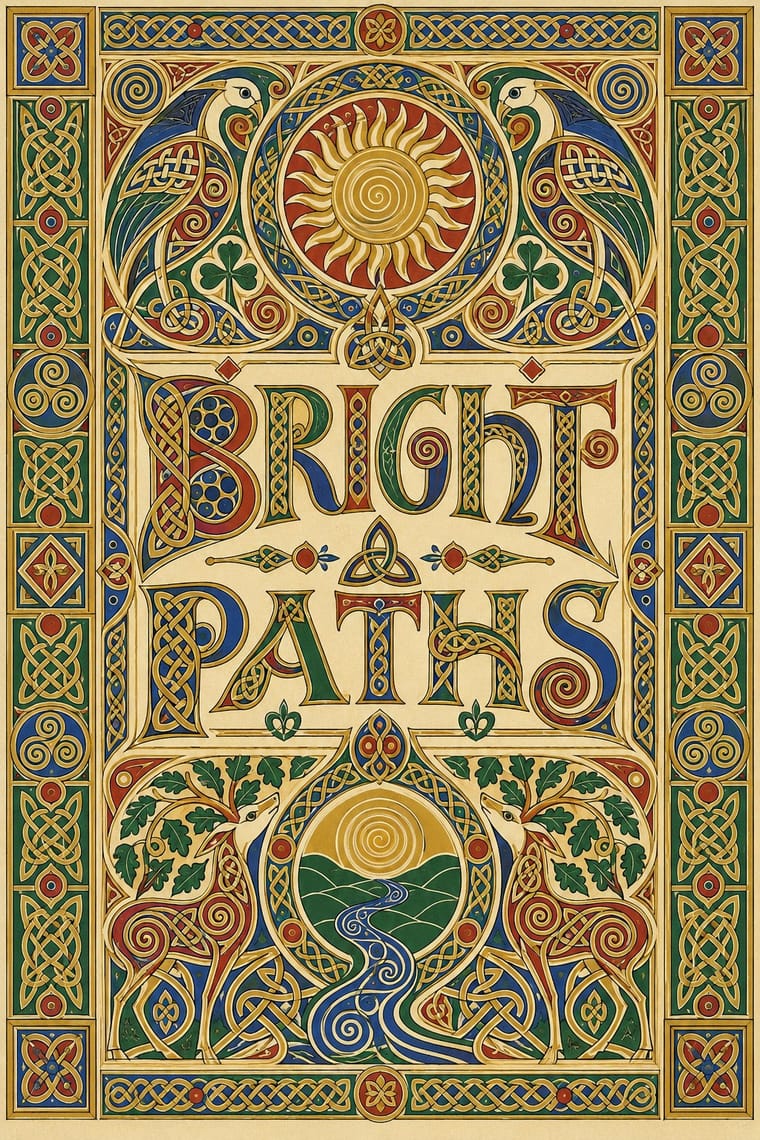
Ornament and lettering of the Celtic Revival in Ireland, Scotland and the Isle of Man, modelled on Insular gospel books such as Kells and on carved stone crosses. Text sits in closed, symmetrical frames of knotwork, key pattern, spirals and interlaced beasts, its letters drawn in insular forms, knotted into the ornament or set in Gaelic type, in deep flat colours on vellum or paper. Its makers carried it from illuminated books and addresses to a nationalist memorial book, Gaelic League mastheads, magazines, the Irish Free State's first stamps and Liberty silver.
EB Garamond; Celtic Revival Illumination used Hand-drawn lettering after the majuscule and half-uncial of the Insular manuscripts, drawn into the ornament and Archibald Knox's interlaced Celtic lettering, drawn so densely into the ornament that it must be studied to be read
03
The colours
The ground and leading colours come from Mir iskusstva Book Art, with a counter-accent from Celtic Revival Illumination. The ink reads on the ground at 4.5:1 or more.
Celtic Revival Illumination & Lettering Mir iskusstva Book Art
-
#efe6cfground · 36% -
#1b1a17ink · 14% -
#c99a3aaccent · 18% -
#b8342aaccent · 14% -
#3d5a85accent · 10% -
#3e6b4faccent · 8%
As CSS
:root {
  --ground: #efe6cf;
  --ink: #1b1a17;
  --accent-1: #c99a3a;
  --accent-2: #b8342a;
  --accent-3: #3d5a85;
  --accent-4: #3e6b4f;
  --font-display: "Federant", sans-serif;
  --font-text: "EB Garamond", serif;
}
Use it with care
Celtic Revival Illumination & Lettering: Its models are Christian gospel books and crosses, and many of its emblems are national and partisan: Leabhar na hAiséirghe is a memorial to the republican dead of 1916–23, including the Civil War, and the Celtic Cross stamp was adapted from a Sinn Féin label, so do not use these as neutral 'Irish' decoration where nationalist imagery is contested, as in Northern Ireland. The 1922 Map of Ireland stamp left out the border, and some in Northern Ireland and Britain read it as a claim to the northern counties, so an undivided map of the island is itself a political statement. A square cross interlocked with or surrounded by a circle is a widespread white-supremacist symbol, while the traditional Celtic cross has a long vertical shaft, so draw the cross accordingly and check knotwork marks in context. 'Celtic' and 'Irish' are not exclusive labels for Kells-type ornament: Insular art was made across Britain and Ireland, the Lindisfarne Gospels in Northumbria, and Kells itself possibly begun on Iona. George Bain died in 1968, so his drawings remain in copyright in the UK until the end of 2038: construct new knots by his methods rather than tracing his plates, and have any Irish or Scottish Gaelic text checked by a fluent reader.
Mir iskusstva Book Art: This 'Russian' folk look is a refined, partly state-commissioned idiom of the imperial capital, assembled by professional artists from northern peasant crafts, lubki and icons: do not present it as timeless ethnic Russian folk art or as a neutral emblem of the Russian state, and keep icon-derived holy figures out of trivial uses. Its makers were not all Russian: Heorhiy Narbut, for example, became rector of the Ukrainian Academy of Arts and designed the Ukrainian People's Republic's banknotes and stamps, so credit artists by their own identities. Benois (d. 1960) and Dobuzhinsky (d. 1957) remain in copyright in the EU and Russia (life plus 70 years, so at least until 2031 and 2028), while Bilibin (d. 1942), Somov (d. 1939) and Narbut (d. 1920) are in the public domain there: draw new borders, figures and lettering rather than reproducing their pages. Somov's Le Livre de la Marquise is explicitly erotic, above all the 1918 edition, so keep its plates out of children's or general-audience pastiche.
04
The two styles
05
More combinations
With Celtic Revival Illumination
- Bezalel School Pairs well · Another national illumination of the 1900s–1920s, with hand-drawn national letters, jewel colours and gold inside heavy symmetrical frames; compare how each built a national art from ancient ornament.
- Gothic Blackletter & Fraktur Tradition Contrasts · The other national script of the same decades: Fraktur set German text until its ban in 1941, as Gaelic type set Irish until the mid-twentieth century; set the dark, broken gothic weave against the round, open insular letter.
- International Typographic Style Contrasts · Its exact opposite: hand-built, symmetrical, ornament-filled national pages against an asymmetric grid, neutral sans-serif and white space; borrow one knotted initial to warm a strict grid.
- Ethiopian Ge'ez Manuscript & Haräg Illumination Pairs well · Another Christian manuscript tradition that marks its divisions with interlace: set a haräg band of interlace and chequers beside a Celtic knotwork frame to compare a varied headpiece with a closed, compartmented border.
- Islamic Geometric & Calligraphic Tradition Pairs well · Both build sacred pages from interlaced strapwork constructed geometrically and framed symmetrically; set a Celtic knot border beside a girih panel to compare closed knotwork with an endless star tiling.
- Glasgow Style Contrasts · Scotland in the same years, but Glasgow stretched space, emptied it and set a few rosebuds on long verticals, while the Celtic Revival fills its compartments densely with knotwork; choose air or density.
- Armenian Manuscript Illumination Pairs well · Both build letters out of animals and interlace; set a bird-letter initial beside a knotted Celtic one to compare an initial made of whole birds with one made of interlaced beasts.
- Norwegian and Finnish National Romantic Graphics (Munthe & Karelianism) Pairs well · Both turned medieval interlace and beast heads into the ornament of a national book; set Norse dragon-head vignettes beside Insular knotwork for a North Sea saga cycle.
With Mir iskusstva Book Art
- Leningrad Avant-Garde Picture Book Contrasts · Lebedev's Leningrad books dropped the frame, the ornament and the fairy-tale past, floating a few flat planes on bare paper; set them side by side to decide between a bordered, retrospective page and an open, modern one.
- Vienna Secession Contrasts · Both enclose pictures in symmetrical frames, but Vienna squared the frame into grids and bars while the Russian book filled a wide border with folk and rococo motifs; pick geometric order or narrative ornament.
- Bezalel School Pairs well · In the same years both used Art Nouveau's ornamental frame to build a national book art from older ornament; set Bilibin's folk borders beside Raban's filigree frames to compare two revivals, or combine their framed, lettered pages.
- Ligne Claire (Franco-Belgian Clear Line) Pairs well · Both draw an even black contour and fill it with flat colour; give a clear-line page Bilibin's ornamental border and headpiece for a storybook with a heritage frame.
- Russian Futurist Book Contrasts · Both drew on the lubok, but the Futurists kept its crude cut, rough paper and handwriting while the World of Art refined it into a polished, bordered ensemble; choose between raw and ennobled folk sources.
- Vyaz (Ornamental Slavonic Lettering) Pairs well · Bilibin's circle drew titles and initials in an Old Russian manner into bordered fairy-tale books; put a newly drawn vyaz title under a folk-ornament headpiece for a Russian Revival page rather than copying a liturgical heading.
- Norwegian and Finnish National Romantic Graphics (Munthe & Karelianism) Pairs well · A parallel national revival of the same years: Bilibin framed Russian fairy tales in Old Russian borders as Munthe framed the sagas; combine for a northern storybook, but keep the Norse and Russian sources distinct.
- Armenian Manuscript Illumination Pairs well · Bilibin's circle turned medieval ornament into the borders and initials of a modern book; follow that route to use canon-table arcades as a frame for new text rather than copying a sacred page.