Style combination · Contrasts
Lebanese Civil War Party Poster × Syrian Revolution Graphics
Party-branded martyr obituaries with emblems and leaders against irreverent sheets, signed only by a town or a collective, that answer one leader's cult; the contrast shows what a poster without a party looks like.
Mix them and make something Lebanese Civil War Party Poster Syrian Revolution Graphics
01
What each style brings
Each part of the design comes from the style with the stronger say in it, and each style gives at least two.
Lebanese Civil War Party Poster Syrian Revolution Graphics (Kafranbel Banners & Poster Collectives)
- Type from Syrian Revolution Graphics
- Colour from Syrian Revolution Graphics
- Form from Lebanese Civil War Party Poster
- Composition from Lebanese Civil War Party Poster
- Surface from Syrian Revolution Graphics
02
The type
Open fonts standing in for each style’s own type, which is often hand-drawn or commercial.
Display · Syrian Revolution Graphics
Now!
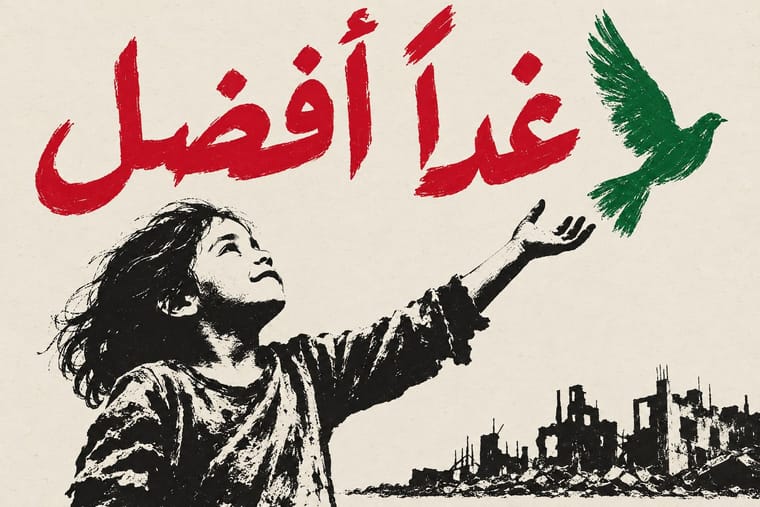
Rakkas, standing in for Freely brushed Arabic calligraphy for one- or two-word slogans, composed for each poster rather than typed in a stock font; one member said he sometimes spent two days designing a single word such as 'freedom' or 'revolution', and that some pieces drew on Persian calligraphy (Al-Safir interview, 2012)
Text · Lebanese Civil War Party Poster
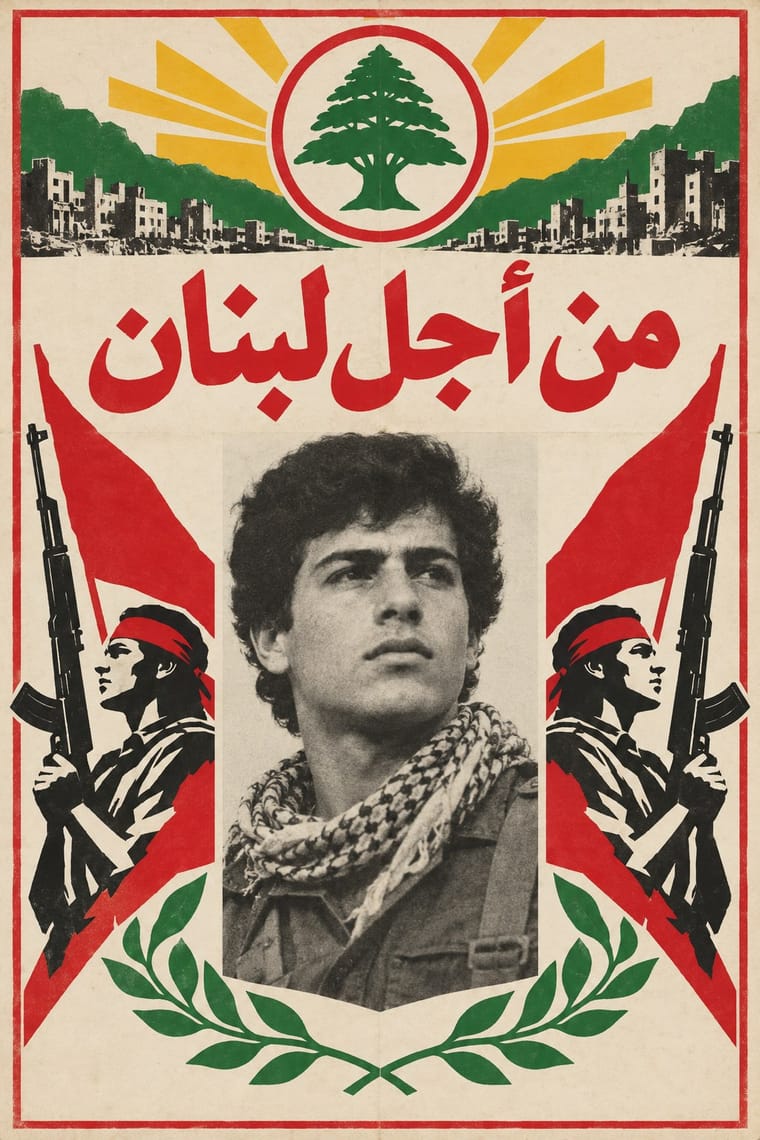
The posters that some twenty parties and militias pasted on the walls of Beirut and other towns between 1975 and 1990, marking each quarter as one faction's territory. With no state style, every party branded its sheets with its own name, emblem, colours, leader and slogans. The staple was the martyr poster: a public obituary with the fallen partisan's straight photograph, name and dates under a header naming the party, often with its emblem, issued in series. Leftist parties also commissioned painters, and Hizbullah and Amal had martyrs painted into symbolic scenes.
Archivo; Lebanese Civil War Party Poster used Hand-lettered Arabic headlines in Naskh, Thuluth and Ruqʿa styles for martyr names, epithets, slogans and Qur'anic verses and Typeset Arabic Naskh text for the martyr's biography and dates
03
The colours
The ground and leading colours come from Syrian Revolution Graphics, with a counter-accent from Lebanese Civil War Party Poster. The ink reads on the ground at 4.5:1 or more.
Lebanese Civil War Party Poster Syrian Revolution Graphics (Kafranbel Banners & Poster Collectives)
-
#f1ece0ground · 36% -
#151515ink · 14% -
#c8102eaccent · 18% -
#f2c12eaccent · 14% -
#e0912faccent · 10% -
#007a3daccent · 8%
As CSS
:root {
  --ground: #f1ece0;
  --ink: #151515;
  --accent-1: #c8102e;
  --accent-2: #f2c12e;
  --accent-3: #e0912f;
  --accent-4: #007a3d;
  --font-display: "Rakkas", cursive;
  --font-text: "Archivo", sans-serif;
}
Use it with care
Lebanese Civil War Party Poster: These posters show real people who were killed, many of them young partisans whose families are alive, and some glorify attacks carried out as 'martyrdom operations'; most of the parties that issued them are still active and the war's memory remains contested in Lebanon. Do not use martyr portraits, party emblems or Shiʿa devotional imagery as edgy 'war poster' decoration: cite the posters as historical documents with their archive, have every Arabic line read by a fluent reader, and remember that a party's colours and symbols still align a design with one camp. Hizbullah is banned in several countries, for example the UK (proscribed in full in 2019) and Germany (a 2020 ban on its activity that covers its symbols), where displaying its emblem can itself be an offence. The collections and Maasri's book also lean towards the Left and its Palestinian allies, while the Christian right fought its image war mainly on television, so the leftist look is not the whole war.
Syrian Revolution Graphics (Kafranbel Banners & Poster Collectives): These graphics come from an uprising met with massacres, sieges, detention and disappearance, and their makers worked under pseudonyms at real risk: Raed Fares and Hamoud Junaid were shot dead in Kafranbel on 23 November 2018 (local activists blamed Hayat Tahrir al-Sham, which did not claim it), and the collective signed only with its own name, so never attribute a poster to an individual member or expose anyone who made this work. The martyr, siege, bread and Hama motifs refer to real massacres and real dead, not to an edgy 'war poster' look. The collective's posters were released under Creative Commons BY-NC, so do not use them or close pastiches commercially, and credit the collective, Kafranbel and the Creative Memory archive. The three-star flag has been the state flag since the HTS-dominated caretaker government took it up after Assad's fall, so using it, or Kafranbel's banners, as generic 'Syria' branding can imply an alignment their makers never gave. Have every Arabic line read by a fluent reader, never fill a design with pseudo-Arabic, do not mock the broken English of some banners, which was written to be understood abroad, and never present a generated image as a work of the uprising.
04
The two styles
05
More combinations
With Lebanese Civil War Party Poster
- Polish Poster School Contrasts · Polish metaphor and ambiguity are the opposite of a literal face, name and date; use the contrast to decide whether a commemoration needs an idea or a record.
- Spanish Civil War Poster Contrasts · Another civil war fought on the walls by rival factions, but with painted allegorical heroes; set them side by side to see what the straight photograph of a named dead partisan does that a drawn fighter cannot.
- Ghanaian Funeral Poster & Banner Contrasts · Both are public obituaries pasted on walls, with a straight photograph of the dead, the name and the dates, but a martyr poster is issued in series by a party under its emblem and slogans to claim a quarter, while a Ghanaian funeral poster is commissioned by one family to invite mourners and rank its kin; take the portrait-and-header format without the partisan voice.
- Egyptian Revolutionary Street Art (Mohamed Mahmoud Murals) Contrasts · Beirut's martyr posters were issued by parties marking walls as territory; Cairo's martyrs were painted by artists who said they had nothing to do with any party. Compare them to judge whose voice a commemoration speaks in.
- Arab Independent Comics (Samandal, TokTok, Lab619, Skefkef) Contrasts · The party posters glorified martyrs and leaders; Lena Merhej said Samandal refused to write about the war, 'a subject that exasperates us', and turned instead to religion, politics and sex, with irony rather than tribute.
With Syrian Revolution Graphics
- Arabic Calligraffiti Pairs well · Scale a brushed slogan from the poster up to a wall with calligraffiti's architectural sweep, keeping the words short and checked by a fluent reader.
- Solidarność & Polish Underground Graphics Contrasts · Both made hand-lettered protest banners and cheap copies and answered force with irony, but Solidarność gathered under one logotype and a union, where these sheets were signed only by a town or a collective, bilingual and made for the feed; set them side by side to weigh one shared mark against many local, dated voices.
- Egyptian Revolutionary Street Art (Mohamed Mahmoud Murals) Pairs well · Its 2011 neighbour: Cairo painted martyrs and friezes onto walls, Syria made portable sheets for the camera; put a Syrian-style printable slogan beside a mural photograph to join wall and feed.
- Atelier Populaire (May '68 Screenprint Poster) Pairs well · Both are anonymous collectives that argue out one figure and one punning slogan together; borrow May '68's single flat ink for a Syrian poster that must print cheaply.
- Ukrainian Wartime Graphics (Saint Javelin, War Stamps and Be Brave Like Ukraine) Contrasts · Both were made for the feed in wartime and answer violence with irony, but the Syrian posters came from an unsponsored, pseudonymous collective facing its own regime, while Ukraine's national post and president's office commission and sign theirs; the comparison shows what state backing does to protest graphics.