Style combination · Pairs well
Atelier Populaire × Syrian Revolution Graphics
Both are anonymous collectives that argue out one figure and one punning slogan together; borrow May '68's single flat ink for a Syrian poster that must print cheaply.
Mix them and make something Atelier Populaire Syrian Revolution Graphics
01
What each style brings
Each part of the design comes from the style with the stronger say in it, and each style gives at least two.
Atelier Populaire (May '68 Screenprint Poster) Syrian Revolution Graphics (Kafranbel Banners & Poster Collectives)
- Type from Syrian Revolution Graphics
- Colour from Atelier Populaire
- Form from Atelier Populaire
- Composition from Atelier Populaire
- Surface from Syrian Revolution Graphics
-
Atelier Populaire avoids halftone & ben-day dots: this is where the two pull against each other.
02
The type
Open fonts standing in for each style’s own type, which is often hand-drawn or commercial.
Display · Syrian Revolution Graphics
Riot
Rakkas, standing in for Freely brushed Arabic calligraphy for one- or two-word slogans, composed for each poster rather than typed in a stock font; one member said he sometimes spent two days designing a single word such as 'freedom' or 'revolution', and that some pieces drew on Persian calligraphy (Al-Safir interview, 2012)
Text · Atelier Populaire
The posters of the Atelier populaire, set up when students, teachers and artists occupied the École des Beaux-Arts in Paris on 14 May 1968, until police cleared the school on 27 June. Designs were voted on at evening assemblies, left unsigned and pulled on improvised silkscreens: one flat ink on cheap or donated paper, a single brushed silhouette (a riot policeman, de Gaulle, a factory) and a short punning slogan in rough capitals, pasted up across Paris overnight.
Oswald; Atelier Populaire used Brushed letters, left open on the silk while gum arabic is painted around them to block the screen, so the edges stay ragged and uneven and Wall-slogan handwriting of May '68, lifted from graffiti and marches
03
The colours
The ground and leading colours come from Atelier Populaire, with a counter-accent from Syrian Revolution Graphics. The ink reads on the ground at 4.5:1 or more.
Atelier Populaire (May '68 Screenprint Poster) Syrian Revolution Graphics (Kafranbel Banners & Poster Collectives)
-
#f2eee3ground · 36% -
#141414ink · 14% -
#cf2027accent · 18% -
#23408eaccent · 14% -
#e0912faccent · 10% -
#b4875aaccent · 8%
As CSS
:root {
  --ground: #f2eee3;
  --ink: #141414;
  --accent-1: #cf2027;
  --accent-2: #23408e;
  --accent-3: #e0912f;
  --accent-4: #b4875a;
  --font-display: "Rakkas", cursive;
  --font-text: "Oswald", sans-serif;
}
Use it with care
Atelier Populaire (May '68 Screenprint Poster): The posters were made anonymously and given away, and some equate the police or de Gaulle with the Nazis (the SS on a riot policeman's shield, popularly 'CRS SS'; Hitler holding a de Gaulle mask); do not attribute them to individual designers, sell pastiches as May '68 originals, or aim those Nazi comparisons at real people today without that history in view. 'Nous sommes tous des Juifs allemands' answered antisemitic attacks on Cohn-Bendit's origins (the far-right press smeared him as a Marxist German Jew, and Georges Marchais wrote in L'Humanité of 'the German anarchist'); do not reuse it, or the 'indésirables' poster, as a generic 'we are all X' template without that history.
Syrian Revolution Graphics (Kafranbel Banners & Poster Collectives): These graphics come from an uprising met with massacres, sieges, detention and disappearance, and their makers worked under pseudonyms at real risk: Raed Fares and Hamoud Junaid were shot dead in Kafranbel on 23 November 2018 (local activists blamed Hayat Tahrir al-Sham, which did not claim it), and the collective signed only with its own name, so never attribute a poster to an individual member or expose anyone who made this work. The martyr, siege, bread and Hama motifs refer to real massacres and real dead, not to an edgy 'war poster' look. The collective's posters were released under Creative Commons BY-NC, so do not use them or close pastiches commercially, and credit the collective, Kafranbel and the Creative Memory archive. The three-star flag has been the state flag since the HTS-dominated caretaker government took it up after Assad's fall, so using it, or Kafranbel's banners, as generic 'Syria' branding can imply an alignment their makers never gave. Have every Arabic line read by a fluent reader, never fill a design with pseudo-Arabic, do not mock the broken English of some banners, which was written to be understood abroad, and never present a generated image as a work of the uprising.
04
The two styles
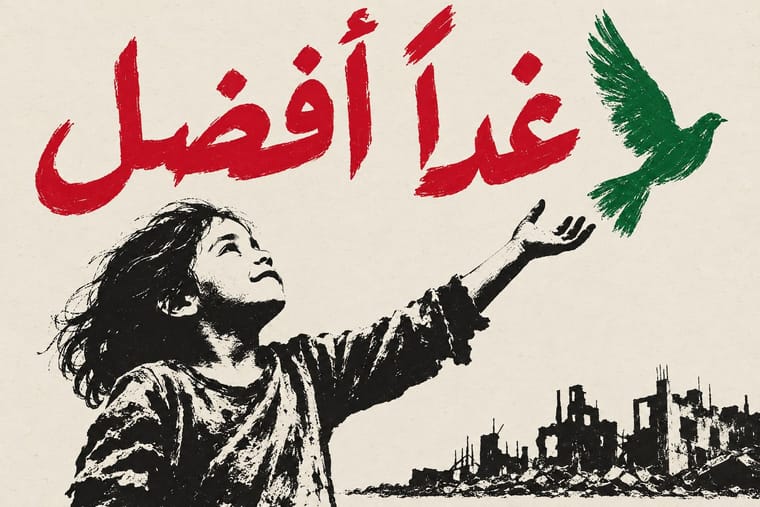
05
More combinations
With Atelier Populaire
- South African Resistance Poster Pairs well · Both chose hand-made silkscreen because it was cheap, quick and teachable to non-artists; borrow the struggle posters' organisation emblems and second ink when a campaign must stay recognisable beyond one day's slogan.
- Cuban Revolutionary Poster (OSPAAAL & ICAIC) Contrasts · Same decade, opposite means: ICAIC's silkscreened film posters and OSPAAAL's mostly offset solidarity posters were polished, many-coloured and made to last, while the Atelier's one anonymous ink was pulled overnight for the next morning's wall; decide which of the two the brief needs.
- Polish Poster School Contrasts · Polish posters are signed painterly metaphors by named authors, while the Atelier stripped away signature and painterly finish; a recognisable individual hand breaks its collective voice.
- ROSTA Windows Pairs well · Like the ROSTA windows, each sheet answers the day's news by hand with a stark figure and a caption; run single posters as a numbered sequence when one image cannot tell the whole story.
- Punk & DIY Zine Pairs well · The House of European History traces a line from these posters to Jamie Reid's Sex Pistols graphics; set one brushed slogan in a single ink against xerox cut-up for a flyer with the same anti-authority bite.
- See Red Women's Workshop Feminist Screenprints Contrasts · Both are collective, unsigned screenprints, but May '68 shouts one emblem and a strike slogan, while See Red tells a small domestic story with a wry caption.
- Grapus (French Militant Graphic Collective) Contrasts · The founders came out of the 1968 workshops, but the Beaux-Arts atelier pulled one flat ink, one brushed silhouette and a slogan in rough capitals; Grapus layers photographs, paint and coloured handwriting, mostly on white. Use the first for overnight urgency, Grapus for a warmer, longer campaign.
- ACT UP & Gran Fury AIDS Activist Graphics Contrasts · Both answered a crisis with overnight slogans on the street, but the May '68 posters were brushed by hand and pulled in one ink, while most ACT UP and Gran Fury posters were professionally printed in offset and modelled on advertising; choose rough urgency or seductive polish before mixing them.
With Syrian Revolution Graphics
- Lebanese Civil War Party Poster Contrasts · Party-branded martyr obituaries with emblems and leaders against irreverent sheets, signed only by a town or a collective, that answer one leader's cult; the contrast shows what a poster without a party looks like.
- Arabic Calligraffiti Pairs well · Scale a brushed slogan from the poster up to a wall with calligraffiti's architectural sweep, keeping the words short and checked by a fluent reader.
- Solidarność & Polish Underground Graphics Contrasts · Both made hand-lettered protest banners and cheap copies and answered force with irony, but Solidarność gathered under one logotype and a union, where these sheets were signed only by a town or a collective, bilingual and made for the feed; set them side by side to weigh one shared mark against many local, dated voices.
- Egyptian Revolutionary Street Art (Mohamed Mahmoud Murals) Pairs well · Its 2011 neighbour: Cairo painted martyrs and friezes onto walls, Syria made portable sheets for the camera; put a Syrian-style printable slogan beside a mural photograph to join wall and feed.
- Ukrainian Wartime Graphics (Saint Javelin, War Stamps and Be Brave Like Ukraine) Contrasts · Both were made for the feed in wartime and answer violence with irony, but the Syrian posters came from an unsponsored, pseudonymous collective facing its own regime, while Ukraine's national post and president's office commission and sign theirs; the comparison shows what state backing does to protest graphics.