Style combination · Contrasts
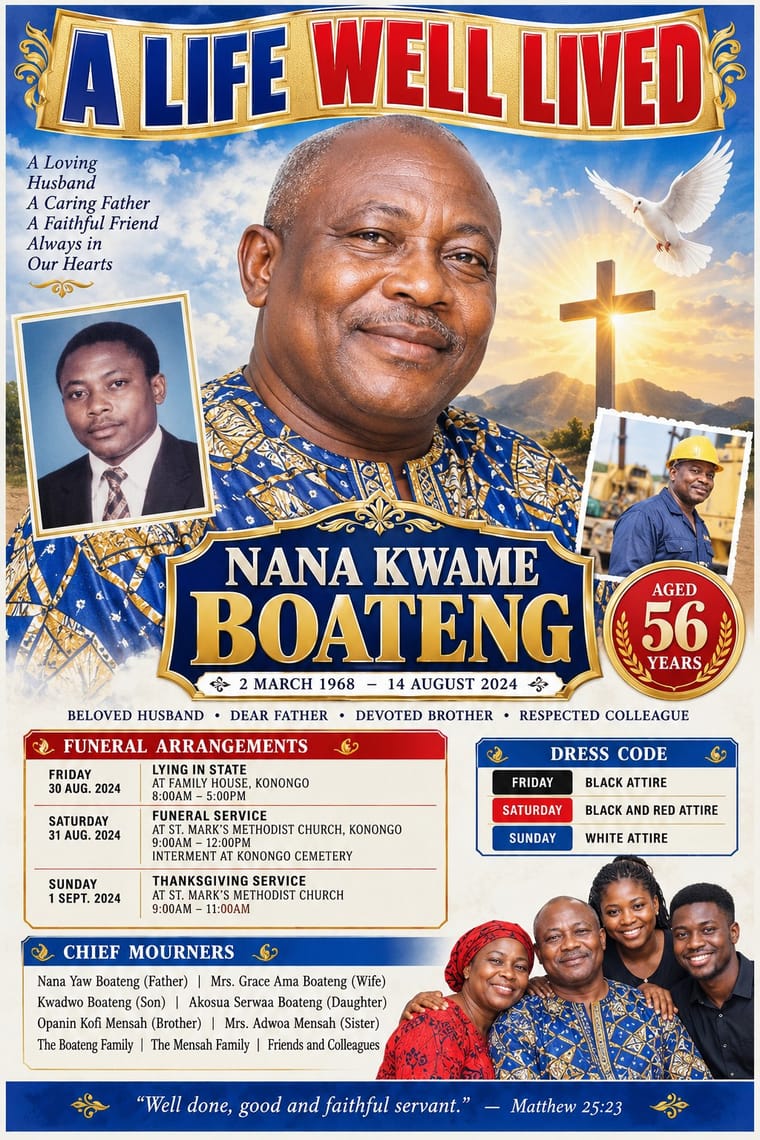
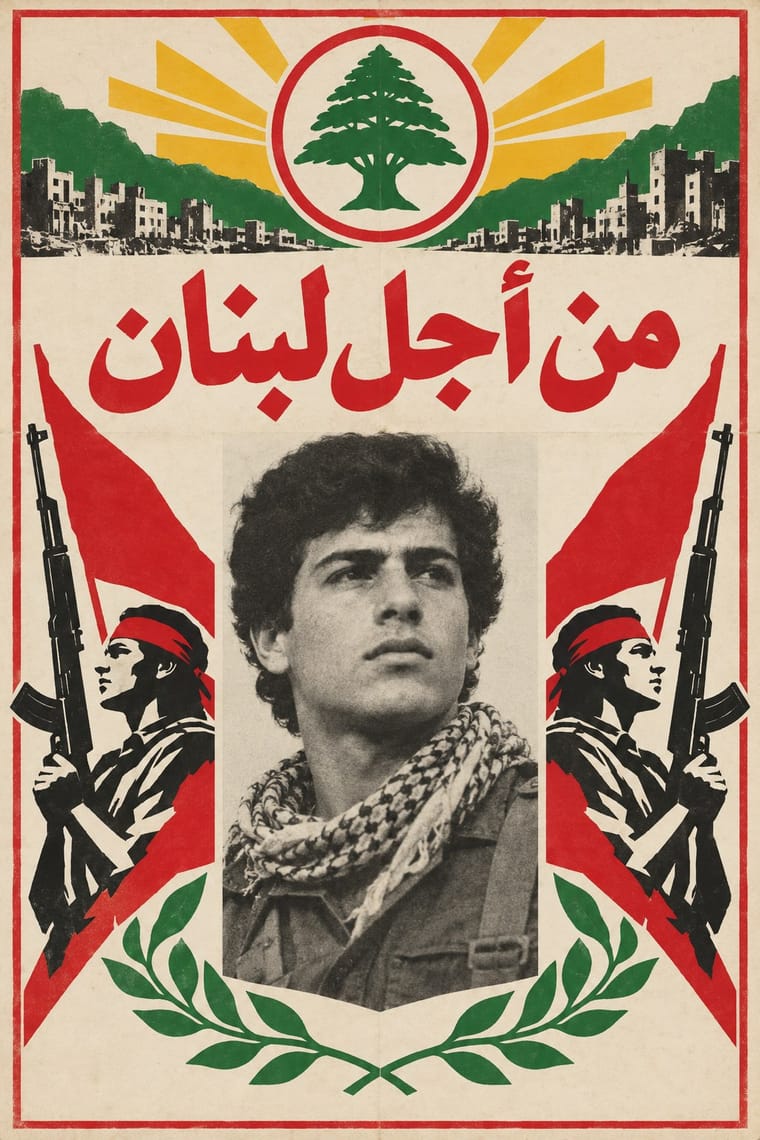
Ghanaian Funeral Poster × Lebanese Civil War Party Poster
Both are public obituaries pasted on walls, with a straight photograph of the dead, the name and the dates, but a martyr poster is issued in series by a party under its emblem and slogans to claim a quarter, while a Ghanaian funeral poster is commissioned by one family to invite mourners and rank its kin; take the portrait-and-header format without the partisan voice.
Mix them and make something Ghanaian Funeral Poster Lebanese Civil War Party Poster
01
What each style brings
Each part of the design comes from the style with the stronger say in it, and each style gives at least two.
Ghanaian Funeral Poster & Banner Lebanese Civil War Party Poster
- Type from Ghanaian Funeral Poster
- Colour from Ghanaian Funeral Poster
- Form from Lebanese Civil War Party Poster
- Composition from Ghanaian Funeral Poster
- Surface from Lebanese Civil War Party Poster
02
The type
Open fonts standing in for each style’s own type, which is often hand-drawn or commercial.
Display · Ghanaian Funeral Poster
Fiesta
Archivo Black, standing in for Connected script for first names and titles (a first name or a title with initials) over the surname in heavy sans-serif capitals, often outlined and set in white, red, navy or yellow
Text · Lebanese Civil War Party Poster
The posters that some twenty parties and militias pasted on the walls of Beirut and other towns between 1975 and 1990, marking each quarter as one faction's territory. With no state style, every party branded its sheets with its own name, emblem, colours, leader and slogans. The staple was the martyr poster: a public obituary with the fallen partisan's straight photograph, name and dates under a header naming the party, often with its emblem, issued in series. Leftist parties also commissioned painters, and Hizbullah and Amal had martyrs painted into symbolic scenes.
Archivo; Lebanese Civil War Party Poster used Hand-lettered Arabic headlines in Naskh, Thuluth and Ruqʿa styles for martyr names, epithets, slogans and Qur'anic verses and Typeset Arabic Naskh text for the martyr's biography and dates
03
The colours
The ground and leading colours come from Ghanaian Funeral Poster, with a counter-accent from Lebanese Civil War Party Poster. The ink reads on the ground at 4.5:1 or more.
Ghanaian Funeral Poster & Banner Lebanese Civil War Party Poster
-
#f6f4efground · 36% -
#151515ink · 14% -
#c3161caccent · 18% -
#f2c12eaccent · 14% -
#1d3f94accent · 10% -
#2f8a3caccent · 8%
As CSS
:root {
  --ground: #f6f4ef;
  --ink: #151515;
  --accent-1: #c3161c;
  --accent-2: #f2c12e;
  --accent-3: #1d3f94;
  --accent-4: #2f8a3c;
  --font-display: "Archivo Black", sans-serif;
  --font-text: "Archivo", sans-serif;
}
Use it with care
Ghanaian Funeral Poster & Banner: These posters and banners show real, recently dead people and name their living relatives, and families pay for them as part of a funeral the community judges closely. Funeral posters are usually made for Christians and followers of traditional African religions (Adotey 2018), so do not present them as the funeral custom of all Ghanaians. Do not lift a real poster's photograph, names or lists into new work, and do not use the headlines and colour code as a gag or a generic 'African' texture: 'What a Shock' and a red ground mark a death as sudden or untimely, and relatives often find a banner on their own house painful to live with. The ranked lists of chief mourners can also carry live disputes over kinship and chieftaincy, as when the Tefle Traditional Council formally protested in 2009 against its omission from the poster of a Sokpoe paramount chief. Commission and credit Ghanaian designers and print shops for work in this idiom.
Lebanese Civil War Party Poster: These posters show real people who were killed, many of them young partisans whose families are alive, and some glorify attacks carried out as 'martyrdom operations'; most of the parties that issued them are still active and the war's memory remains contested in Lebanon. Do not use martyr portraits, party emblems or Shiʿa devotional imagery as edgy 'war poster' decoration: cite the posters as historical documents with their archive, have every Arabic line read by a fluent reader, and remember that a party's colours and symbols still align a design with one camp. Hizbullah is banned in several countries, for example the UK (proscribed in full in 2019) and Germany (a 2020 ban on its activity that covers its symbols), where displaying its emblem can itself be an offence. The collections and Maasri's book also lean towards the Left and its Palestinian allies, while the Christian right fought its image war mainly on television, so the leftist look is not the whole war.
04
The two styles
05
More combinations
With Ghanaian Funeral Poster
- Ghanaian Movie Poster Contrasts · They share the walls of Ghanaian towns, but the movie poster is painted by hand on flour sacks with invented, lurid scenes, while the funeral poster is typeset on a computer around a real photograph; set one painted, exaggerated figure against a funeral poster's sober portrait for a deliberate clash of registers.
- Adinkra & Kente Symbol Systems Pairs well · A multicoloured strip border like kente's already frames some funeral banners; frame a portrait with a woven-strip border or a single adinkra sign whose proverb suits a death, learning its meaning first and keeping sacred signs out of trivial use.
- African Wax & Fancy Print Pairs well · Bredenbröker lists commemorative T-shirts, mugs and handkerchiefs beside the posters and banners as popular items that commemorate the dead in public, and wax print's one-sided fancy prints already serve as commemorative cloth with portraits; pair a funeral poster's photograph, name and age badge with a fancy-print repeat for a commemorative textile, keeping real people's faces and names out of new work.
- South African Vernacular Design (Ijusi) Pairs well · Both work in the street-level commercial vernacular of outlined lettering, badges and many typefaces at once, but Ijusi collages township signage as a designer's quotation while the funeral poster is that vernacular in use; pair the funeral poster's photographic portrait and ranked lists with Ijusi's collage for a layered, local announcement.
With Lebanese Civil War Party Poster
- Polish Poster School Contrasts · Polish metaphor and ambiguity are the opposite of a literal face, name and date; use the contrast to decide whether a commemoration needs an idea or a record.
- Spanish Civil War Poster Contrasts · Another civil war fought on the walls by rival factions, but with painted allegorical heroes; set them side by side to see what the straight photograph of a named dead partisan does that a drawn fighter cannot.
- Syrian Revolution Graphics (Kafranbel Banners & Poster Collectives) Contrasts · Party-branded martyr obituaries with emblems and leaders against irreverent sheets, signed only by a town or a collective, that answer one leader's cult; the contrast shows what a poster without a party looks like.
- Egyptian Revolutionary Street Art (Mohamed Mahmoud Murals) Contrasts · Beirut's martyr posters were issued by parties marking walls as territory; Cairo's martyrs were painted by artists who said they had nothing to do with any party. Compare them to judge whose voice a commemoration speaks in.
- Arab Independent Comics (Samandal, TokTok, Lab619, Skefkef) Contrasts · The party posters glorified martyrs and leaders; Lena Merhej said Samandal refused to write about the war, 'a subject that exasperates us', and turned instead to religion, politics and sex, with irony rather than tribute.