Style combination · Pairs well
Ghanaian Funeral Poster × South African Vernacular Design
Both work in the street-level commercial vernacular of outlined lettering, badges and many typefaces at once, but Ijusi collages township signage as a designer's quotation while the funeral poster is that vernacular in use; pair the funeral poster's photographic portrait and ranked lists with Ijusi's collage for a layered, local announcement.
Mix them and make something Ghanaian Funeral Poster South African Vernacular Design
01
What each style brings
Each part of the design comes from the style with the stronger say in it, and each style gives at least two.
Ghanaian Funeral Poster & Banner South African Vernacular Design (Ijusi)
- Type from South African Vernacular Design
- Colour from Ghanaian Funeral Poster
- Form from Ghanaian Funeral Poster
- Composition from Ghanaian Funeral Poster
- Surface from South African Vernacular Design
02
The type
Open fonts standing in for each style’s own type, which is often hand-drawn or commercial.
Display · South African Vernacular Design
Fiesta
Sedgwick Ave Display, standing in for Son of Sam (Garth Walker, 2003–04), the Constitutional Court's unicase display face, named after the cell graffiti 'son of sam now son of hope' and built from prison-cell graffiti, a judge's handwriting and site lettering, with numerals after the stencilled cell numbers
Text · Ghanaian Funeral Poster
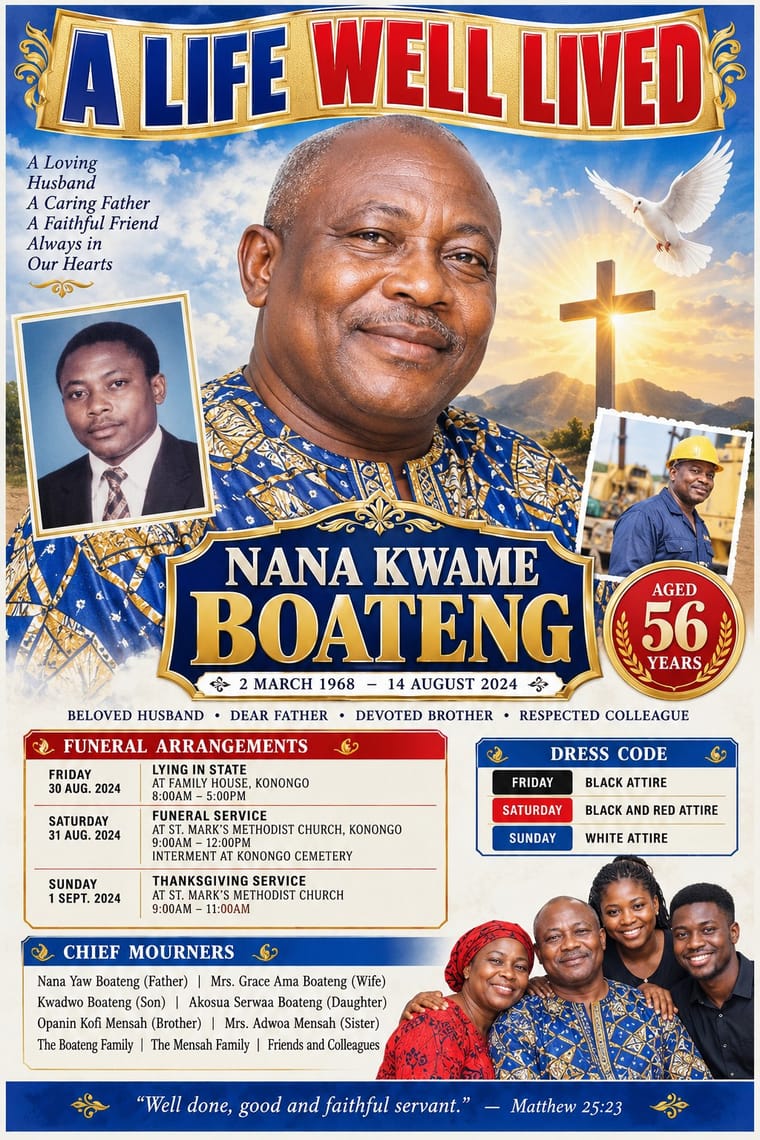
The printed death announcements of southern Ghana, also found elsewhere in West Africa: colour posters, mostly A2, pasted on walls, trees, poles and vehicles, and by the mid-2010s large PVC banners hung at the family house. Laid out on computers by local designers and photographers, each sets the deceased's photograph under a stock headline that classes the death ('What a Shock', 'Home Call', 'Celebration of Life'), with the name, the age in a badge, the funeral programme and long ranked lists of children, relatives and chief mourners that display the family's standing.
Newsreader; Ghanaian Funeral Poster used Stock headline phrases ('Celebration Of Life', 'What a Shock', 'Home Call') in serif or sans-serif display, often outlined in white or set on a coloured band, from a red serif in upper and lower case ('Celebration Of Life') to light capitals on a black band ('HOME CALL') and Connected script for first names and titles (a first name or a title with initials) over the surname in heavy sans-serif capitals, often outlined and set in white, red, navy or yellow
03
The colours
The ground and leading colours come from Ghanaian Funeral Poster, with a counter-accent from South African Vernacular Design. The ink reads on the ground at 4.5:1 or more.
Ghanaian Funeral Poster & Banner South African Vernacular Design (Ijusi)
-
#f6f4efground · 36% -
#151515ink · 14% -
#c3161caccent · 18% -
#ffb612accent · 14% -
#d4a52aaccent · 10% -
#f26c28accent · 8%
As CSS
:root {
  --ground: #f6f4ef;
  --ink: #151515;
  --accent-1: #c3161c;
  --accent-2: #ffb612;
  --accent-3: #d4a52a;
  --accent-4: #f26c28;
  --font-display: "Sedgwick Ave Display", cursive;
  --font-text: "Newsreader", serif;
}
Use it with care
Ghanaian Funeral Poster & Banner: These posters and banners show real, recently dead people and name their living relatives, and families pay for them as part of a funeral the community judges closely. Funeral posters are usually made for Christians and followers of traditional African religions (Adotey 2018), so do not present them as the funeral custom of all Ghanaians. Do not lift a real poster's photograph, names or lists into new work, and do not use the headlines and colour code as a gag or a generic 'African' texture: 'What a Shock' and a red ground mark a death as sudden or untimely, and relatives often find a banner on their own house painful to live with. The ranked lists of chief mourners can also carry live disputes over kinship and chieftaincy, as when the Tefle Traditional Council formally protested in 2009 against its omission from the poster of a Sokpoe paramount chief. Commission and credit Ghanaian designers and print shops for work in this idiom.
South African Vernacular Design (Ijusi): Ijusi's raw material is the work of living people: township sign painters, hair-salon and funeral-parlour sign makers, Zulu beadworkers and wire crafters. The Constitutional Court's typeface also quotes cell graffiti from the Old Fort, whose prisons held activists such as Mandela and Sobukwe and scores of ordinary Black South Africans jailed under the pass laws. Eye's reviewer, who judged Walker's efforts sincere, warned that anyone expecting Black design in i-jusi would find 'very little of it'. Credit and pay the makers whose lettering and craft you quote, commission them where you can, and do not reduce township design to a 'gritty African' texture for a brand with no stake in those streets. The comics issues featured Bitterkomix co-founder Anton Kannemeyer, criticised for 'offensive, racist imagery' in satires such as Pappa in Afrika, which recasts Hergé's Tintin as a white African; do not generate racial caricature outside that authorship and context. Son of Sam was commissioned for the Court's exclusive use.
04
The two styles
05
More combinations
With Ghanaian Funeral Poster
- Ghanaian Movie Poster Contrasts · They share the walls of Ghanaian towns, but the movie poster is painted by hand on flour sacks with invented, lurid scenes, while the funeral poster is typeset on a computer around a real photograph; set one painted, exaggerated figure against a funeral poster's sober portrait for a deliberate clash of registers.
- Adinkra & Kente Symbol Systems Pairs well · A multicoloured strip border like kente's already frames some funeral banners; frame a portrait with a woven-strip border or a single adinkra sign whose proverb suits a death, learning its meaning first and keeping sacred signs out of trivial use.
- Lebanese Civil War Party Poster Contrasts · Both are public obituaries pasted on walls, with a straight photograph of the dead, the name and the dates, but a martyr poster is issued in series by a party under its emblem and slogans to claim a quarter, while a Ghanaian funeral poster is commissioned by one family to invite mourners and rank its kin; take the portrait-and-header format without the partisan voice.
- African Wax & Fancy Print Pairs well · Bredenbröker lists commemorative T-shirts, mugs and handkerchiefs beside the posters and banners as popular items that commemorate the dead in public, and wax print's one-sided fancy prints already serve as commemorative cloth with portraits; pair a funeral poster's photograph, name and age badge with a fancy-print repeat for a commemorative textile, keeping real people's faces and names out of new work.
With South African Vernacular Design
- Emigre & Early Digital Type Contrasts · Ijusi's Typografika issues answered the 1990s experimental-font culture (Walker's Red Mercury pays tribute to Jonathan Barnbrook, whose early faces Emigre released), but drew their letters from Durban's shopfront hoardings, funeral parlours, beadwork and wire craft rather than from the screen; use Emigre for the digital edge and Ijusi for a sense of place.
- Cranbrook & Deconstructivist Typography Contrasts · Both layer vernacular lettering into experimental pages, but Cranbrook starts from literary theory and Ijusi from Durban's streets and the politics of a new democracy; choose by whether the brief is about reading or about place.
- International Typographic Style Contrasts · Ijusi was made against the clean, orderly corporate European look; one strict Swiss column can steady a crowded vernacular spread.
- South African Resistance Poster Contrasts · The struggle posters spoke with one voice in two or three inks; Ijusi, after 1994, mixes many voices, languages and colours. Quote the stencilled slogans as history, not as decoration.
- West African Barbershop & Hair Salon Signs Pairs well · Hair-salon boards were among Ijusi's sources; pair a painted grid of named hairstyles with a many-typeface layout and found photographs.
- Hand-Painted Signage & Vernacular Lettering Pairs well · Ijusi quotes the sign writer's drop-shadowed capitals; commission a working sign painter for the headline and collage it with photographs instead of faking the brush in vector.
- Drum Magazine & Sophiatown Photojournalism Pairs well · Post-apartheid Ijusi collages the street lettering of the townships Drum photographed; pair Drum's documentary pictures with Ijusi's vernacular type for a South African layout across both eras.