Style combination · Pairs well
Expressionist Woodcut Graphics × Hungarian Revolutionary Poster
Kinchin sees 'a burgeoning taste for Futurist and Expressionist design' in the MA circle's exhibition poster (Bortnyik); add a gouged, splintered edge to the red body when the hero should look anguished rather than triumphant.
Mix them and make something Expressionist Woodcut Graphics Hungarian Revolutionary Poster
01
What each style brings
Each part of the design comes from the style with the stronger say in it, and each style gives at least two.
Expressionist Woodcut Graphics Hungarian Revolutionary Poster
- Type from Hungarian Revolutionary Poster
- Colour from Expressionist Woodcut Graphics
- Form from Expressionist Woodcut Graphics
- Composition from Hungarian Revolutionary Poster
- Surface from Expressionist Woodcut Graphics
02
The type
Open fonts standing in for each style’s own type, which is often hand-drawn or commercial.
Display · Hungarian Revolutionary Poster
Loud
Big Shoulders, standing in for Heavy hand-drawn poster capitals for short Hungarian slogans and dates, lettered on the stone with the figure
Text · Expressionist Woodcut Graphics
The graphic arm of German Expressionism, from Die Brücke in Dresden (1905) to the Berlin journals Der Sturm and Die Aktion and Frans Masereel's woodcut novels. Artists revived the woodcut as a raw, subjective medium: they gouged distorted figures and jagged lettering into the same block and printed them in harsh black or a single flat ink, often on coloured paper, for exhibition posters, portfolios, manifestos and magazine covers.
Special Elite; Expressionist Woodcut Graphics used Hand-cut woodcut capitals and Rudolf Koch's Neuland (Klingspor, 1923), a display face in the same hand-cut spirit
03
The colours
The ground and leading colours come from Expressionist Woodcut Graphics, with a counter-accent from Hungarian Revolutionary Poster. The ink reads on the ground at 4.5:1 or more.
Expressionist Woodcut Graphics Hungarian Revolutionary Poster
-
#ede4cfground · 36% -
#151311ink · 14% -
#d9932faccent · 18% -
#c62a1faccent · 14% -
#2c4a8caccent · 10% -
#6e8b57accent · 8%
As CSS
:root {
  --ground: #ede4cf;
  --ink: #151311;
  --accent-1: #d9932f;
  --accent-2: #c62a1f;
  --accent-3: #2c4a8c;
  --accent-4: #6e8b57;
  --font-display: "Big Shoulders", sans-serif;
  --font-text: "Special Elite", monospace;
}
Use it with care
Hungarian Revolutionary Poster: Biró's red hammer man 'has been much repeated in Central European political iconography up to the present day' (MoMA), so it is still a live political sign. These are propaganda posters of a regime whose 133 days included the Red Terror, in which up to 590 people were killed; do not present them as neutral folk heroics. In Hungary the hammer and sickle and the five-pointed red star are restricted symbols under Btk. § 335 when distributed, used in public or displayed in a way that can disturb public peace, especially by offending the dignity of the victims of totalitarian regimes; keep them out of work aimed there. Never borrow the antisemitic 'Jewish Bolshevik' caricature that anti-communist posters of 1919 turned against the Republic, as in Manno Miltiades's poster in the USHMM's Katz Ehrenthal Collection.
04
The two styles
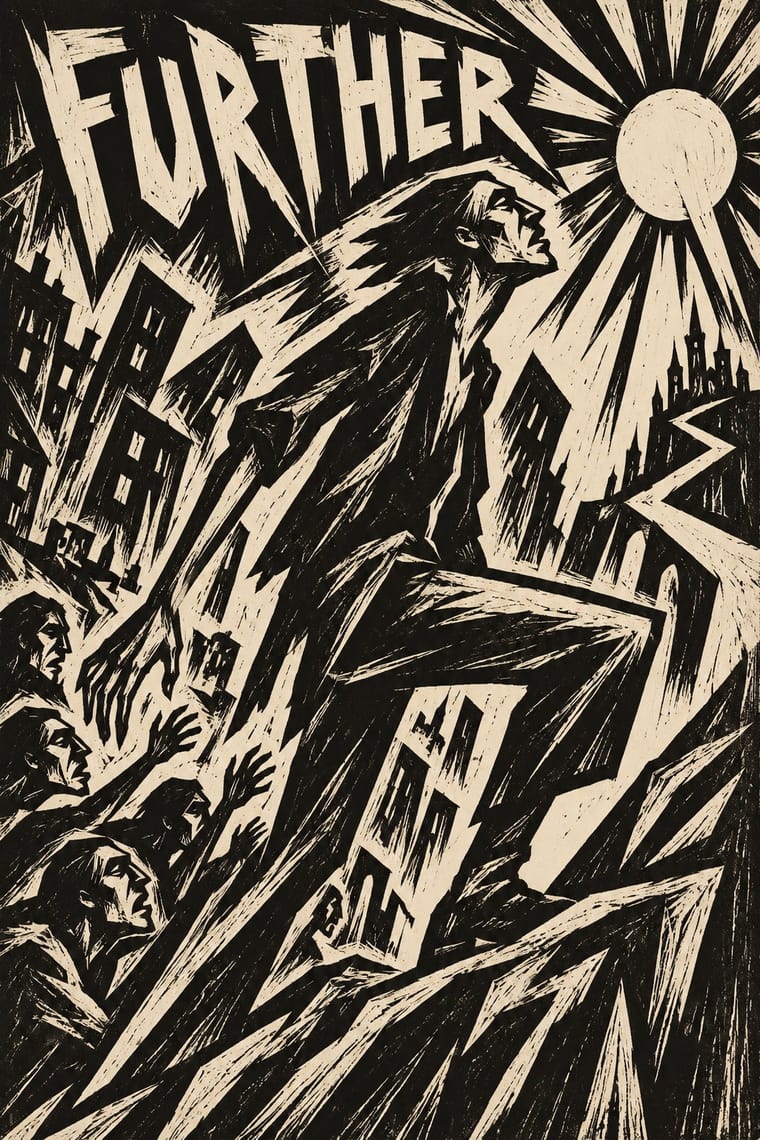
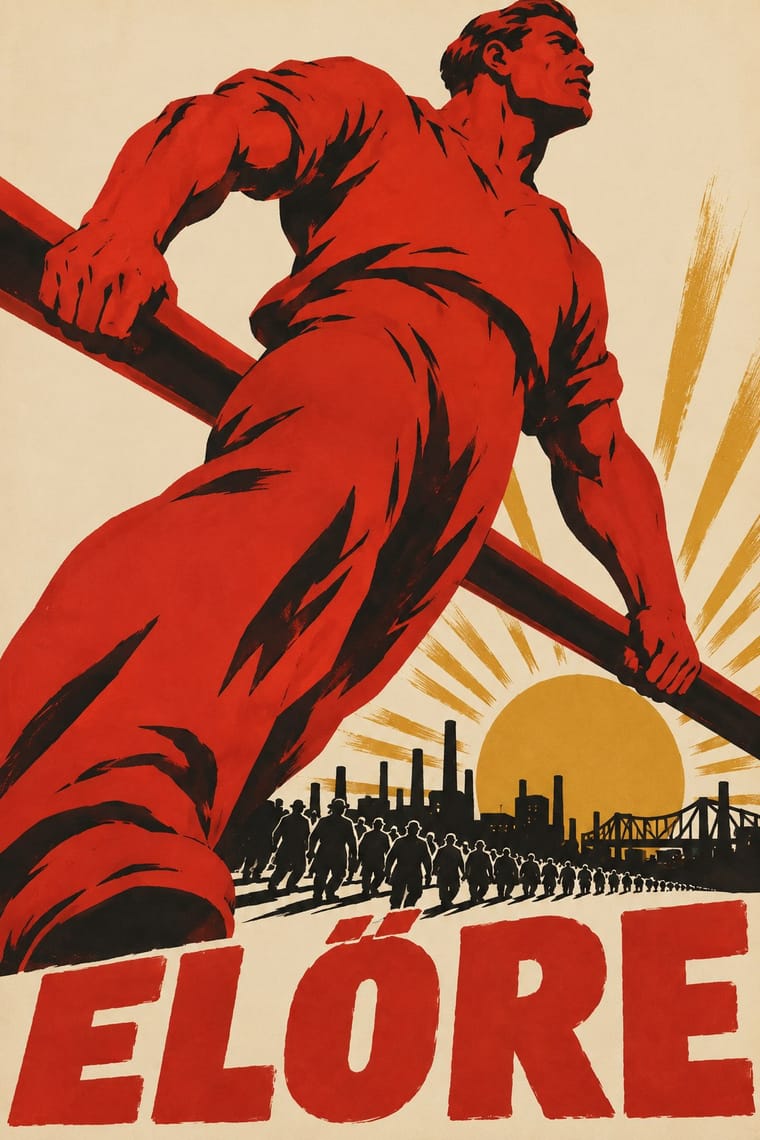
05
More combinations
With Expressionist Woodcut Graphics
- Art Nouveau Contrasts · The parent's smooth whiplash and floral harmony is exactly what the gouge splinters; use one against the other to stage order breaking down.
- Punk & DIY Zine Pairs well · Hand-cut jagged letters and one cheap ink suit gig posters and zines that want anger without photocopy clichés.
- Plakatstil / Sachplakat Contrasts · Same country and years: Bernhard's calm flat object poster against an anguished Brücke woodcut shows commercial clarity versus inner expression.
- Taller de Gráfica Popular Pairs well · Both gouge black-and-white relief images; add TGP's legible headlines and social subjects to steady expressionist distortion for a public message.
- Chinese Modern Woodcut Movement Pairs well · Lu Xun's movement learned from Kollwitz and Masereel; set the two side by side to show subjective anguish turning into collective resistance.
- Simplicissimus Satirical Style (Munich) Contrasts · Both distort the figure in protest, but Expressionist prints gouge it from the woodblock with angular, raw marks; Simplicissimus keeps a clean brush contour and flat tints, and adds a punchline.
- Argentine Adventure Historieta (Oesterheld–Breccia) Pairs well · Breccia's white scraped out of a black ground looks like the gouge of a Brücke woodcut; borrow the woodcut's jagged hand-cut capitals for a historieta title page or cover, and keep the comic's panels and captions inside.
- Rorke's Drift Linocut Contrasts · Both gouge black relief prints, but the Brücke woodcut distorts one anguished figure on tilted axes, while Rorke's Drift spreads a whole story across calm, packed bands; pick by whether the image should confess or narrate.
With Hungarian Revolutionary Poster
- Socialist Realist Propaganda Poster Contrasts · Both glorify the worker, but 1919 Budapest set a single red, mythic body against a plain ground where Soviet doctrine later demanded polychrome, illusionistic scenes of real workers and leaders; compare them to choose between mythic energy and illusionist credibility.
- Russian Constructivism Contrasts · Bortnyik and Kassák's circle moved towards construction in Vienna exile; set photomontage, grids and sans-serif bars against the hand-drawn heroic body to show that turn.
- ROSTA Windows Contrasts · Same year, opposite format: Moscow's stencilled comic-strip frames tell the news in sequence, Budapest's single lithographed giant states one demand at street scale.
- Spanish Civil War Poster Pairs well · Both throw one bursting figure across a red-and-black lithograph; borrow Spain's acronym signatures and stacked slogans to give a Budapest-style hero an organisation behind it.