Avant-garde · 1905–1925 · Central Europe, Western Europe
Expressionist Woodcut Graphics
Also known as German Expressionist print, Brücke graphics, Sturm & Aktion style
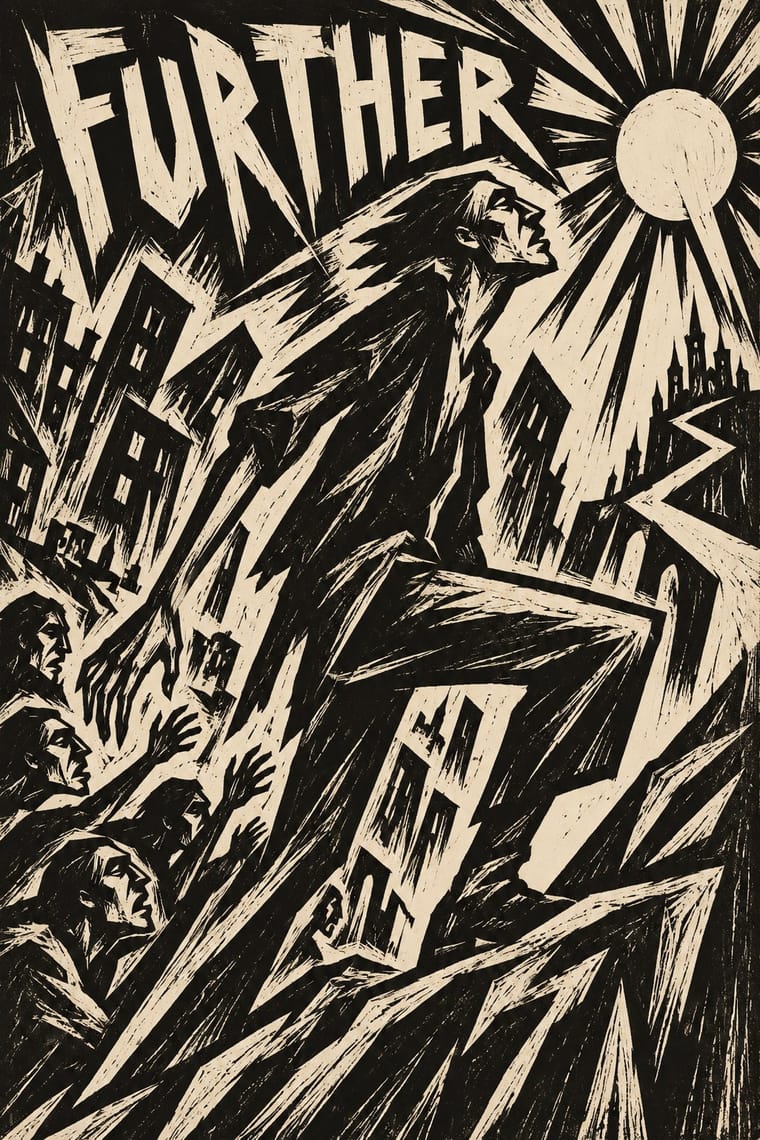
The graphic arm of German Expressionism, from Die Brücke in Dresden (1905) to the Berlin journals Der Sturm and Die Aktion and Frans Masereel's woodcut novels. Artists revived the woodcut as a raw, subjective medium: they gouged distorted figures and jagged lettering into the same block and printed them in harsh black or a single flat ink, often on coloured paper, for exhibition posters, portfolios, manifestos and magazine covers.
Make something in this styleGet advice in this styleMix it with another style
01
How it works
- Cut image and lettering into the same block, so the letters share the gouge's splintered, angular edge.
- Model form with raw black masses and white gouge strokes, and leave chisel marks and wood grain visible.
- Distort and elongate figures, faces and landscapes to express inner feeling rather than describe appearance.
- Print a single flat ink, often on coloured or rough paper (red on green, black on ochre), instead of full colour.
- Push figures against the edges of the block on tilted axes so the sheet feels charged and unstable.
- On journals, run a heavy masthead over a full-page woodcut; in books, tell the story as a wordless sequence of prints.
Dresden and Berlin (Die Brücke), Berlin (Der Sturm, Die Aktion), Munich (Der Blaue Reiter) and Vienna (Kokoschka); Frans Masereel in Geneva and Paris
02
Its design choices
From Stylogeny’s vocabulary of design choices: defining choices make the style, characteristic ones are usual, occasional ones turn up now and then.
- Layout & composition
- Space & hierarchy
- Typography
- Colour
- Form & shape
- Surface & texture
- Ornament
- Imagery
- Medium & production
- Tone & intent
- Avoids
- Floral & vegetal, Abundant decoration, Whiplash line, Naturalistic depiction, Gradients, Pastel, Gloss & highlights, Straight photography, Modular grid
Palette
#151311#ede4cf#c8432b#6e8b57#d9932f#2c4a8c
Typefaces
Hand-cut woodcut capitals
Kirchner's Brücke lettering
Rudolf Koch's Neuland (Klingspor, 1923), a display face in the same hand-cut spirit
Heavy grotesque and Fraktur journal mastheads
Known for
Ernst Ludwig Kirchner, Programm der Künstlergruppe Brücke
1906, woodcut manifesto
Erich Heckel, Die Brücke exhibition poster for the Kunstsalon Emil Richter, Dresden
1908, woodcut in red on green paper; Detroit Institute of Arts
Max Pechstein, poster for the Brücke exhibition at the Emil Richter gallery
1909, woodcut; Harvard Art Museums
Karl Schmidt-Rottluff, 'Brücke 1909' title woodcut for the group's fourth annual portfolio
LACMA
Oskar Kokoschka, Der Sturm poster
1910, lithograph; Leopold Museum, Vienna
Wassily Kandinsky, woodcut cover of the Der Blaue Reiter almanac
1912
Die Aktion (ed. Franz Pfemfert, Berlin, 1911–32), woodcut covers
Frans Masereel, Mon livre d'heures (Passionate Journey, 1919), woodcut novel
03
Make something in this style
Say what you need, and Stylogeny’s image studio draws it from Expressionist Woodcut Graphics’s design choices and checks it against them. It takes about a minute, and you get a link to share.
04
Where it comes from, and what it’s close to
Before it
The style it grew out of, and the styles it borrowed from.


Alike in its design choices
Styles that make many of the same choices, related or not, besides those above.


05
Real works
Artefacts in museums, libraries and archives that show the style, linked at their source.
- KG Brücke (exhibition poster for the Galerie Arnold, Dresden)Ernst Ludwig Kirchner (printed by the Gärtnersche Druckerei) · 1910 · Albertina, Vienna (DG2003/2048)
- Das Vater Unser (portfolio cover with title woodcut)Max Pechstein (Propyläen-Verlag, Berlin) · 1921 · Syracuse University Art Museum (1975.012)
- Die Aktion, IX. Jahrgang, Nr. 45/46 (15 November 1919), cover with the woodcut 'Die Revolution'Herbert Anger (woodcut); Franz Pfemfert (editor and publisher) · 15 November 1919 · The Museum of Modern Art, New York (as credited on Wikimedia Commons; image via Commons)
- Der Blaue Reiter (almanac), 2nd edition, front coverWassily Kandinsky (cover woodcut); Wassily Kandinsky and Franz Marc (editors); R. Piper & Co., Munich · 1914 (first edition 1912) · Heidelberg University Library (64 C 53 RES)
- Der Sturm (poster advertising a new issue)Oskar Kokoschka (printed by Kunstanstalt Arnold Weylandt, Berlin) · 1910 · Leopold Museum, Vienna (Inv. 5972)
06
Sources
- Detroit Institute of Arts, Erich Heckel, Die Brücke exhibition poster, 1908 (https://dia.org/collection/die-brucke-exhibition-poster-47696)
- LACMA, Robert Gore Rifkind Center for German Expressionist Studies, Karl Schmidt-Rottluff, Die Brücke IV, 1909 (M.82.288.368a-d)
- Leopold Museum, Oskar Kokoschka, Poster Der Sturm, 1910 (https://onlinecollection.leopoldmuseum.org/en/object/29968-poster-der-sturm/)
How Stylogeny researches and checks a style: where the facts come from.