Style combination · Pairs well
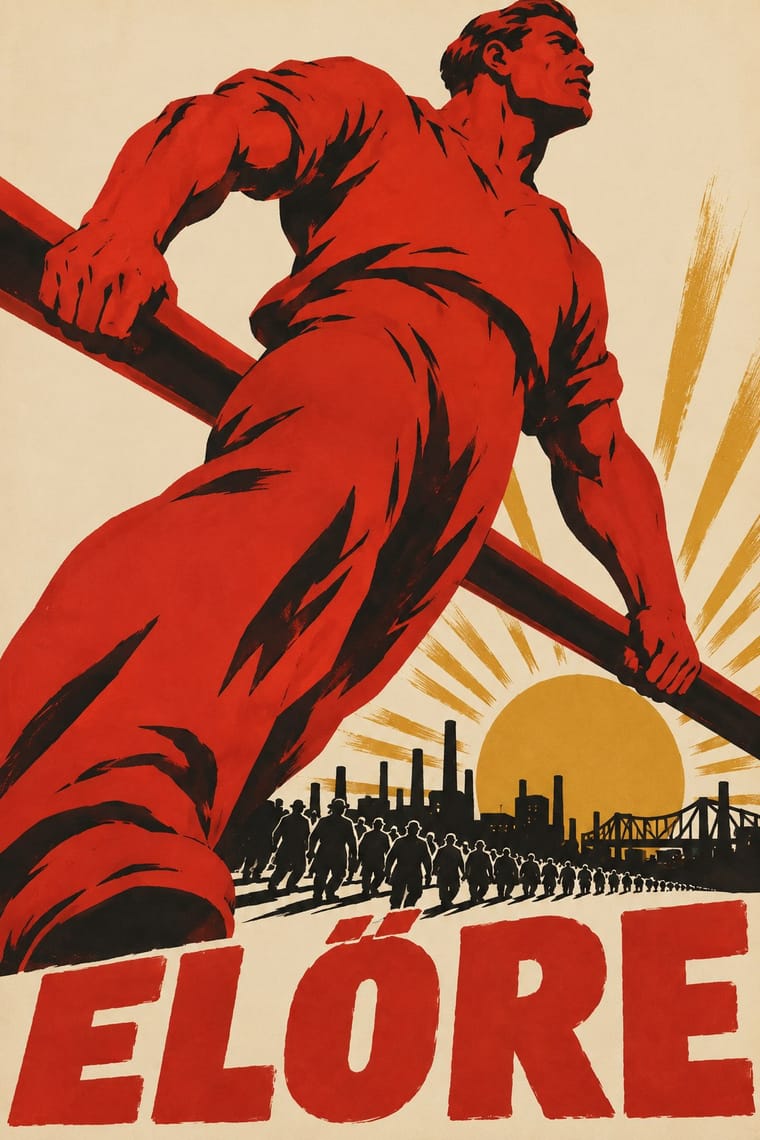
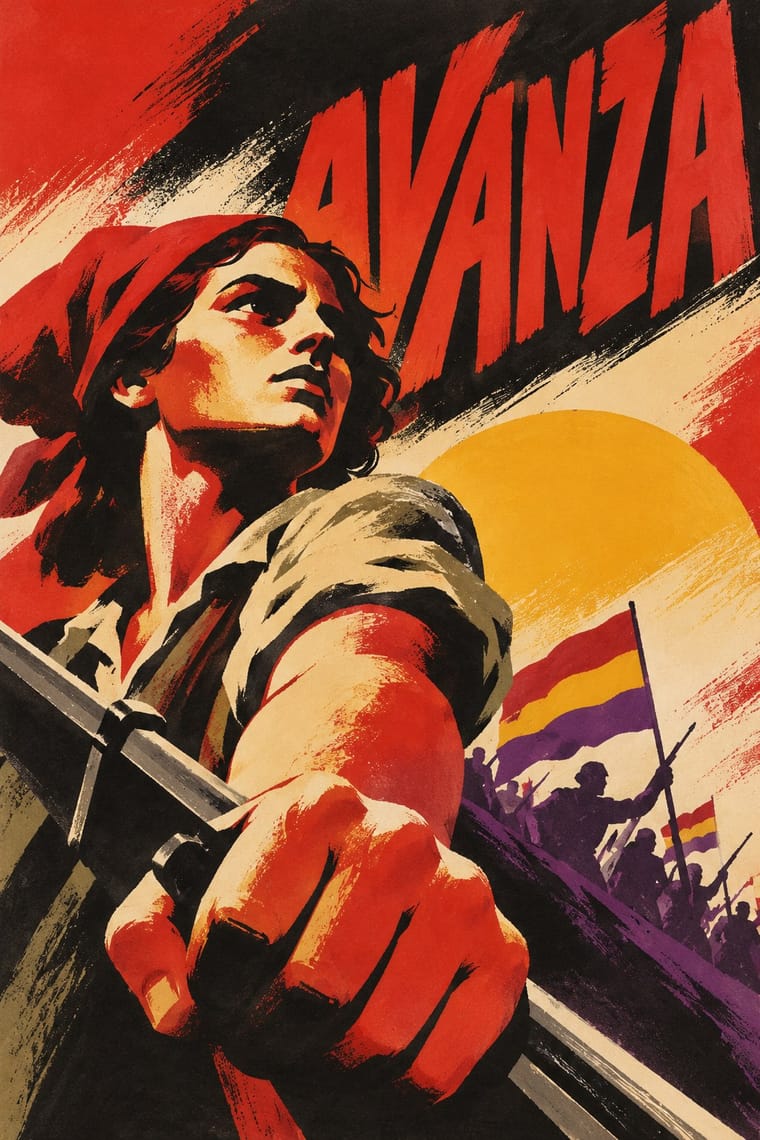
Hungarian Revolutionary Poster × Spanish Civil War Poster
Both throw one bursting figure across a red-and-black lithograph; borrow Spain's acronym signatures and stacked slogans to give a Budapest-style hero an organisation behind it.
Mix them and make something Hungarian Revolutionary Poster Spanish Civil War Poster
01
What each style brings
Each part of the design comes from the style with the stronger say in it, and each style gives at least two.
Hungarian Revolutionary Poster Spanish Civil War Poster
- Type from Hungarian Revolutionary Poster
- Colour from Spanish Civil War Poster
- Form from Spanish Civil War Poster
- Composition from Hungarian Revolutionary Poster
- Surface from Hungarian Revolutionary Poster
02
The type
Open fonts standing in for each style’s own type, which is often hand-drawn or commercial.
Display · Hungarian Revolutionary Poster
Act
Big Shoulders, standing in for Heavy hand-drawn poster capitals for short Hungarian slogans and dates, lettered on the stone with the figure
Text · Spanish Civil War Poster
The poster war waged by the Spanish Republic, its unions and its anarchist, communist and socialist parties against Franco's uprising. Unionised commercial artists painted gouache designs that lithographers split onto three or four zinc plates, so foreshortened militiamen, peasants and fists burst from flat red-and-black fields under stacked hand-lettered slogans and party acronyms. Renau's photomontage, Deco polish, caricature and Miró's stencil coexisted.
Oswald; Spanish Civil War Poster used Hand-drawn condensed grotesque capitals and Brush-painted slogan lettering in Castilian and Catalan
03
The colours
The ground and leading colours come from Spanish Civil War Poster, with a counter-accent from Hungarian Revolutionary Poster. The ink reads on the ground at 4.5:1 or more.
Hungarian Revolutionary Poster Spanish Civil War Poster
-
#efe3c6ground · 36% -
#141414ink · 14% -
#f1b52faccent · 18% -
#c62a1faccent · 14% -
#c8952faccent · 10% -
#5f2b6baccent · 8%
As CSS
:root {
  --ground: #efe3c6;
  --ink: #141414;
  --accent-1: #f1b52f;
  --accent-2: #c62a1f;
  --accent-3: #c8952f;
  --accent-4: #5f2b6b;
  --font-display: "Big Shoulders", sans-serif;
  --font-text: "Oswald", sans-serif;
}
Use it with care
Hungarian Revolutionary Poster: Biró's red hammer man 'has been much repeated in Central European political iconography up to the present day' (MoMA), so it is still a live political sign. These are propaganda posters of a regime whose 133 days included the Red Terror, in which up to 590 people were killed; do not present them as neutral folk heroics. In Hungary the hammer and sickle and the five-pointed red star are restricted symbols under Btk. § 335 when distributed, used in public or displayed in a way that can disturb public peace, especially by offending the dignity of the victims of totalitarian regimes; keep them out of work aimed there. Never borrow the antisemitic 'Jewish Bolshevik' caricature that anti-communist posters of 1919 turned against the Republic, as in Manno Miltiades's poster in the USHMM's Katz Ehrenthal Collection.
04
The two styles
05
More combinations
With Hungarian Revolutionary Poster
- Expressionist Woodcut Graphics Pairs well · Kinchin sees 'a burgeoning taste for Futurist and Expressionist design' in the MA circle's exhibition poster (Bortnyik); add a gouged, splintered edge to the red body when the hero should look anguished rather than triumphant.
- Socialist Realist Propaganda Poster Contrasts · Both glorify the worker, but 1919 Budapest set a single red, mythic body against a plain ground where Soviet doctrine later demanded polychrome, illusionistic scenes of real workers and leaders; compare them to choose between mythic energy and illusionist credibility.
- Russian Constructivism Contrasts · Bortnyik and Kassák's circle moved towards construction in Vienna exile; set photomontage, grids and sans-serif bars against the hand-drawn heroic body to show that turn.
- ROSTA Windows Contrasts · Same year, opposite format: Moscow's stencilled comic-strip frames tell the news in sequence, Budapest's single lithographed giant states one demand at street scale.
With Spanish Civil War Poster
- Cuban Revolutionary Poster (OSPAAAL & ICAIC) Contrasts · Cuba kept the raised fist but traded urgent painted bodies for one witty silhouette; use the pair to choose between urgency and wit.
- Art Deco Pairs well · The Deco commercial training behind these posters shows in their airbrushed gradients and geometric lettering; push that polish for a cleaner heroic image.
- Socialist Realist Propaganda Poster Contrasts · Keep figures stylised, foreshortened and flat-coloured rather than academically modelled; that is what separates street mobilisation from official doctrine.
- Russian Constructivism Pairs well · Borrow Soviet photomontage and heavy bars, as Renau did, when a painted figure needs documentary force.
- Spanish Bullfight Poster (Cartel Taurino) Contrasts · Josep Renau learned lithography at Ortega's Valencia works while a student; his generation traded the cartel's naturalistic brushwork and long programme for flat, foreshortened figures, diagonal slogans and photomontage.
- Escuela Bruguera (Spanish Humour Comics) Contrasts · Barcelona's wartime posters agitated openly in large single images; a decade later in the same city, Bruguera's cartoonists put postwar hunger and petty tyranny into children's gags under Franco's censors, who made them soften after the 1955 decree. Choose the poster for an open call, the gag strip for satire kept under the fun.
- Estado Novo Folk Modernism (SPN) Contrasts · Its Iberian contemporary: Republican posters are diagonal, urgent and red-and-black, while the Estado Novo's are static, pale and 'pseudo-tranquil'; set them side by side to stage revolt against order.
- Lebanese Civil War Party Poster Contrasts · Another civil war fought on the walls by rival factions, but with painted allegorical heroes; set them side by side to see what the straight photograph of a named dead partisan does that a drawn fighter cannot.