Pictorial & machine age · 1912–1919 · Central Europe
Hungarian Revolutionary Poster
Also known as 1919 Hungarian revolutionary poster, Hungarian Republic of Councils posters, tanácsköztársasági plakátok
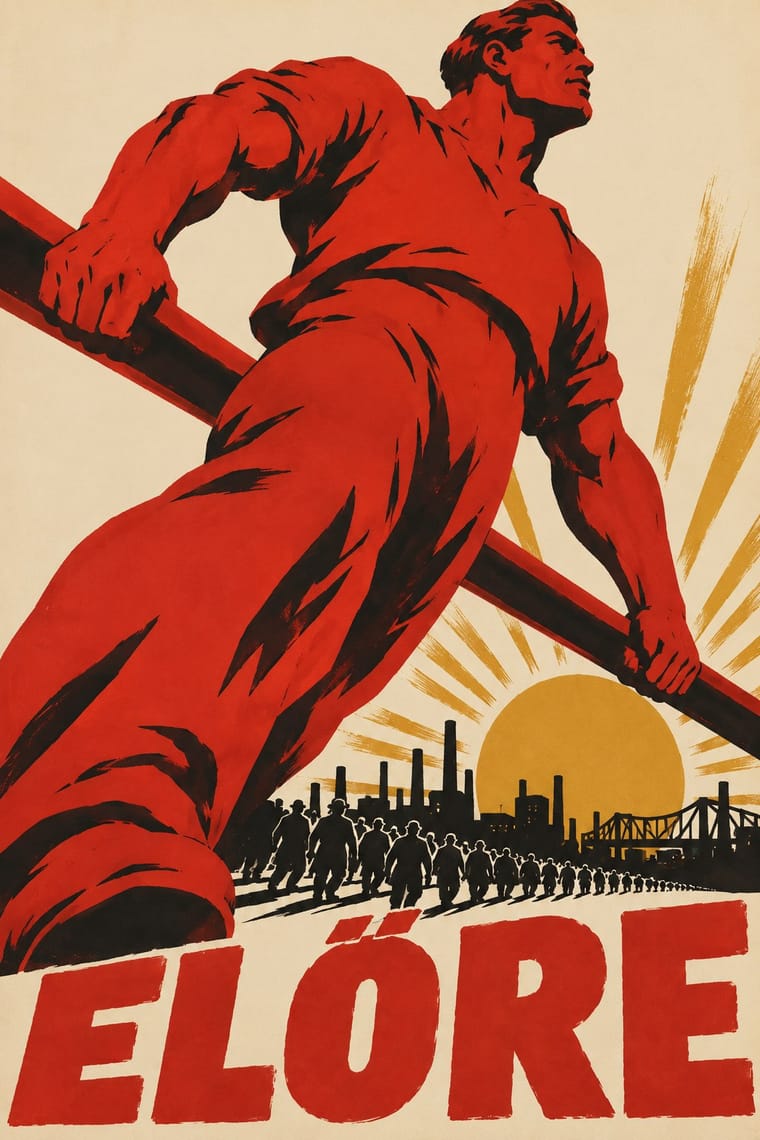
The political posters of Hungary's revolutions. Mihály Biró drew his red hammer man for the newspaper Népszava in 1912; it returned after the Aster Revolution of October 1918 and in huge numbers during the 133-day Republic of Councils of 1919, when Biró, Pór, Berény, Bortnyik and others covered Budapest in large stone lithographs. One monumental worker, soldier or nude, often red, swings, leaps or whirls across the sheet above a short hand-lettered slogan. With no official style decreed, Biró's Secession-tinged realism hung beside Pór's classicised nudes and the Activists' cubo-expressionism.
Make something in this styleGet advice in this styleMix it with another style
Use it with care
Biró's red hammer man 'has been much repeated in Central European political iconography up to the present day' (MoMA), so it is still a live political sign. These are propaganda posters of a regime whose 133 days included the Red Terror, in which up to 590 people were killed; do not present them as neutral folk heroics. In Hungary the hammer and sickle and the five-pointed red star are restricted symbols under Btk. § 335 when distributed, used in public or displayed in a way that can disturb public peace, especially by offending the dignity of the victims of totalitarian regimes; keep them out of work aimed there. Never borrow the antisemitic 'Jewish Bolshevik' caricature that anti-communist posters of 1919 turned against the Republic, as in Manno Miltiades's poster in the USHMM's Katz Ehrenthal Collection.
01
How it works
- Build the sheet around one monumental body, a muscular worker, soldier or allegorical nude, scaled up until it dominates the street.
- Colour the hero red: let red carry the figure or the banner, and keep everything else to black, a little ochre and the light paper.
- Simplify and distort: exaggerate muscle, scale and viewpoint, and tilt the body on a swinging, leaping or whirling diagonal.
- Hand-letter a short imperative slogan or date in heavy capitals, drawn on the stone with the image.
- Print big from the stone: typically the two-sheet 126 × 95 cm, also the single 95 × 63 cm sheet, and up to 250 × 180 cm (Pór), so posters can serve as public decoration, as on May Day 1919.
- Mythologise rather than describe: make the worker a Hercules or Vulcan, and model the muscles but not the world: one body in an unnatural red, set against plain paper, newsprint or abstract swirls rather than a described place, with no photographs, grids or illusionistic settings.
Budapest: Mihály Biró's posters for the Social Democratic daily Népszava, then the artists of the 1918 People's Republic and the 1919 Hungarian Republic of Councils, from The Eight (Berény, Pór) to the Activists of Lajos Kassák's MA circle (Bortnyik)
02
Its design choices
From Stylogeny’s vocabulary of design choices: defining choices make the style, characteristic ones are usual, occasional ones turn up now and then.
- Layout & composition
- Space & hierarchy
- Colour
- Form & shape
- Medium & production
- Tone & intent
- Avoids
- Photomontage, Straight photography, Modular grid, Gradients, Horror vacui, Abundant decoration, Floral & vegetal, Ironic & self-aware
Palette
#ede3cc#c62a1f#151312#c8952f#7d1d16
Typefaces
Heavy hand-drawn poster capitals for short Hungarian slogans and dates, lettered on the stone with the figure
Newspaper masthead lettering
the Népszava title on Biró's red man
Avant-garde block capitals of the MA circle's exhibition posters
Bortnyik
Known for
Formal precursor
Mihály Biró, Pauker (paper-goods advertisement, 1911–12, lithograph, 116 × 86 cm; MoMA): distorted scale and angle, simplified form and colour
Mihály Biró, the red man with a hammer, designed in 1912 for Népszava, the Social Democratic newspaper, modelled on the wrestler Tibor Fischer; reissued as 'Népszava: Magyarország népköztársaság' (1918, lithograph and newsprint, overprinted with an issue of Népszava, 94 × 63.5 cm; MoMA)
Mihály Biró, 1919 Május 1.
May Day 1919, lithograph, 126 × 95 cm; MoMA
Mihály Biró, Bitangok! Ezt akartátok? (Scoundrels! Is This What You Wanted?, 1919, stone lithograph, c. 126 × 95 cm), against the Paris peace conference
Bertalan Pór, Világ proletárjai egyesüljetek! (Proletarians of the World, Unite!, 1919, lithograph, 250 × 180 cm; MoMA)
two classicised nudes in a whirling composition with long red banners
Róbert Berény, Fegyverbe! Fegyverbe! (To Arms! To Arms!, 1919), his best-known poster, made while he headed the painting section of the Art Directorate
Sándor Bortnyik, MA VII (Grafikai) Kiállítás, poster for the MA group's 7th graphics exhibition (1919, lithograph, 95 × 63 cm; MoMA)
the Activist strand and the exception to the single red hero, smaller and printed in black only, with energetic figures whirling round giant lettering inside a rectangular frame, which Kinchin ties to Futurist and Expressionist design
Vörös katonák, előre! (Red Soldiers, Forward!, 1919), Red Army recruitment poster, 126 × 95 cm
Deutsches Historisches Museum, Berlin, P 62/1521, credited there to János Tábor
03
Make something in this style
Say what you need, and Stylogeny’s image studio draws it from Hungarian Revolutionary Poster’s design choices and checks it against them. It takes about a minute, and you get a link to share.
04
Where it comes from, and what it’s close to
Before it
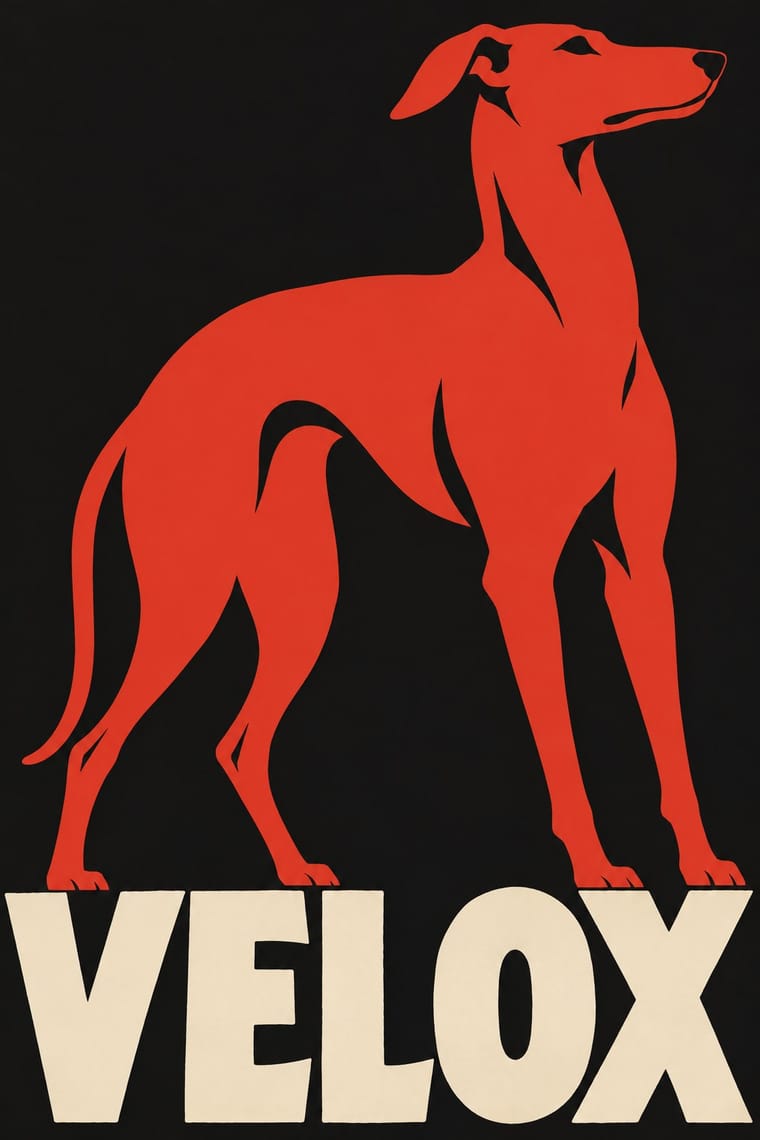
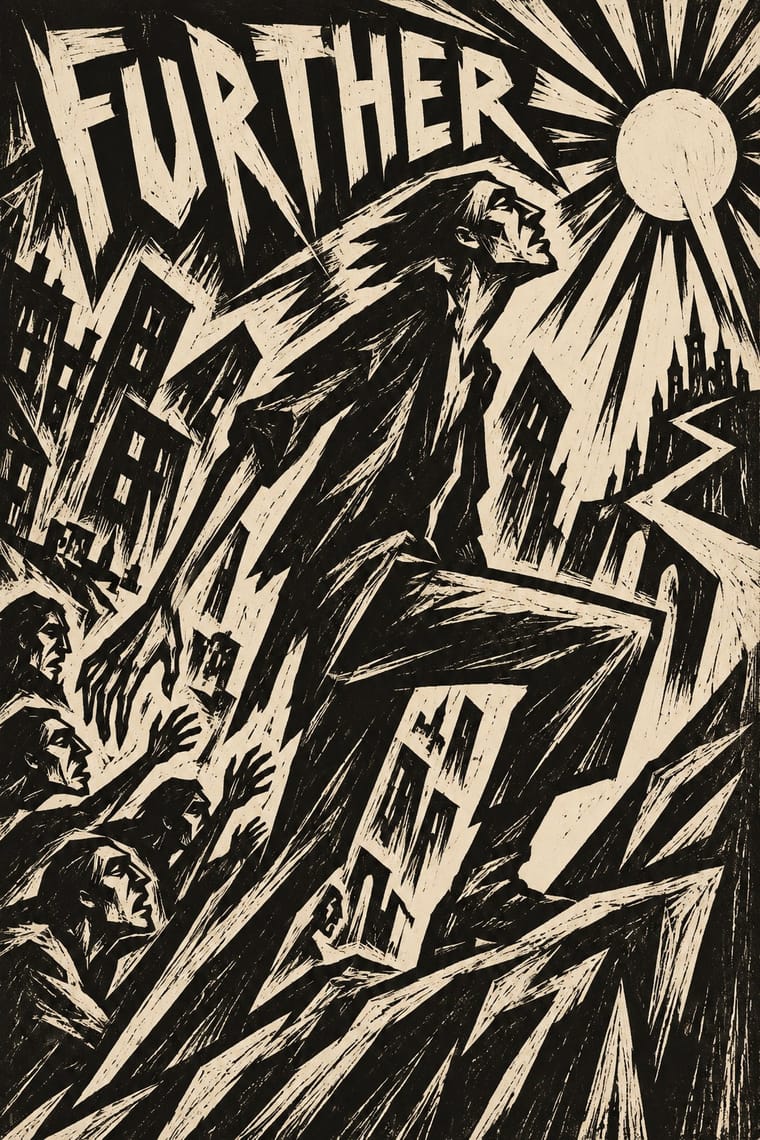
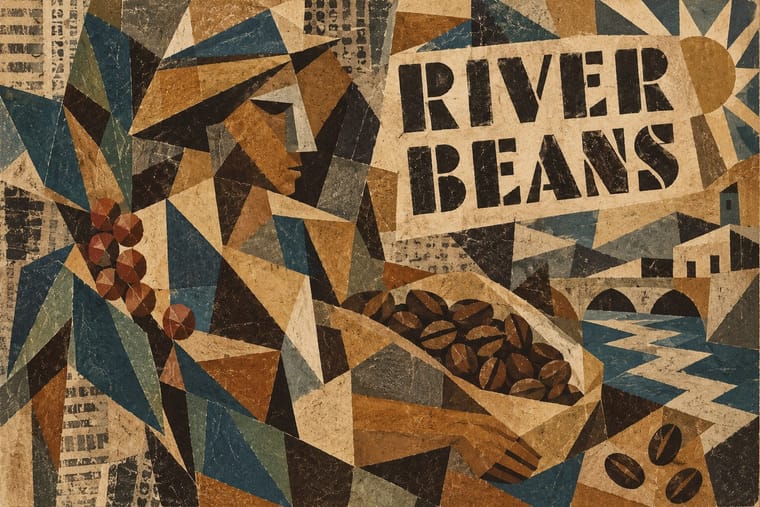
The style it grew out of, and the styles it borrowed from.
After it
The styles that grew out of it.
No later style in the atlas grew out of it yet.
Alike in its design choices
Styles that make many of the same choices, related or not, besides those above.
05
Sources
- Juliet Kinchin, 'Hungarian Posters from the 1910s', post (Museum of Modern Art), 25 February 2016: https://post.moma.org/hungarian-posters-from-the-1910s/
- Kókai Károly, 'Pátosz vörösben: Bíró Mihály plakátjai' (review of the Biró exhibition at the MAK, Vienna, 2010–11), Balkon 2011/2, p. 43: https://epa.hu/03000/03057/00032/pdf/EPA03057_balkon_2011_2_43.pdf
- Museum of Modern Art, Seeing Red: Hungarian Revolutionary Posters, 1919 (exhibition, 2011): https://www.moma.org/calendar/exhibitions/1120
- Deutsches Historisches Museum, LeMO, Plakat 'Rote Soldaten nach vorn', Ungarn 1919 (P 62/1521): https://www.dhm.de/lemo/bestand/objekt/plakat-rote-soldaten-nach-vorn-ungarn-1919
- Hungarian Wikipedia, 'Berény Róbert' (Art Directorate, Fegyverbe! Fegyverbe!): https://hu.wikipedia.org/wiki/Berény_Róbert
- Hungarian Wikipedia, 'Aktivizmus (művészet)' (Kassák, A Tett, MA): https://hu.wikipedia.org/wiki/Aktivizmus_(művészet)
- budapestposter.com, Biró Mihály, Bitangok! Ezt akartátok? (1919): https://budapestposter.com/posters/5755
- budapestposter.com, Barta Ernő, Dolgozzatok, mert fogytán a kenyér! (1919), on Lukács's cultural policy: https://budapestposter.com/posters/177
- Novák Zoltán, 'Adalékok Lukács és Kassák viszonyához', Magyar Filozófiai Szemle 27 (1983) 1, pp. 70–83 (Kun's speech of 13 June 1919; Lukács, Vörös Újság, 18 April 1919): https://real.mtak.hu/244333/1/1983_1_novak.pdf
- Wikipedia, 'MA (journal)' (Kun's 'bourgeois decadence'; discontinued July 1919): https://en.wikipedia.org/wiki/MA_(journal)
- Wikipedia, 'First Hungarian Republic' (Aster Revolution, 31 October 1918; People's Republic, 16 November 1918): https://en.wikipedia.org/wiki/First_Hungarian_Republic
- Wikipedia, 'Red Terror (Hungary)': https://en.wikipedia.org/wiki/Red_Terror_(Hungary)
- Act C of 2012 on the Criminal Code (Btk.), § 335, Önkényuralmi jelkép használata: https://net.jogtar.hu/jogszabaly?docid=a1200100.tv
- United States Holocaust Memorial Museum (via EHRI), Manno Miltiades, 'Is this why we fought?' (1919), Katz Ehrenthal Collection of antisemitic visual materials: https://portal.ehri-project.eu/units/us-005578-irn537029-irn542650
How Stylogeny researches and checks a style: where the facts come from.