Style combination · Contrasts
Chicano Screenprint Poster × Mexican Calendar Chromo
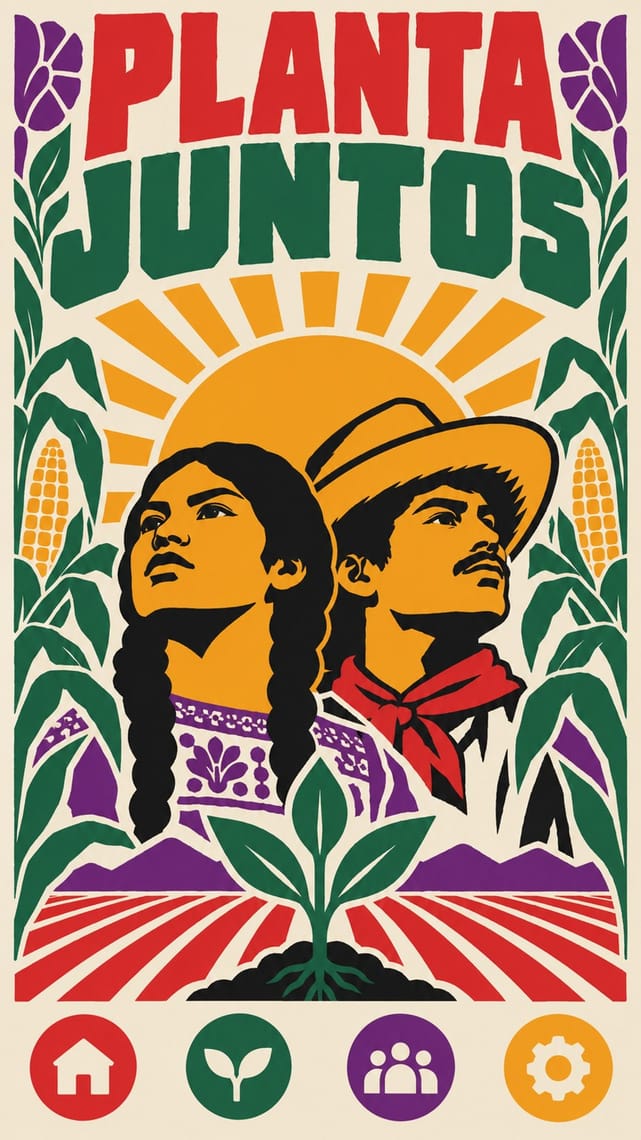
Many Chicanos grew up with these give-away calendars hanging at home, and Chicano workshops took up the calendar as a fundraising print (Méchicano Art Center's 1977 Calendario), but, in Terezita Romo's words, revised its single image format, offset medium and commercial objective: screenprinted flat colour and political and cultural messages in place of a brand's modelled oil scene.
Mix them and make something Chicano Screenprint Poster Mexican Calendar Chromo
01
What each style brings
Each part of the design comes from the style with the stronger say in it, and each style gives at least two.
Chicano Screenprint Poster Mexican Calendar Chromo (Cromos calendáricos)
- Type from Chicano Screenprint Poster
- Colour from Chicano Screenprint Poster
- Form from Chicano Screenprint Poster
- Composition from Mexican Calendar Chromo
- Surface from Mexican Calendar Chromo
02
The type
Open fonts standing in for each style’s own type, which is often hand-drawn or commercial.
Display · Chicano Screenprint Poster
Square
Londrina Solid, standing in for Bold sans and hand-drawn capitals for bilingual strike and boycott slogans ('¡Huelga!', 'Boycott Grapes')
Text · Mexican Calendar Chromo
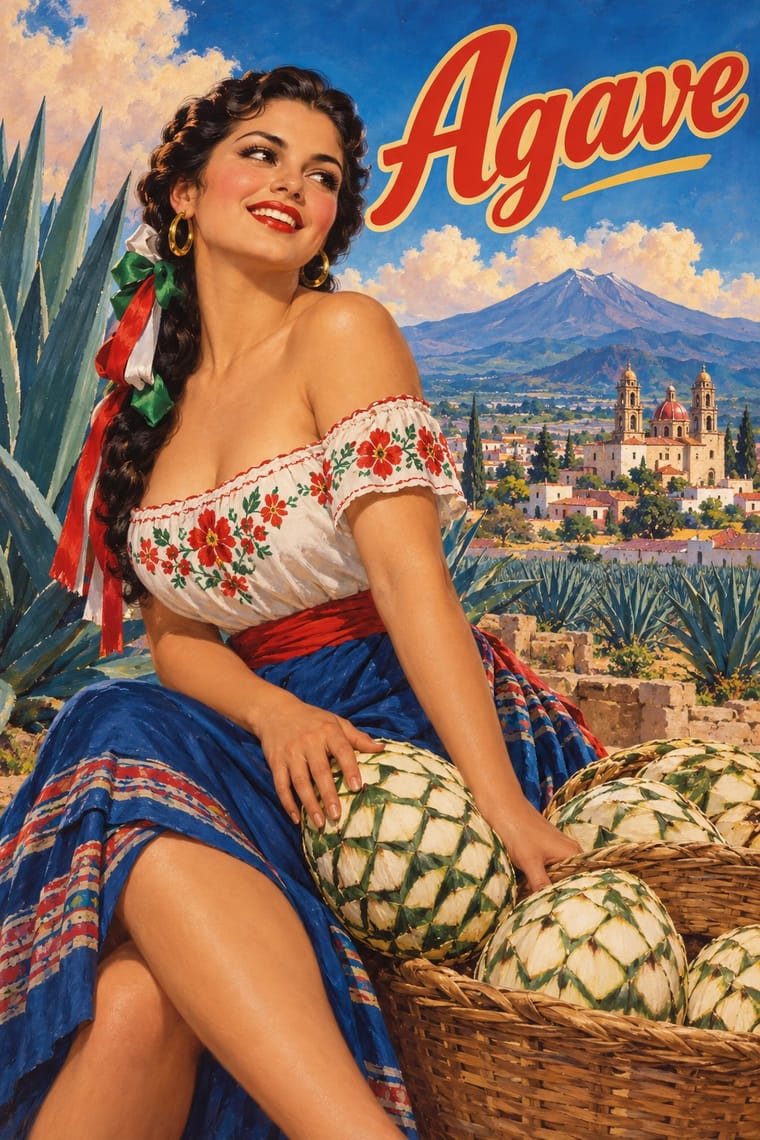
Mexico's give-away advertising calendars, at their height from the 1930s to the late 1960s. Printers led by Galas de México kept studios of painters, among them Jesús Helguera, Eduardo Cataño, Jorge González Camarena and Josep Renau, whose large oil paintings were printed by offset above a sponsor's name and a small calendar pad. In an idealising academic realism touched by Hollywood glamour they staged Aztec legends as melodrama, charros and chinas poblanas, saints, film stars and pin-ups, and hung all year in homes, shops and workshops.
Archivo; Mexican Calendar Chromo used The sponsor's name and address overprinted in the band left blank below the picture and Brand logotypes painted into the picture or carried on the product
03
The colours
The ground and leading colours come from Chicano Screenprint Poster, with a counter-accent from Mexican Calendar Chromo. The ink reads on the ground at 4.5:1 or more.
Chicano Screenprint Poster Mexican Calendar Chromo (Cromos calendáricos)
-
#f2eadbground · 36% -
#141414ink · 14% -
#f4a11caccent · 18% -
#d7262eaccent · 14% -
#7a2d8caccent · 10% -
#1f6f4aaccent · 8%
As CSS
:root {
  --ground: #f2eadb;
  --ink: #141414;
  --accent-1: #f4a11c;
  --accent-2: #d7262e;
  --accent-3: #7a2d8c;
  --accent-4: #1f6f4a;
  --font-display: "Londrina Solid", cursive;
  --font-text: "Archivo", sans-serif;
}
Use it with care
Chicano Screenprint Poster: The Virgin of Guadalupe is a devotional image for many Mexicans and Chicanos, and Chicana feminist reworkings of her have met protest. Mexica glyphs and calendar imagery carry Indigenous meaning, and the UFW black eagle is the union's own emblem, not a free motif. Use them with community context, credit the movement, and commission Chicanx printmakers rather than lifting the look for marketing.
Mexican Calendar Chromo (Cromos calendáricos): The Aztec scenes are a nationalist fantasy of the pre-Hispanic past painted by academically trained artists, several of them born or raised in Spain, not Indigenous art: do not present them as Nahua or Mexica tradition or copy their feathered costumes as if they were ethnography. The saints and the Virgin of Guadalupe are devotional images that many owners pray before, so do not parody them, and the pin-ups were painted, as a UNAM study of the Galas archive puts it, to satisfy male longing and promote the sponsors' brands, carrying old and new stereotypes of women. The paintings are still in copyright (Helguera died in 1971) and Grupo Carso holds the rights to the Galas archive, while Alta reported in 2023 that Calendarios Landin owns the rights to Helguera, so paint new pictures in the manner rather than retouching old chromos.
04
The two styles
05
More combinations
With Chicano Screenprint Poster
- Corporate Identity Modernism Contrasts · Chicano parody works by quoting the clean corporate mark and corrupting it; study the brand's grammar before you subvert it.
- Cuban Revolutionary Poster (OSPAAAL & ICAIC) Pairs well · Both are solidarity screenprints; borrow OSPAAAL's single bold image and add Chicano bilingual wordplay and barrio iconography.
- Mexican Popular Graphics (Posada) Pairs well · Posada's calaveras are a shared ancestor; mix his relief skeletons with flat screen colour for Día de Muertos work with a political edge.
- Mixteca-Puebla Codex Painting Pairs well · Chicano screenprinters reclaimed Mexica glyphs and calendar imagery for the movement; when contour-and-flat-colour glyphs meet a modern poster, follow their example of community context and credit. Mexica (Aztec) glyphs are a different source from these Mixtec and Borgia Group books: credit a codex source as such rather than folding it into 'Aztec'.
- AfriCOBRA Pairs well · Movement screenprints of the same years, made in and for their own communities: Chicano posters set one emblematic figure on flat colour, often parodying American packaging; AfriCOBRA packs the figure into a lettered, many-coloured field and stays sincere. Pair them, as both pair with the Panthers, for coalition work.
- Fania and Nuyorican Salsa LP Sleeves Pairs well · Another US Latino graphic voice; borrow its community iconography.
- Puerto Rican Silkscreen Poster (DIVEDCO & ICP) Pairs well · Two Spanish-language screenprint traditions of the Americas; add Chicano bilingual slogans and posterised portraits to Puerto Rican letrismo for community event posters.
- Chilean Unidad Popular & Nueva Canción Graphics Pairs well · Both tie community walls to cheap posters for a movement; combine a black-contoured Ramona Parra frieze with Chicano bilingual screenprints for coalition street graphics.
With Mexican Calendar Chromo
- Shanghai Modern & Yuefenpai Contrasts · Both are tobacco-sponsored calendar pictures of beauties, but yuefenpai set softly rubbed watercolour women inside decorative borders with the products alongside, while the Mexican chromo is an oil painting of a whole scene that fills the sheet, with the pad pasted at its foot.
- Egyptian Painted Film Poster Contrasts · Both paint the stars of a national cinema's golden age, but the Egyptian poster collages star heads under huge calligraphic titles, while the chromo paints one unified scene and keeps its lettering to a small band below.
- Socialist Realist Propaganda Poster Contrasts · Both idealise the nation in heroic academic realism, but the Socialist Realist poster adds slogans and marching crowds to mobilise, while the chromo sells beer and cigarettes with romance and nostalgia; borrow its heroic anatomy for a national-history scene and leave the slogan out.
- Mexican Popular Graphics (Posada) Contrasts · Posada's broadsheets are black relief cuts under shouting type, sold for news and satire; the chromo is a full-colour oil painting given away to be admired all year, with the type kept small and out of the picture.
- Lotería Card Imagery (Mexican Lotería) Contrasts · Both are popular Mexican colour prints for everyday use, but the lotería sets one flat, outlined emblem figure per numbered card in a ruled frame, named in capitals at the foot, for a game, while the chromo paints one modelled scene in deep landscape to hang for a year.
- Hand-Painted Signage & Vernacular Lettering Pairs well · Grocery stores, poultry shops and workshops gave the calendars to their customers; pair a painted rótulo for the shop's name with a chromo-style painting for the look of a mid-century Mexican neighbourhood business.
- Taller de Gráfica Popular Contrasts · Both grew out of post-revolutionary Mexico and picture its history, but the TGP cut black-and-white linocuts and woodcuts with bold headlines for popular and anti-fascist struggles, while the calendar painters made saturated oils of an idealised Mexico to sell beer and cigarettes.
- Indian Calendar & Bazaar Art Contrasts · Both are give-away calendars that reproduce commissioned paintings above a sponsor's name, but Indian bazaar art centres a frontal deity in haloes, gold and ornamental frames for worship, while the Mexican chromo stages a secular scene in deep landscape (a legend, a charro, a film star, a pin-up) with no frame around it; its saints are one genre among many.