Style combination · Contrasts
Indian Calendar × Mithila Painting
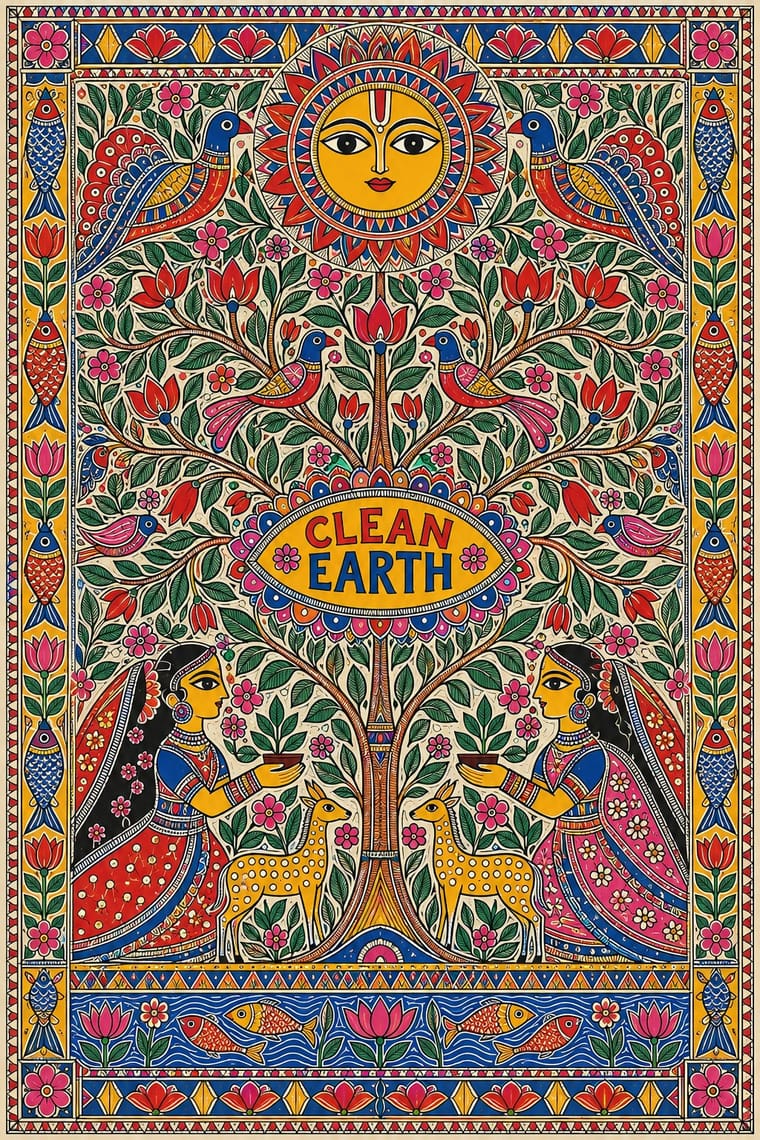
Calendar art models its gods with gradients, gloss and illusionistic space; Mithila draws the same deities as flat outlined shapes on a packed ground. Use the contrast to separate devotional realism from devotional pattern.
Mix them and make something Indian Calendar Mithila Painting
01
What each style brings
Each part of the design comes from the style with the stronger say in it, and each style gives at least two.
Indian Calendar & Bazaar Art Mithila (Madhubani) Painting
- Type from Indian Calendar
- Colour from Mithila Painting
- Form from Mithila Painting
- Composition from Indian Calendar
- Surface from Indian Calendar
-
Mithila Painting avoids gloss & highlights: this is where the two pull against each other, which is the point of the contrast.
02
The type
Open fonts standing in for each style’s own type, which is often hand-drawn or commercial.
Text · Mithila Painting
Women's ritual wall and floor painting from Mithila in north Bihar and Nepal's Terai, attested from at least the 14th century, seen by W. G. Archer after the 1934 earthquake and photographed in 1940, and moved to paper for sale in the 1966–67 drought. Line comes first: figures and borders are drawn, often as double outlines, then filled with flat colour (bharni), fine hatching (kachni) or tattoo-derived rings (godna) until no ground is left empty. Wedding-chamber kohbar images, deities, epics and, later, village life and world events fill sheets closed by border bands.
Fira Sans; Mithila Painting used Hand-written artist's names, villages and occasional titles in Devanagari or Latin script, added with the outlining nib along a margin or inside the border band and For accompanying Hindi or Maithili text in graphic work, a sturdy even-stroke Devanagari text face (for example Mukta or Hind) set outside the bordered painting rather than over its filled ground
03
The colours
The ground and leading colours come from Mithila Painting, with a counter-accent from Indian Calendar. The ink reads on the ground at 4.5:1 or more.
Indian Calendar & Bazaar Art Mithila (Madhubani) Painting
-
#f1e6ccground · 36% -
#1a1714ink · 14% -
#e9b21baccent · 18% -
#e8822aaccent · 14% -
#c8281eaccent · 10% -
#d8457faccent · 8%
As CSS
:root {
  --ground: #f1e6cc;
  --ink: #1a1714;
  --accent-1: #e9b21b;
  --accent-2: #e8822a;
  --accent-3: #c8281e;
  --accent-4: #d8457f;
  --font-display: "Rozha One", serif;
  --font-text: "Fira Sans", sans-serif;
}
Use it with care
Indian Calendar & Bazaar Art: These are devotional images that many viewers worship, so do not crop, distort or deface deities or place them on footwear, floors, underwear or in mocking contexts. Many original painters went uncredited; name the artist and press where known.
Mithila (Madhubani) Painting: Mithila painting is the living craft and livelihood of named painters, mostly women, across many castes in Madhubani district and southern Nepal, and 'Madhubani paintings' is a registered Geographical Indication of Bihar (2006–07): do not label machine-printed, traced or AI-generated images as Madhubani or Mithila painting, never add a painter's name or signature to generated work, and commission, buy from or credit painters by name instead. Kohbar and aripana images are made for marriages, births and other rites and many sheets show Hindu deities still worshipped, so do not crop, distort or put them on disposable or demeaning goods. Godna painting and the figure of Raja Salhesh belong to the Dalit Dusadh community's history of claiming a place their painting was once denied; do not treat them as generic tribal pattern or erase whose tradition they are. Godna painting also draws on the tattoo art of Nat (Natin) women; credit that source too. Use 'Mithila painting' as the inclusive name: 'Madhubani' is the Bihar GI name, so do not label work by Maithil painters in Nepal, such as those of Janakpur, as Madhubani or Indian.
04
The two styles
05
More combinations
With Indian Calendar
- International Typographic Style Contrasts · A neutral grid and grotesque type make a calm frame for one lush calendar image, letting it read as the single focal point.
- Nianhua & Chinese Folk Print Pairs well · Both are festive devotional bazaar prints; share frontal figures, rich borders and auspicious symbols across a festival campaign.
- Hand-Painted Bollywood Poster Pairs well · Hand-painted film posters grew from calendar art; reuse its glowing faces and saturated colour for entertainment work.
- Pop Art Graphics Pairs well · Treat a calendar print as found imagery, repeated and flattened Pop-style, while respecting devotional subjects.
- Santiniketan & Bengal School Graphics Contrasts · The Bengal School defined itself against the academic naturalism of Raja Ravi Varma, whose paintings the oleograph presses reproduced; set the two side by side to show soft wash and earth pigment against glossy, saturated chromolithograph.
- Thai Hand-Painted Film Poster and Billboard Pairs well · A parallel in saturated naturalistic painting of idealised figures, not a documented influence; adds devotional frontality to the romantic mood.
- Nirnaya Sagar Devanagari Typography (Bombay Metal Type) Pairs well · For a devotional book, put one chromolithographed god picture from the Bombay presses opposite a black, typeset text page, and keep the type itself free of colour.
- Amar Chitra Katha Comics Pairs well · Borrow the calendar print's frontal, haloed deity and saturated jewel colour for a cover or a single full-page epiphany panel, and keep the pages around it to flat colour and ruled panels.
With Mithila Painting
- Indian Institutional Modernism (NID) Pairs well · Set one bordered Mithila panel, credited to its painter, inside the quiet grid and white space of NID modernism, so the dense line work becomes the single focal point of an otherwise restrained Indian layout.
- Uli & Nsibidi Line and Sign Tradition Contrasts · Both are women's wall-painting traditions led by line, but uli sets a few swelling lines and named motifs asymmetrically on open ground, so the gaps count, while Mithila closes a symmetrical, bordered field and fills every gap. Set them side by side to show restraint against abundance.
- Kalighat Pat & Battala Bazaar Prints Contrasts · Both are eastern Indian popular pictures of deities, but Kalighat sweeps a few brushed figures across an empty sheet while Mithila outlines everything and fills every gap; set them side by side to show sparse brush against dense line.
- Batik Pattern Tradition Contrasts · Batik spreads a resist-dyed repeat evenly across cloth; Mithila builds a unique, hand-drawn composition around a centre and closes it with borders. Borrow one or the other, not both, to keep pattern and picture distinct.
- Chinese Paper-Cut (Jianzhi) Contrasts · Both are folk arts made mostly by rural women for weddings and other rites, with fish and lotus among their auspicious signs, but paper-cut is a silhouette, usually red, cut from one sheet and folded for mirror symmetry, while Mithila draws an outline and fills it with colour, hatching or rings until no ground is left. Use one of them, not a blend of the two.
- Data Humanism Pairs well · Both treat hand-drawn hatching, dots and repeated small marks as content; a kachni-style legend or border can give a hand-drawn chart a South Asian line vocabulary, provided a Mithila painter is commissioned for it.