Style combination · Pairs well
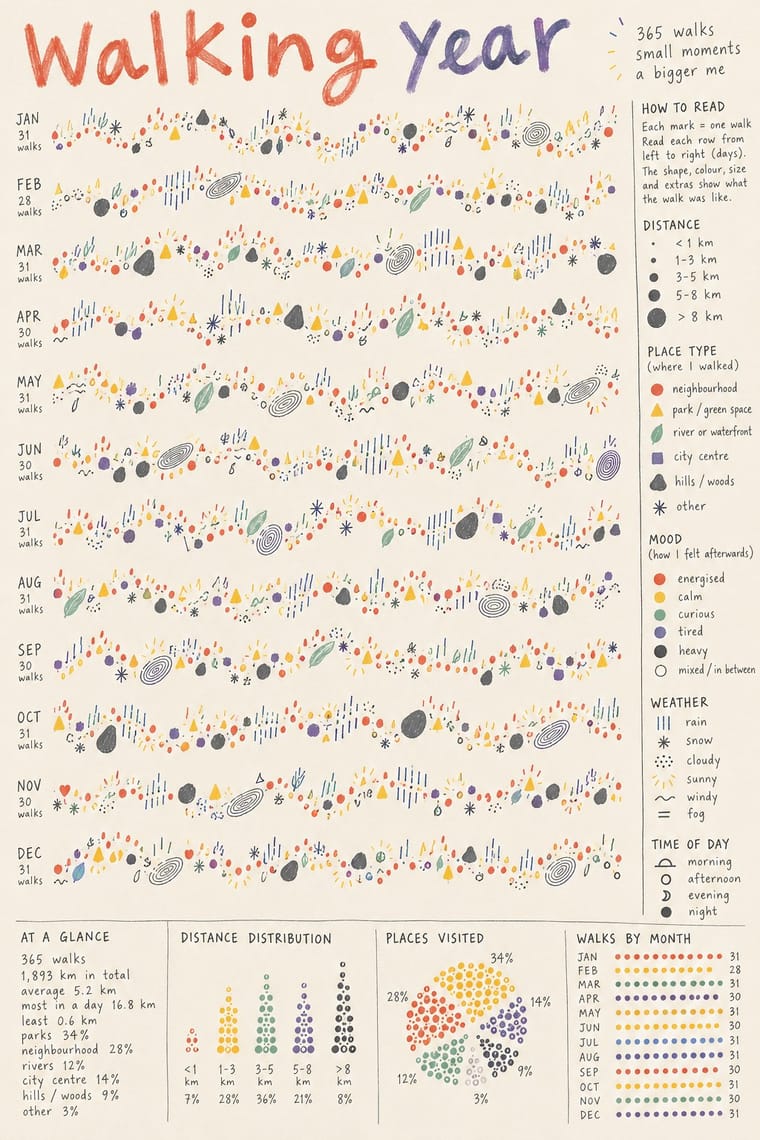
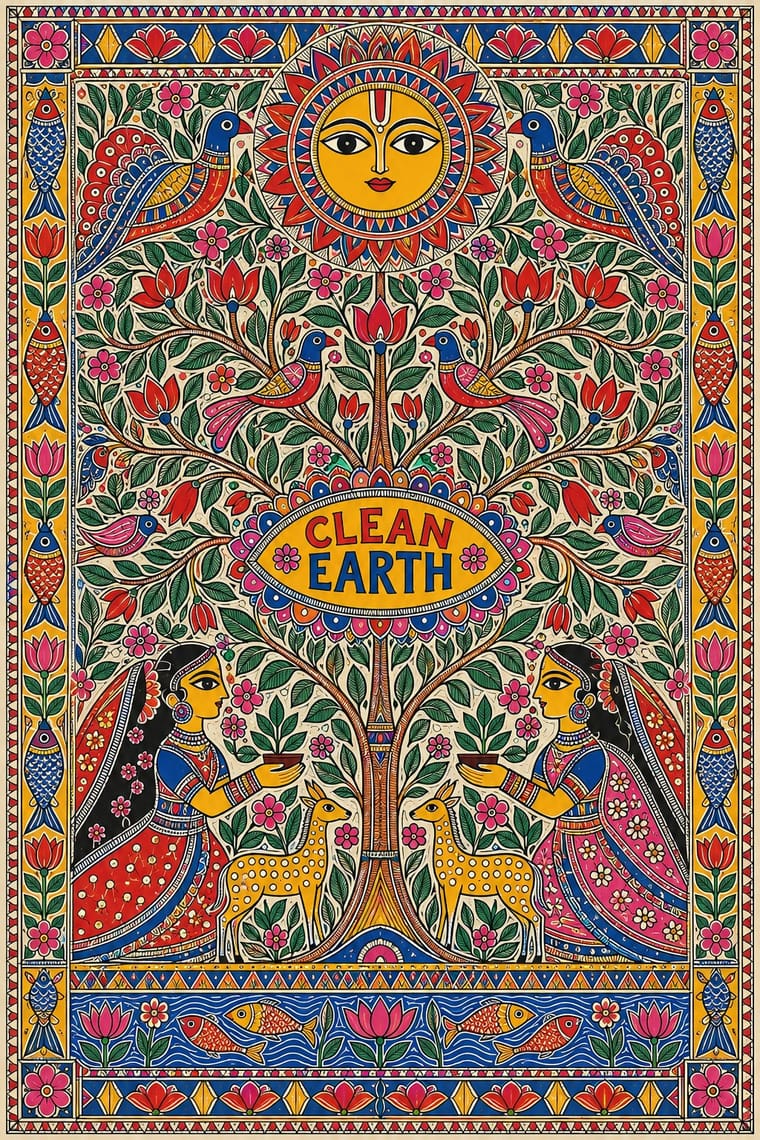
Data Humanism × Mithila Painting
Both treat hand-drawn hatching, dots and repeated small marks as content; a kachni-style legend or border can give a hand-drawn chart a South Asian line vocabulary, provided a Mithila painter is commissioned for it.
01
What each style brings
Each part of the design comes from the style with the stronger say in it, and each style gives at least two.
Data Humanism Mithila (Madhubani) Painting
- Type from Data Humanism
- Colour from Mithila Painting
- Form from Mithila Painting
- Composition from Data Humanism
- Surface from Data Humanism
02
The type
Open fonts standing in for each style’s own type, which is often hand-drawn or commercial.
Display · Data Humanism
Hello
Caveat, standing in for The designer's own handwriting in pen or pencil for titles, legends and annotations (the Dear Data postcards; the red handwritten script of Lupi's Print manifesto, 2017)
Text · Mithila Painting
Women's ritual wall and floor painting from Mithila in north Bihar and Nepal's Terai, attested from at least the 14th century, seen by W. G. Archer after the 1934 earthquake and photographed in 1940, and moved to paper for sale in the 1966–67 drought. Line comes first: figures and borders are drawn, often as double outlines, then filled with flat colour (bharni), fine hatching (kachni) or tattoo-derived rings (godna) until no ground is left empty. Wedding-chamber kohbar images, deities, epics and, later, village life and world events fill sheets closed by border bands.
Fira Sans; Mithila Painting used Hand-written artist's names, villages and occasional titles in Devanagari or Latin script, added with the outlining nib along a margin or inside the border band and For accompanying Hindi or Maithili text in graphic work, a sturdy even-stroke Devanagari text face (for example Mukta or Hind) set outside the bordered painting rather than over its filled ground
03
The colours
The ground and leading colours come from Mithila Painting, with a counter-accent from Data Humanism. The ink reads on the ground at 4.5:1 or more.
Data Humanism Mithila (Madhubani) Painting
-
#f1e6ccground · 36% -
#1a1714ink · 14% -
#e9b21baccent · 18% -
#f2c14eaccent · 14% -
#c8281eaccent · 10% -
#e0574aaccent · 8%
As CSS
:root {
  --ground: #f1e6cc;
  --ink: #1a1714;
  --accent-1: #e9b21b;
  --accent-2: #f2c14e;
  --accent-3: #c8281e;
  --accent-4: #e0574a;
  --font-display: "Caveat", cursive;
  --font-text: "Fira Sans", sans-serif;
}
Use it with care
Data Humanism: Data portraits are usually drawn from real people's lives (health, moods, relationships, locations): get consent and anonymise before publishing other people's personal data. Because the custom encodings cannot be read at a glance, give a plain-text summary and the key alongside the drawing for readers who use screen readers or are in a hurry.
Mithila (Madhubani) Painting: Mithila painting is the living craft and livelihood of named painters, mostly women, across many castes in Madhubani district and southern Nepal, and 'Madhubani paintings' is a registered Geographical Indication of Bihar (2006–07): do not label machine-printed, traced or AI-generated images as Madhubani or Mithila painting, never add a painter's name or signature to generated work, and commission, buy from or credit painters by name instead. Kohbar and aripana images are made for marriages, births and other rites and many sheets show Hindu deities still worshipped, so do not crop, distort or put them on disposable or demeaning goods. Godna painting and the figure of Raja Salhesh belong to the Dalit Dusadh community's history of claiming a place their painting was once denied; do not treat them as generic tribal pattern or erase whose tradition they are. Godna painting also draws on the tattoo art of Nat (Natin) women; credit that source too. Use 'Mithila painting' as the inclusive name: 'Madhubani' is the Bihar GI name, so do not label work by Maithil painters in Nepal, such as those of Janakpur, as Madhubani or Indian.
04
The two styles
05
More combinations
With Data Humanism
- Isotype Pictorial Statistics Contrasts · Isotype fixes one standard sign per thing and counts by repeating it so anyone can read the chart; data humanism invents a new code for each dataset and asks for slow reading. Choose Isotype for public information, data humanism for portraits of particular lives.
- Corporate Memphis Contrasts · Both aim to feel warm and human, but Corporate Memphis draws generic faceless figures for mood, while data humanism draws the specific data of specific people. Replace stock warmth with a drawing of real data when a brand needs sincerity.
- Generative & Dynamic Identities Pairs well · Let a generative system draw personal data portraits from people's own answers, as What Counts did, but give the code a hand-drawn grammar and a legend so the output reads as made by people.
- Dark Tech Minimalism Contrasts · The dark dashboard shows a few clean metrics at a glance; data humanism draws the messy, qualitative data a dashboard leaves out. Put one hand-drawn data portrait beside the KPIs to show the people behind the numbers.
- Risograph & Indie Print Culture Pairs well · Print hand-drawn data drawings in two or three riso spot inks for zines and postcards, so each ink becomes one data category and the grain matches the hand.
- Biobrand (Organic Biotech CGI) Contrasts · Data humanism draws organic forms by hand to encode real observations; the biobrand renders them as promotional objects. Borrow its honest encoding when a render risks overclaiming.
- Sketchnoting and Graphic Recording Pairs well · Both keep the human hand visible in explanatory drawing; sketchnoting adds live speed and containers.
- Newsroom Data Graphics & Scrollytelling Contrasts · Newsroom graphics use chart types readers already know, labelled directly so they can be read at a glance; data humanism invents a new hand-drawn code for each dataset and asks for slow reading. Use the newsroom chart for the finding, a hand-drawn data portrait for the people behind it.
With Mithila Painting
- Indian Institutional Modernism (NID) Pairs well · Set one bordered Mithila panel, credited to its painter, inside the quiet grid and white space of NID modernism, so the dense line work becomes the single focal point of an otherwise restrained Indian layout.
- Uli & Nsibidi Line and Sign Tradition Contrasts · Both are women's wall-painting traditions led by line, but uli sets a few swelling lines and named motifs asymmetrically on open ground, so the gaps count, while Mithila closes a symmetrical, bordered field and fills every gap. Set them side by side to show restraint against abundance.
- Kalighat Pat & Battala Bazaar Prints Contrasts · Both are eastern Indian popular pictures of deities, but Kalighat sweeps a few brushed figures across an empty sheet while Mithila outlines everything and fills every gap; set them side by side to show sparse brush against dense line.
- Batik Pattern Tradition Contrasts · Batik spreads a resist-dyed repeat evenly across cloth; Mithila builds a unique, hand-drawn composition around a centre and closes it with borders. Borrow one or the other, not both, to keep pattern and picture distinct.
- Chinese Paper-Cut (Jianzhi) Contrasts · Both are folk arts made mostly by rural women for weddings and other rites, with fish and lotus among their auspicious signs, but paper-cut is a silhouette, usually red, cut from one sheet and folded for mirror symmetry, while Mithila draws an outline and fills it with colour, hatching or rings until no ground is left. Use one of them, not a blend of the two.
- Indian Calendar & Bazaar Art Contrasts · Calendar art models its gods with gradients, gloss and illusionistic space; Mithila draws the same deities as flat outlined shapes on a packed ground. Use the contrast to separate devotional realism from devotional pattern.