Style combination · Contrasts
Mithila Painting × Uli
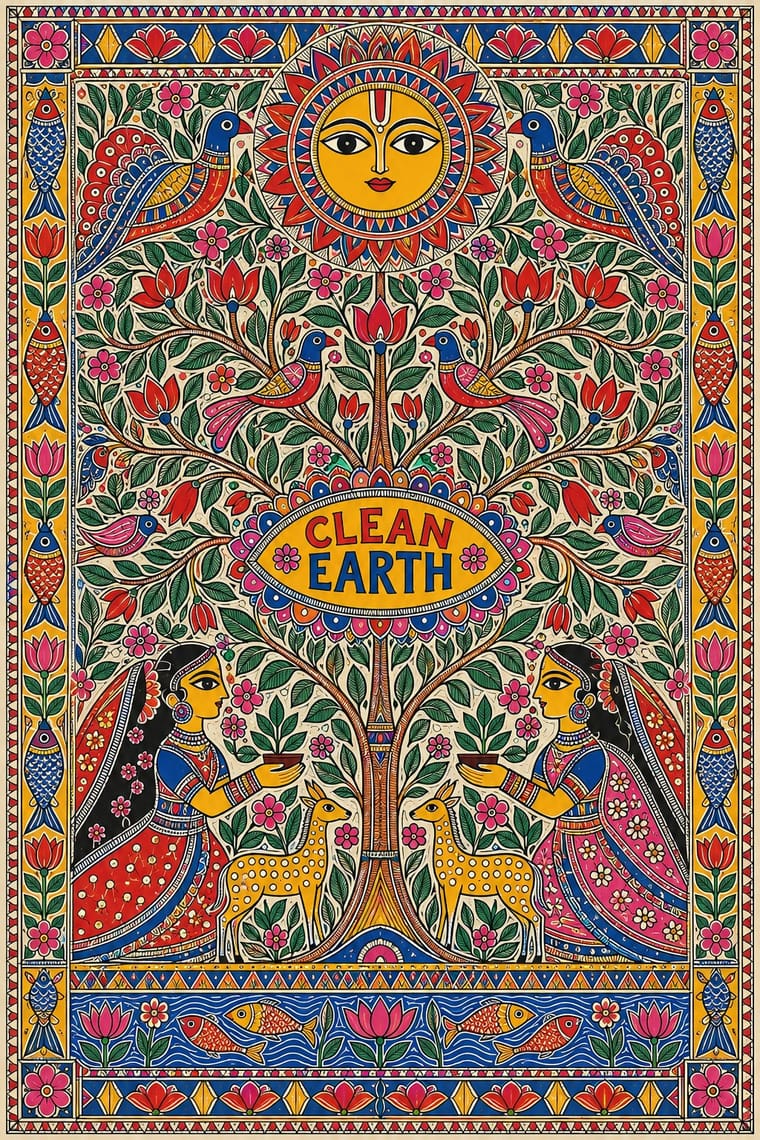
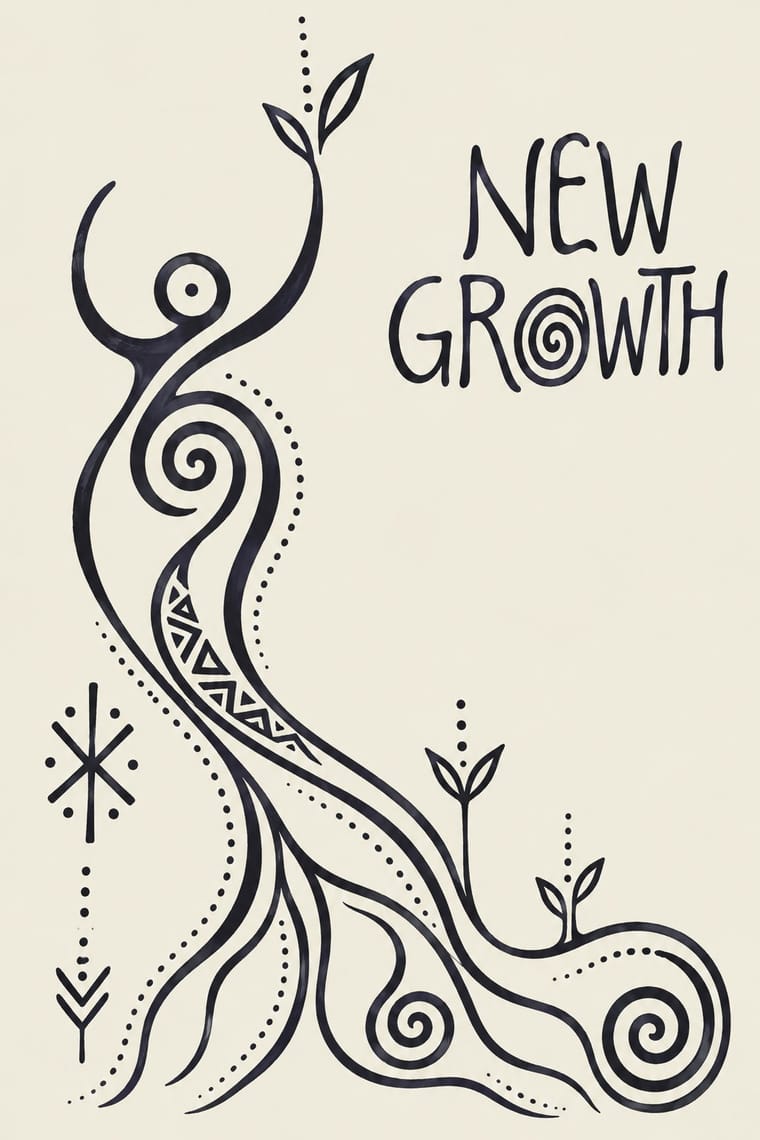
Both are women's wall-painting traditions led by line, but uli sets a few swelling lines and named motifs asymmetrically on open ground, so the gaps count, while Mithila closes a symmetrical, bordered field and fills every gap. Set them side by side to show restraint against abundance.
01
What each style brings
Each part of the design comes from the style with the stronger say in it, and each style gives at least two.
Mithila (Madhubani) Painting Uli & Nsibidi Line and Sign Tradition
- Type from Uli
-
- Colour from Mithila Painting
-
Uli avoids full polychrome: this is where the two pull against each other, which is the point of the contrast.
- Form from Uli
- Composition from Mithila Painting
- Surface from Mithila Painting
02
The type
Open fonts standing in for each style’s own type, which is often hand-drawn or commercial.
Display · Uli
Halo
Ojuju, standing in for Nsibidi signs as an ideographic set, drawn by hand (there is no standard font; check each sign's meaning and keep to public signs)
Text · Mithila Painting
Women's ritual wall and floor painting from Mithila in north Bihar and Nepal's Terai, attested from at least the 14th century, seen by W. G. Archer after the 1934 earthquake and photographed in 1940, and moved to paper for sale in the 1966–67 drought. Line comes first: figures and borders are drawn, often as double outlines, then filled with flat colour (bharni), fine hatching (kachni) or tattoo-derived rings (godna) until no ground is left empty. Wedding-chamber kohbar images, deities, epics and, later, village life and world events fill sheets closed by border bands.
Fira Sans; Mithila Painting used Hand-written artist's names, villages and occasional titles in Devanagari or Latin script, added with the outlining nib along a margin or inside the border band and For accompanying Hindi or Maithili text in graphic work, a sturdy even-stroke Devanagari text face (for example Mukta or Hind) set outside the bordered painting rather than over its filled ground
03
The colours
The ground and leading colours come from Mithila Painting, with a counter-accent from Uli. The ink reads on the ground at 4.5:1 or more.
Mithila (Madhubani) Painting Uli & Nsibidi Line and Sign Tradition
-
#f1e6ccground · 36% -
#1a1714ink · 14% -
#e9b21baccent · 18% -
#c4952faccent · 14% -
#c8281eaccent · 10% -
#8c3a23accent · 8%
As CSS
:root {
  --ground: #f1e6cc;
  --ink: #1a1714;
  --accent-1: #e9b21b;
  --accent-2: #c4952f;
  --accent-3: #c8281e;
  --accent-4: #8c3a23;
  --font-display: "Ojuju", sans-serif;
  --font-text: "Fira Sans", sans-serif;
}
Use it with care
Mithila (Madhubani) Painting: Mithila painting is the living craft and livelihood of named painters, mostly women, across many castes in Madhubani district and southern Nepal, and 'Madhubani paintings' is a registered Geographical Indication of Bihar (2006–07): do not label machine-printed, traced or AI-generated images as Madhubani or Mithila painting, never add a painter's name or signature to generated work, and commission, buy from or credit painters by name instead. Kohbar and aripana images are made for marriages, births and other rites and many sheets show Hindu deities still worshipped, so do not crop, distort or put them on disposable or demeaning goods. Godna painting and the figure of Raja Salhesh belong to the Dalit Dusadh community's history of claiming a place their painting was once denied; do not treat them as generic tribal pattern or erase whose tradition they are. Godna painting also draws on the tattoo art of Nat (Natin) women; credit that source too. Use 'Mithila painting' as the inclusive name: 'Madhubani' is the Bihar GI name, so do not label work by Maithil painters in Nepal, such as those of Janakpur, as Madhubani or Indian.
Uli & Nsibidi Line and Sign Tradition: These are living traditions with restricted parts. Nsibidi has a sacred side kept by the Ekpe and Mgbe leopard societies, and ukara cloth is used exclusively by Ekpe members, so never copy society signs or ukara layouts for decoration, merchandise or invented 'secret' meanings; use only signs whose public meaning has been checked with knowledgeable members of the community. Uli is Igbo women's art, which declined after Christian missionaries discouraged it, and the mostly male Nsukka artists were criticised for drawing on it; credit and commission Igbo and Cross River artists, including women painters such as those of the Upa Women Artists Collective, and do not present invented pseudo-nsibidi or generated 'uli' as historical work. Keep the two traditions apart in credit: uli is Igbo women's painting, nsibidi a sign system of Ejagham origin kept by Ekpe and Mgbe men's societies; never label one as the other.
04
The two styles
05
More combinations
With Mithila Painting
- Indian Institutional Modernism (NID) Pairs well · Set one bordered Mithila panel, credited to its painter, inside the quiet grid and white space of NID modernism, so the dense line work becomes the single focal point of an otherwise restrained Indian layout.
- Kalighat Pat & Battala Bazaar Prints Contrasts · Both are eastern Indian popular pictures of deities, but Kalighat sweeps a few brushed figures across an empty sheet while Mithila outlines everything and fills every gap; set them side by side to show sparse brush against dense line.
- Batik Pattern Tradition Contrasts · Batik spreads a resist-dyed repeat evenly across cloth; Mithila builds a unique, hand-drawn composition around a centre and closes it with borders. Borrow one or the other, not both, to keep pattern and picture distinct.
- Chinese Paper-Cut (Jianzhi) Contrasts · Both are folk arts made mostly by rural women for weddings and other rites, with fish and lotus among their auspicious signs, but paper-cut is a silhouette, usually red, cut from one sheet and folded for mirror symmetry, while Mithila draws an outline and fills it with colour, hatching or rings until no ground is left. Use one of them, not a blend of the two.
- Data Humanism Pairs well · Both treat hand-drawn hatching, dots and repeated small marks as content; a kachni-style legend or border can give a hand-drawn chart a South Asian line vocabulary, provided a Mithila painter is commissioned for it.
- Indian Calendar & Bazaar Art Contrasts · Calendar art models its gods with gradients, gloss and illusionistic space; Mithila draws the same deities as flat outlined shapes on a packed ground. Use the contrast to separate devotional realism from devotional pattern.
With Uli
- Ma & Wabi-sabi Aesthetics Pairs well · Both make the empty interval carry meaning and place a few elements off-centre in earth colours; uli supplies a living line and named signs where wabi-sabi supplies texture and a single mark.
- Kōwhaiwhai & Toi Māori Design Contrasts · Both build from curving line and balance positive against negative space, but kōwhaiwhai mirrors koru in continuous bands along a rafter, while uli scatters single motifs asymmetrically over open skin, wall or paper.
- Adinkra & Kente Symbol Systems Contrasts · Both put named signs on West African cloth, but adinkra stamps solid silhouettes into a filled grid in one dark dye, while uli draws open line on empty ground and ukara reserves nsibidi signs white in indigo; keep the two sign systems, their meanings and their makers apart.
- Afrofuturist Design Pairs well · Afrofuturism already borrows nsibidi, as in Black Panther's Ancient Wakandan script; keep uli's sparse dark line and real, public signs rather than glowing pseudo-glyphs on deep-space grounds.
- Bògòlanfini Mud Cloth Pairs well · Both leave pale signs in a dark-dyed ground, bògòlan by painting mud around them and ukara by stitching raffia to resist indigo; ukara itself is restricted to Ekpe, so borrow the light-on-dark idea with public signs placed freely, credit each source and keep each motif's meaning.
- Warli Painting Contrasts · Both are women's wall painting built on line; uli usually draws one dark tone on a light ground, skin or paper and leaves wide empty ground around single motifs, the reverse of Warli's white on earth with rows of figures filling the field, so borrow uli's restraint to calm a crowded Warli-derived layout.