Avant-garde · 1910–1920 · Eastern Europe
Russian Futurist Book
Also known as Cubo-Futurist book, Budetlyane books, Zaum books, Russian avant-garde artist's book
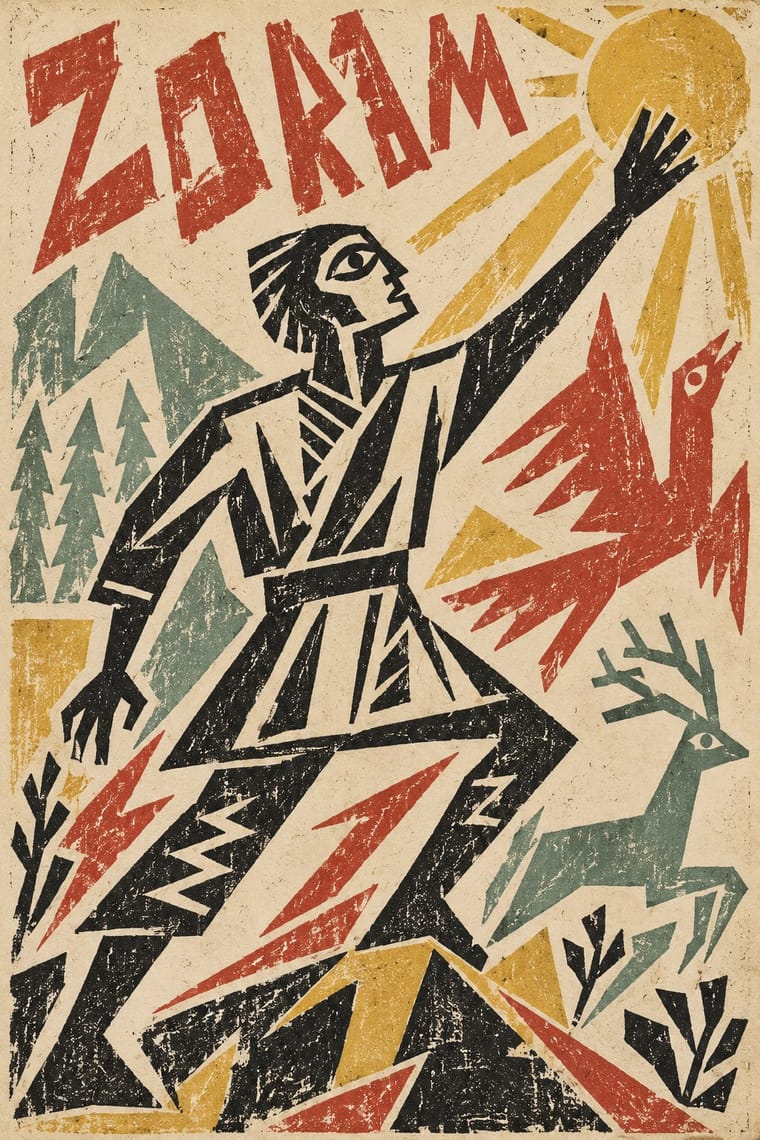
The cheap, small-run books of the Russian Cubo-Futurist poets and painters, from Kruchenykh and Khlebnikov to Goncharova, Larionov and Rozanova. Against the luxurious Symbolist book, they lithographed handwriting and crude neo-primitive drawings together, at times with rubber stamps or colour hectograph, or printed mixed letterpress founts on wallpaper, in thin sewn or stapled pamphlets. Transrational zaum words made the letter itself a visual sound. They adopted Marinetti's manifesto but obstructed his 1914 visit. The Burliuks, Malevich and Kruchenykh were Ukrainian-born, Zdanevich Georgian.
Make something in this styleGet advice in this styleMix it with another style
01
How it works
- Write the text by hand and print it by lithography together with the drawings, so script and picture share one surface.
- Keep the book cheap and small: thin, unevenly cut pages sewn or stapled as a pamphlet, often with a collaged cover.
- Draw figures in a deliberately crude, neo-primitive line that borrows from icons and lubok prints.
- Stamp, misspell and break up words, and let transrational zaum sound decide what the letters look like.
- Where type is used, mix founts, weights and sizes, stack or turn lines vertically, and print on wallpaper or coloured paper so the found pattern faces the text.
- Keep the ink mostly black and bring colour in through the ground (coloured, metallic or wallpaper stock), a collaged cover, colour linocut or hectograph.
Moscow and St Petersburg, with makers from across the Russian Empire: Hylaea (the Burliuk brothers, Khlebnikov, Kamensky, Kruchenykh, Mayakovsky), the Larionov–Goncharova circle and the Union of Youth; later Tiflis (the 41° group)
02
Its design choices
From Stylogeny’s vocabulary of design choices: defining choices make the style, characteristic ones are usual, occasional ones turn up now and then.
- Layout & composition
- Space & hierarchy
- Typography
- Colour
- Form & shape
- Surface & texture
- Imagery
- Medium & production
- Tone & intent
- Avoids
- Modular grid, Naturalistic depiction, Straight photography, Photomontage, Gloss & highlights, Gradients, Rational & objective, Luxurious & glamorous
Palette
#ede4cf#1c1a17#b8996a#8ea596#d6b44a#b5463a
Typefaces
The poets' own handwriting transferred to the lithographic stone
Rozanova and Kruchenykh's samopismo, 'self-writing'
Rubber-stamp letters for zaum poems
Explodity, 1913
Mixed letterpress founts in Kamensky's ferro-concrete poems
Tango with Cows, 1914
Ilia Zdanevich's letterpress compositions for the 41° group in Tiflis
Milliork, 1919
Known for
Aleksei Kruchenykh & Mikhail Larionov, Old-Fashioned Love (Starinnaia liubov', 1912), lithographed text and images
Kruchenykh & Velimir Khlebnikov with Goncharova, Larionov, Rogovin and Tatlin, Worldbackwards (Mirskontsa, 1912), collaged cover
Khlebnikov & Kruchenykh, A Game in Hell
Igra v adu, 1912, Natalia Goncharova; 1914 edition with Kazimir Malevich and Olga Rozanova
Kruchenykh & Larionov, Pomade (Pomada, 1913), with the zaum poem 'Dyr bul shchyl'; some lithographs laid down on metallic leaf or red paper
Kruchenykh with Goncharova, Kulbin, Malevich, Rozanova and Altman, Explodity (Vzorval', 1913), lithographs and rubber stamp
Olga Rozanova & Nikolai Kulbin, Te li le (text by Kruchenykh and Khlebnikov, 1914), manuscript text and images hectographed in seven colours
Vasily Kamensky with David and Vladimir Burliuk, Tango with Cows
Ferro-Concrete Poems (1914), mixed-fount letterpress and lithographs on wallpaper
Olga Rozanova, Kruchenykh & Roman Jakobson, Transrational Boog (Zaumnaia gniga, 1916), colour linocuts and collage
03
Make something in this style
Say what you need, and Stylogeny’s image studio draws it from Russian Futurist Book’s design choices and checks it against them. It takes about a minute, and you get a link to share.
04
Where it comes from, and what it’s close to
Before it
The style it grew out of, and the styles it borrowed from.


Alike in its design choices
Styles that make many of the same choices, related or not, besides those above.


05
Sources
- J. Paul Getty Museum, Tango with Cows: Book Art of the Russian Avant-Garde, 1910–1917 (exhibition, 2008–09): https://www.getty.edu/art/exhibitions/tango_with_cows/, with the Te li le page (https://www.getty.edu/art/exhibitions/tango_with_cows/telile.html) and curator's essay (https://www.getty.edu/art/exhibitions/tango_with_cows/curators_essay.html)
- Art Institute of Chicago collection records for Worldbackwards (https://www.artic.edu/artworks/199083), A Game in Hell (199125, 199126), Old-Fashioned Love (199061), Pomade (199060), Explodity (153596), Tango with Cows (199067), Transrational Boog (199129), A Trap for Judges (199073) and Milliork (199543)
- Museum of Modern Art collection records for Sadok Sudei (A Trap for Judges), 1910 (https://www.moma.org/collection/works/9421) and Te li le, 1914 (https://www.moma.org/collection/works/10866)
- Wikipedia: 'Russian Futurism' (https://en.wikipedia.org/wiki/Russian_Futurism), 'Aleksei Kruchenykh' (https://en.wikipedia.org/wiki/Aleksei_Kruchenykh), 'Olga Rozanova' (https://en.wikipedia.org/wiki/Olga_Rozanova) and 'Soyuz Molodyozhi' (https://en.wikipedia.org/wiki/Soyuz_Molodyozhi)
- Encyclopaedia of St Petersburg, 'Youth Union' (https://www.encspb.ru/object/2804029049?lc=en)
How Stylogeny researches and checks a style: where the facts come from.