Avant-garde · 1917–1924 · Eastern Europe, Central Europe
Kultur-Lige & Yiddish Avant-Garde Book Design
Also known as Jewish avant-garde book art, Yiddish modernist book, Kultur-Lige art section
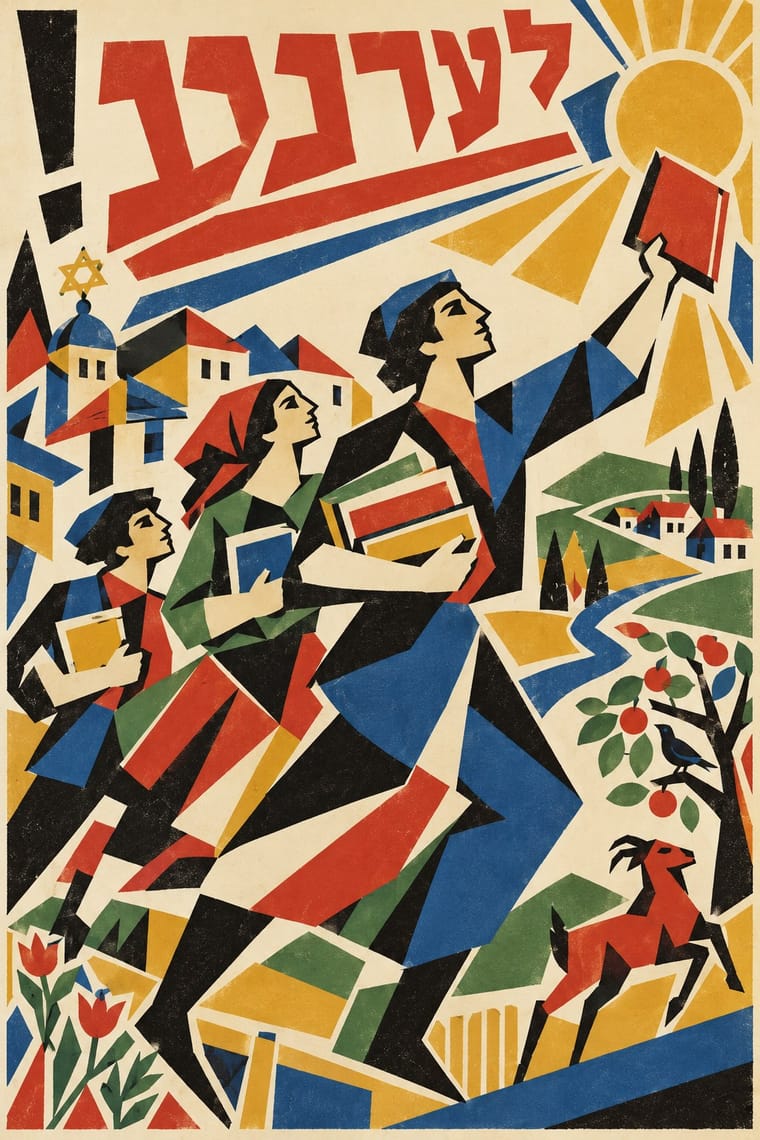
The Yiddish modernist book of the Kultur-Lige, the secular Jewish culture league founded in Kyiv in 1918, and its circle: El Lissitzky, Issachar Ber Ryback, Iosif Chaikov, Boris Aronson and others, who sought a new Jewish art in the shtetl synagogues and tombstones they had recorded and in Cubo-Futurism and Suprematism. In children's books and poetry, hand-drawn Hebrew-alphabet letters are built into faceted folk pictures in flat lithographic colour or black line.
Make something in this styleGet advice in this styleMix it with another style
Use it with care
These books quote sacred forms: Hebrew letters, the divine name (written in Had Gadya), scroll formats and scribal square script, synagogue art and tombstone inscriptions. Do not use the letters as decorative glyphs or mirror them; have any Yiddish or Hebrew written and checked by a fluent reader, and keep divine names and scroll and tombstone forms off throwaway or commercial items. The movement was secular and Yiddishist, a modern Jewish culture in Yiddish backed by Jewish socialist parties, Folkists and left-wing Zionists, not the Hebrew, Zionist art of Bezalel and not religious art, so do not present it as a generic 'Jewish look', and do not reduce its folk figures to stereotyped shtetl types. Many of its people were persecuted: Ryback's father was killed in the pogroms, and Hofshteyn, Markish, Bergelson and Kvitko were executed in Moscow on 12 August 1952. Chagall (d. 1985) and Chaikov (d. 1979) are still in copyright: draw your own letters and figures rather than reproducing their pages.
01
How it works
- Draw the Hebrew-alphabet letters by hand and build them into the picture: run a verse along a margin, close it in a circle or set it in a tablet, and arrange text and drawing differently on every page.
- Take the motifs from Jewish folk art, from the painted synagogue interiors, carved tombstones, Passover songs and folk tales recorded in the shtetls, and recast them in the faceted planes of Cubo-Futurism and, from 1919, in Suprematist circles and squares.
- Borrow the forms of Jewish ritual writing, such as the scroll written by a scribe in square script, the tombstone tablet and its formulas, and the cumulative Passover song, for a secular Yiddish book addressed to a new reader.
- Print the pictures in lithography in a few bright, flat colours on pale paper, or in black line for cheap letterpress children's editions, and let the artist draw the whole page, letters included wherever he can, as in Had Gadya (in Sikhes khulin a scribe wrote the text inside the artist's borders).
- Keep the tone hopeful and playful: a utopian culture in Yiddish for children and the people, not a provocation aimed at taste.
Kyiv: the art section of the Kultur-Lige (Culture League), the secular Yiddish cultural league founded early in 1918 (founding conference April 1918), set up by El Lissitzky, Issachar Ber Ryback, Iosif Chaikov, Mark Epstein, Boris Aronson and others, after Lissitzky and Ryback's 1916 expedition to record the synagogues and folk art of the shtetls; Aronson and Ryback set out its programme in the essay 'Di vegn fun der yidisher molerey' (Paths of Jewish Painting) in the league's journal Oyfgang in 1919; the Kultur-Lige Press was founded early in 1920, the Communists took the league over by force in December 1920, and its artists carried the idiom to Moscow and to the Yiddish presses of Berlin, such as Schwellen
02
Its design choices
From Stylogeny’s vocabulary of design choices: defining choices make the style, characteristic ones are usual, occasional ones turn up now and then.
- Layout & composition
- Space & hierarchy
- Typography
- Colour
- Form & shape
- Surface & texture
- Medium & production
- Tone & intent
- Avoids
- Straight photography, Photomontage, Naturalistic depiction, Ornament-free, Modular grid, Ironic & self-aware
Palette
#efe5cc#1c1a17#c43b2c#dca533#2f5b8c#4f7a4f
Typefaces
The scribe's square Hebrew script (ktav ashuri), written by a sofer for Sikhes khulin (1917), whose 'wonderful' style Lissitzky set out to match in his illustrations
Lissitzky's hand-drawn Yiddish verses lithographed into each picture of Had Gadya (1919), the refrain running along the margins and closing in a circle at the foot
Hebrew tombstone formulas, such as pei-nun ('here lies', po nikbar), lettered above the Angel of Death's palm on the last plate of Had Gadya, where the hand of God slays him
Known for
El Lissitzky with Moyshe Broderzon, Sikhes khulin
Prager legende (Small Talk: The Legend of Prague; Moscow: Schomir, 1917), edition of 110, his first book design: the Yiddish text written by a scribe in square Hebrew script, in columns framed by Lissitzky's illustrated borders; most copies bound as books (MoMA 213.2001: 17 letterpress illustrations, one with watercolour additions, 23.1 × 28 cm), a handful (12 to 20) made up as hand-coloured lithographic scrolls, a rare secular use of the scroll form; the colophon pairs the story's style with the 'wonderful' style of the square Hebrew letters
El Lissitzky, Had Gadya (Tsigele) (Kyiv: Kultur-Lige, 1919), ten colour lithographs and a cover, 28 × 26 cm, edition of 75
the Yiddish verses drawn into each picture, the refrain repeated along the margins and joined round a circle at the foot, and an abstract, Proun-like inner jacket in Suprematist planes (often called the cover) bearing the divine name in Hebrew at top left, the first and last letters of Lissitzky's name in Hebrew at top right and the Kultur-Lige imprint in Yiddish in the lower circle (Jewish Museum, New York, Had Gadya Suite, 1986-121); a 1917 version in bright, folk-like watercolours preceded it
El Lissitzky with Mani Leib, Yingl tsingl khvat (The Mischievous Boy; Kyiv–St Petersburg: Yidisher Folks-Farlag, 1919), one lithographed and ten letterpress illustrations, with text and drawing arranged differently on every page (MoMA 362.2001)
Marc Chagall, design for Dovid Hofshteyn's poems Troyer
Sorrow; Kyiv: Kultur-Lige, 1922
Iosif Chaikov, illustration for Lipe Resnick's Samet
Velvet; Kyiv: Kultur-Lige, 1922
Issachar Ber Ryback, covers and illustrations for Leib Kvitko's children's books In vald (In the Forest, 1922) and Foyglen (Birds, 1922 or 1923), Berlin: Schwellen
Issachar Ber Ryback, Shtetl
mayn khorever heym, a gedenknish (My Destroyed Home, a Memorial; Berlin: Schwellen, 1923), lithographs of shtetl life before the pogroms
El Lissitzky, illustrations for Leib Kvitko's Ukraynishe folkmayses (Ukrainian Folk Tales; Berlin, 1922), probably drawn before 1919
03
Make something in this style
Say what you need, and Stylogeny’s image studio draws it from Kultur-Lige & Yiddish Avant-Garde Book Design’s design choices and checks it against them. It takes about a minute, and you get a link to share.
04
Where it comes from, and what it’s close to
Before it
The style it grew out of, and the styles it borrowed from.


After it
The styles that grew out of it.
No later style in the atlas grew out of it yet.
Alike in its design choices
Styles that make many of the same choices, related or not, besides those above.

- Norwegian and Finnish National Romantic Graphics (Munthe & Karelianism)64% alike
- Persian Popular Narrative (Lithographs & Coffeehouse Painting)64% alike


05
Sources
- Hillel Kazovsky, 'Kultur-lige', YIVO Encyclopedia of Jews in Eastern Europe (2010), on its founding in Kiev early in 1918 (founding conference April 1918) with the support of a coalition of Jewish socialist parties, left-wing Zionists and Folkists, members including Lissitzky, Ryback, Chaikov and Boris Aronson, the Kultur-Lige Press (founded early 1920, closed 1931), the forcible Communist takeover of December 1920, its art shows (Kiev 1920 and 1922, Moscow 1922) and captions for Lissitzky's Khad gadya (1919), Chaikov's Samet (1922) and Chagall's Troyer (1922): https://encyclopedia.yivo.org/article.aspx/Kultur-Lige (archived: https://web.archive.org/web/2021/https://yivoencyclopedia.org/article.aspx/Kultur-Lige)
- Hillel Kazovsky, 'The Art Section of the Kultur-Lige', Jews in Eastern Europe 3.22 (1993): 5–22; and Khudozhniki Kul'tur-Ligi / The Artists of the Kultur-Lige (Moscow and Jerusalem, 2003)
- Museum of Modern Art, El Lissitzky, Sikhes kholin. Prager legende (1917), Schomir, Moscow, edition 110, 213.2001: https://www.moma.org/collection/works/13806
- Sotheby's, Important Judaica, New York, 2007, lot 177, Sichas Chulin scroll, copy 8: hand-coloured lithographic scroll, 17 panels and a blank, 22 × 410 cm, the text penned by a professional sofer in square script in columns framed by illustrated borders, one of a handful (variously 12 to 20) of scrolls from an edition of 110, a rare use of the scroll form for a secular text: https://www.sothebys.com/en/auctions/ecatalogue/2007/judaica-n08392/lot.177.html
- Sotheby's, Books and Manuscripts: 19th and 20th Century, London, 2021, lot 95, Sichas Cholin (Moscow, 1917), first edition limited to 110 copies, lithographed text surrounded by Lissitzky's illustrations, 'some copies were rolled up as scrolls': https://www.sothebys.com/en/buy/auction/2021/books-and-manuscripts-19th-and-20th-century-2/el-lissitzky-sichas-cholin-moscow-1917-disbound
- Museum of Modern Art, El Lissitzky, Yingl tsingl khvat (1919), Idisher Folks Farlag, Kiev–St Petersburg, 362.2001.1-11: https://www.moma.org/collection/works/16278
- The Jewish Museum, New York, El Lissitzky, 'The Fire Came and Burnt the Stick', Had Gadya Suite (Tale of a Goat), lithograph, 1919, 1986-121g: https://collections.thejewishmuseum.org/collection/1964-the-fire-came-and-burnt-the-stick
- Dr. Bernard Heller Museum, Hebrew Union College, 'Frank Stella's Had Gadya' (exhibition), on Lissitzky's Had Gadya (Tsigele), Kultur Lige, Kiev, 1919: ten colour lithographs and cover, edition of 75, with the refrain in the margins and around a circle, and the Proun-like interior jacket bearing God's name in Hebrew at top left, the first and last letters of Lissitzky's name at top right and the Kultur Lige imprint in the lower circle: https://huc.edu/public-programs-events/museums/dr-bernard-heller-museum-in-new-york/exhibition-archive/frank-stellas-had-gadya-ada/
- Jewish Museum Berlin, Berlin Transit, 'Schwellen' publishing house, on Ryback's covers and illustrations for Kvitko's In vald and Foyglen: https://www.jmberlin.de/berlin-transit/orte/en/schwellen.php
- Posen Library, 'Issachar Ber Ryback': https://www.posenlibrary.com/node/975
- Ben Uri Gallery and Museum, 'Boris Aronson' (biography), on the manifesto of progressive Jewish art he co-published with Ryback in the Yiddish journal Oyfgang in 1919: https://benuri.org/artists/260-boris-aronson/biography/
- El Lissitzky Foundation (Van Abbemuseum), 'Boris Aronson', on his work with the Kultur-Lige from 1918 and the essay 'Di Vegen fun der Yidisher Malerei' (Paths of Jewish Painting) in Oifgang, published by the Kultur-Lige: https://ls.vanabbemuseum.nl/A/aronson%20b/text/aronson%20b.htm
- Internet Encyclopedia of Ukraine, 'Chaikov, Joseph' (https://www.encyclopediaofukraine.com/pages%5CC%5CH%5CChaikovJoseph.htm) and 'Ryback, Issachar Ber' (https://www.encyclopediaofukraine.com/pages%5CR%5CY%5CRybackIssacharBer.htm), on the founding of the art section in 1918; and 'Aronson, Boris' (https://www.encyclopediaofukraine.com/pages%5CA%5CR%5CAronsonBoris.htm), on Aronson as a co-founder of the art section in spring 1918 and the programmatic article 'Di vegn fun der yidisher molerey' (Paths of Jewish Painting), written with Ryback
- Wikipedia: 'El Lissitzky' (https://en.wikipedia.org/wiki/El_Lissitzky), for the 1916 expedition, the Mogilev synagogue, the Sikhes khulin colophon, Had Gadya (including the pei-nun, 'here lies', above the Angel of Death's palm on the last page) and Yingl tsingl khvat; 'Issachar Ber Ryback' (https://en.wikipedia.org/wiki/Issachar_Ber_Ryback); 'Kultur Lige' (https://en.wikipedia.org/wiki/Kultur_Lige); 'Chad Gadya' (https://en.wikipedia.org/wiki/Chad_Gadya); 'Night of the Murdered Poets' (https://en.wikipedia.org/wiki/Night_of_the_Murdered_Poets)
How Stylogeny researches and checks a style: where the facts come from.