Style combination · Contrasts
Harlem Renaissance Graphic Art × Woodland School
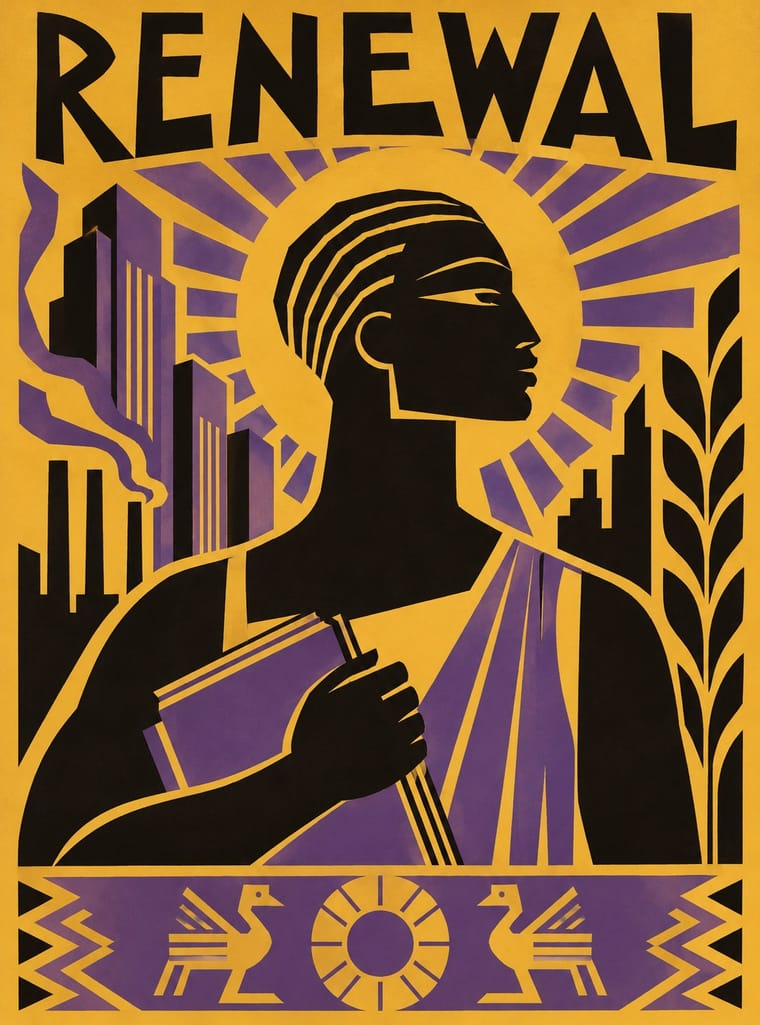
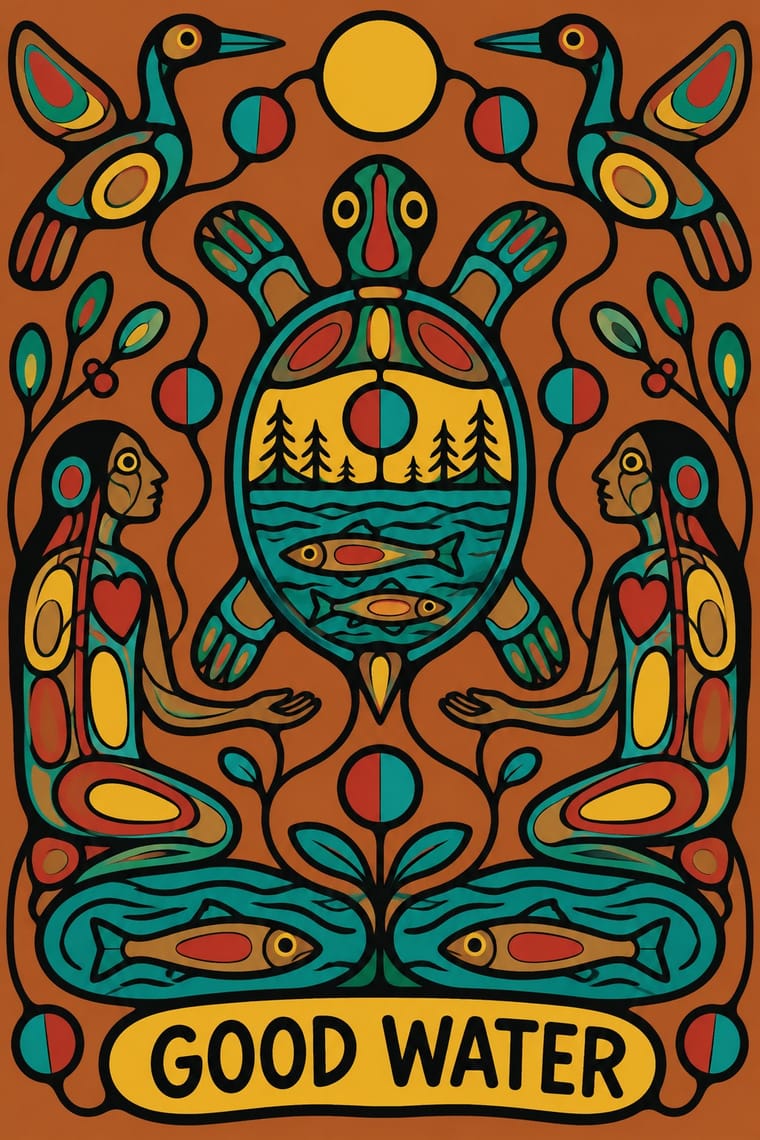
Both set flat, stylised figures to spiritual and communal ends, but Aaron Douglas's Harlem graphics print hard-edged silhouettes in one to three flat colours, stepping their tone where concentric rings of light cross them among Deco angles, while Woodland painting closes many bright colours inside a continuous black contour and opens each body in x-ray.
Mix them and make something Harlem Renaissance Graphic Art Woodland School
01
What each style brings
Each part of the design comes from the style with the stronger say in it, and each style gives at least two.
Harlem Renaissance Graphic Art Woodland School (Legend Painting)
- Type from Harlem Renaissance Graphic Art
- Colour from Woodland School
- Form from Harlem Renaissance Graphic Art
- Composition from Harlem Renaissance Graphic Art
- Surface from Woodland School
02
The type
Open fonts standing in for each style’s own type, which is often hand-drawn or commercial.
Display · Harlem Renaissance Graphic Art
Grace
Limelight, standing in for Aaron Douglas's hand-lettered Deco capitals on jackets and covers
Text · Woodland School
A school of painting from northwestern Ontario, made public when Norval Morrisseau showed at Toronto's Pollock Gallery in 1962 and carried on by Ojibwe, Odawa, Oji-Cree and Cree artists such as Daphne Odjig and Carl Ray. Legends, spirit beings and visions, drawn from rock paintings and Midewiwin birchbark scrolls, are painted in heavy black outlines around flat, bright colour, in x-ray views of organs and inner energy lines, joined by lines of communication and divided circles, with no ground line or horizon. Red Lake's Triple K screenprints, murals and book and album covers took it public.
Caveat; Woodland School used Cree syllabics as the painter's signature and Pencil signature, date and edition number in the margin of limited-edition screenprints
03
The colours
The ground and leading colours come from Woodland School, with a counter-accent from Harlem Renaissance Graphic Art. The ink reads on the ground at 4.5:1 or more.
Harlem Renaissance Graphic Art Woodland School (Legend Painting)
-
#f2c230ground · 36% -
#141210ink · 14% -
#c8322baccent · 18% -
#e3782baccent · 14% -
#5d4a86accent · 10% -
#1aa39baccent · 8%
As CSS
:root {
  --ground: #f2c230;
  --ink: #141210;
  --accent-1: #c8322b;
  --accent-2: #e3782b;
  --accent-3: #5d4a86;
  --accent-4: #1aa39b;
  --font-display: "Limelight", sans-serif;
  --font-text: "Caveat", cursive;
}
Use it with care
Harlem Renaissance Graphic Art: Douglas built this idiom so that Black artists could picture Black history against minstrel caricature and white primitivist fantasy. Lifted as generic Jazz Age or 'tribal' decoration, the Egyptian profiles, mask-like eyes and black silhouettes can slide back into the stereotypes it answered, so use it to tell Black stories with Black artists and writers, and credit Douglas and the magazines (The Crisis, Opportunity) whose images you draw on.
Woodland School (Legend Painting): Woodland painting is the living practice of named Anishinaabe, Oji-Cree and Cree artists, and it draws on sacred knowledge: Morrisseau's relatives and community discouraged him from painting sacred subjects because Anishinaabe protocols forbid sharing ceremonial knowledge, Carl Ray was among the first Cree painters to set aside the bans on depicting sacred legends, and the imagery comes from Midewiwin scrolls and rock paintings. That was their decision to make, not an outsider's. Do not assemble thunderbirds, divided circles, power lines or x-ray bodies into a generic 'Indigenous' look, and never imitate a painter's hand or syllabic signature: a Thunder Bay ring run by David Voss from 1996 to 2019 turned out thousands of fake Morrisseaus by pencilling outlines and filling letter-coded flat colour, and its leader was jailed in 2024. Commission or license work from Woodland artists, such as Saul Williams of North Caribou Lake First Nation, and credit them by name and nation.
04
The two styles
05
More combinations
With Harlem Renaissance Graphic Art
- Corporate Memphis Contrasts · Both flatten the human figure, but Douglas's silhouettes are specific and historical where corporate Memphis is generic; study the difference before drawing people flat.
- WPA Silkscreen Posters Pairs well · Douglas's 1934 murals were New Deal commissions; pair his silhouettes with WPA screenprint layouts for civic, narrative posters.
- Afrofuturist Design Pairs well · Carry Douglas's Egyptian profiles and radiating light into a jewel-dark cosmos for a Black futurism that knows its own lineage.
- Bezalel School Pairs well · Both built a graphic language for a people's cultural renewal from ancestral ornament and biblical subjects in the 1920s; combine Bezalel's gilded frames with Aaron Douglas's flat silhouettes.
- AfriCOBRA Pairs well · Aaron Douglas's flat silhouettes are an earlier Black self-portrait in print; set his stepped light and profiles beside AfriCOBRA's lettered colour to trace the line from the New Negro to Black Power.
With Woodland School
- Pop Art Graphics Contrasts · Both arrived in screenprint with flat colour behind a black line in the 1960s and 70s, but Pop quotes consumer images with irony and halftone, while Woodland prints carry legend and vision with none of either.
- Cubist Pictorial Space Pairs well · Daphne Odjig took the overlapping planes of the Cubism she encountered in Toronto into her own curving, strongly outlined Woodland painting; when a layout wants overlapping flat planes, overlap type and colour panels around a commissioned Woodland image rather than imitating her hand.
- Minimalist Graphic Design Pairs well · Give a commissioned Woodland painting or print a quiet, white, sparsely typeset layout so the artist's outline and colour carry the whole page, as on a book cover or exhibition poster.
- Northwest Coast Formline Design Contrasts · Both enclose spirit and crest beings in black line, but formline swells and tapers its line through a codified grammar of ovoids and U-forms in a few colours, while a Woodland contour keeps a steady weight around free, many-coloured fields and opens the body in x-ray; never fuse the two into a generic 'Native' look.