Style combination · Pairs well
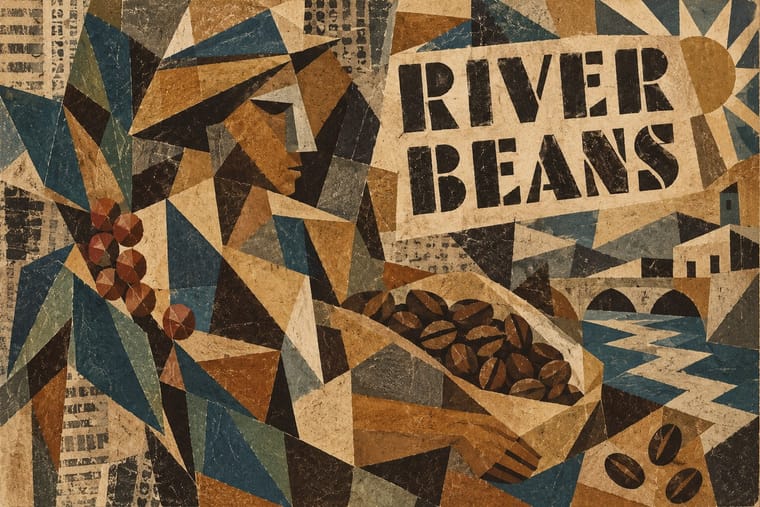
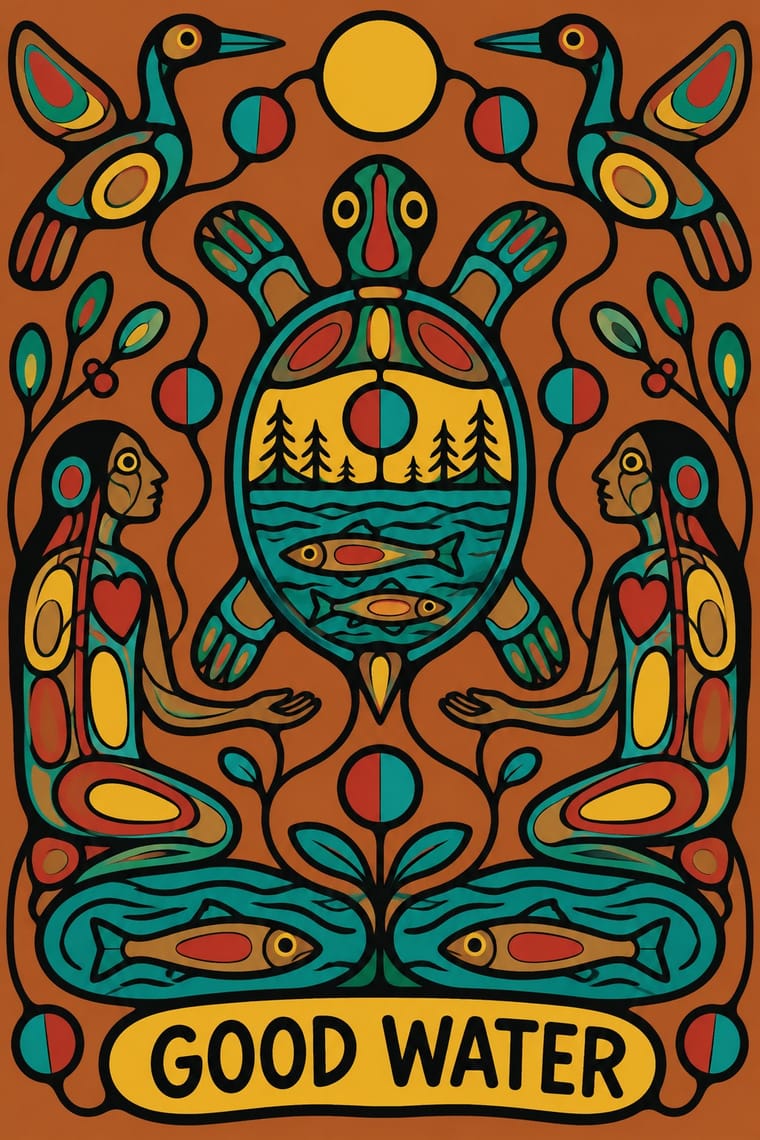
Cubist Pictorial Space × Woodland School
Daphne Odjig took the overlapping planes of the Cubism she encountered in Toronto into her own curving, strongly outlined Woodland painting; when a layout wants overlapping flat planes, overlap type and colour panels around a commissioned Woodland image rather than imitating her hand.
Mix them and make something Cubist Pictorial Space Woodland School
01
What each style brings
Each part of the design comes from the style with the stronger say in it, and each style gives at least two.
Cubist Pictorial Space Woodland School (Legend Painting)
- Colour from Woodland School
- Form from Woodland School
- Composition from Cubist Pictorial Space
- Surface from Cubist Pictorial Space
02
The type
Open fonts standing in for each style’s own type, which is often hand-drawn or commercial.
Display · Cubist Pictorial Space
Light
Allerta Stencil, standing in for Sign-painters' stencilled capitals (Braque, from 1911)
Text · Woodland School
A school of painting from northwestern Ontario, made public when Norval Morrisseau showed at Toronto's Pollock Gallery in 1962 and carried on by Ojibwe, Odawa, Oji-Cree and Cree artists such as Daphne Odjig and Carl Ray. Legends, spirit beings and visions, drawn from rock paintings and Midewiwin birchbark scrolls, are painted in heavy black outlines around flat, bright colour, in x-ray views of organs and inner energy lines, joined by lines of communication and divided circles, with no ground line or horizon. Red Lake's Triple K screenprints, murals and book and album covers took it public.
Caveat; Woodland School used Cree syllabics as the painter's signature and Pencil signature, date and edition number in the margin of limited-edition screenprints
03
The colours
The ground and leading colours come from Woodland School, with a counter-accent from Cubist Pictorial Space. The ink reads on the ground at 4.5:1 or more.
Cubist Pictorial Space Woodland School (Legend Painting)
-
#f2c230ground · 36% -
#141210ink · 14% -
#c8322baccent · 18% -
#8b6b3eaccent · 14% -
#b8642eaccent · 10% -
#3e5a6baccent · 8%
As CSS
:root {
  --ground: #f2c230;
  --ink: #141210;
  --accent-1: #c8322b;
  --accent-2: #8b6b3e;
  --accent-3: #b8642e;
  --accent-4: #3e5a6b;
  --font-display: "Allerta Stencil", sans-serif;
  --font-text: "Caveat", cursive;
}
Use it with care
Woodland School (Legend Painting): Woodland painting is the living practice of named Anishinaabe, Oji-Cree and Cree artists, and it draws on sacred knowledge: Morrisseau's relatives and community discouraged him from painting sacred subjects because Anishinaabe protocols forbid sharing ceremonial knowledge, Carl Ray was among the first Cree painters to set aside the bans on depicting sacred legends, and the imagery comes from Midewiwin scrolls and rock paintings. That was their decision to make, not an outsider's. Do not assemble thunderbirds, divided circles, power lines or x-ray bodies into a generic 'Indigenous' look, and never imitate a painter's hand or syllabic signature: a Thunder Bay ring run by David Voss from 1996 to 2019 turned out thousands of fake Morrisseaus by pencilling outlines and filling letter-coded flat colour, and its leader was jailed in 2024. Commission or license work from Woodland artists, such as Saul Williams of North Caribou Lake First Nation, and credit them by name and nation.
04
The two styles
05
More combinations
With Cubist Pictorial Space
- Risograph & Indie Print Culture Pairs well · Print synthetic-Cubist planes as overlapping flat riso inks so the overprints do the faceting for you.
- Art Deco Pairs well · Fracture a Deco poster subject into crisp Cubist planes, as Cassandre did, to add depth and movement without losing polish.
- Isotype Pictorial Statistics Contrasts · Isotype shows one thing from one view, Cubism one thing from many; choose Cubist fragmentation only when ambiguity is the point.
- Art Nouveau Contrasts · Set faceted, straight-edged planes against a single whiplash curve to dramatise the break with organic ornament.
- Chaekgeori & Minhwa Screen Painting Pairs well · Chaekgeori already shows objects from several viewpoints at once; borrow Cubist faceting to push its tilted shelves further, or cite chaekgeori as an East Asian precedent for multi-view still life.
- Low Poly Illustration Contrasts · Cubism breaks an object into planes seen from several viewpoints at once and flattens the space; low poly facets it from one consistent viewpoint and keeps the perspective. Borrow Cubist overlap only when ambiguity, not legibility, is the point.
With Woodland School
- Pop Art Graphics Contrasts · Both arrived in screenprint with flat colour behind a black line in the 1960s and 70s, but Pop quotes consumer images with irony and halftone, while Woodland prints carry legend and vision with none of either.
- Minimalist Graphic Design Pairs well · Give a commissioned Woodland painting or print a quiet, white, sparsely typeset layout so the artist's outline and colour carry the whole page, as on a book cover or exhibition poster.
- Harlem Renaissance Graphic Art Contrasts · Both set flat, stylised figures to spiritual and communal ends, but Aaron Douglas's Harlem graphics print hard-edged silhouettes in one to three flat colours, stepping their tone where concentric rings of light cross them among Deco angles, while Woodland painting closes many bright colours inside a continuous black contour and opens each body in x-ray.
- Northwest Coast Formline Design Contrasts · Both enclose spirit and crest beings in black line, but formline swells and tapers its line through a codified grammar of ovoids and U-forms in a few colours, while a Woodland contour keeps a steady weight around free, many-coloured fields and opens the body in x-ray; never fuse the two into a generic 'Native' look.