Traditions & vernacular · 1962–present · North America
Woodland School (Legend Painting)
Also known as Woodlands style, Woodlands School, Woodland Art, Legend painting, Medicine painting, Anishnabe painting
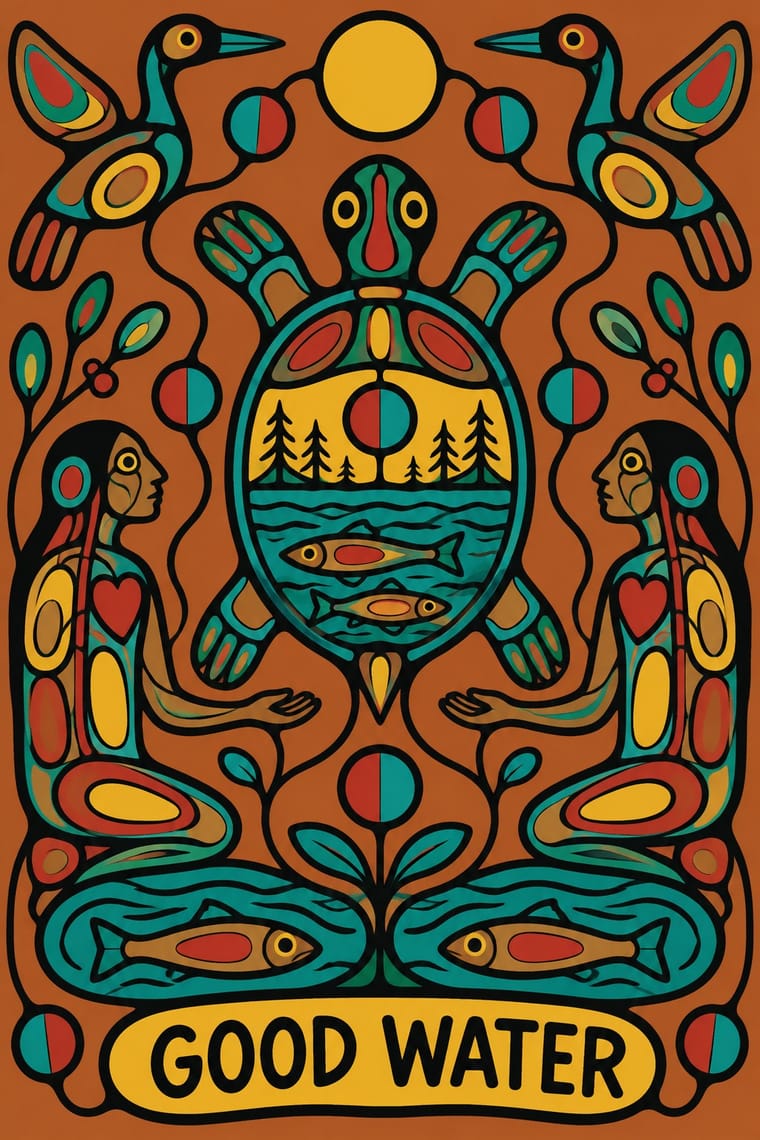
A school of painting from northwestern Ontario, made public when Norval Morrisseau showed at Toronto's Pollock Gallery in 1962 and carried on by Ojibwe, Odawa, Oji-Cree and Cree artists such as Daphne Odjig and Carl Ray. Legends, spirit beings and visions, drawn from rock paintings and Midewiwin birchbark scrolls, are painted in heavy black outlines around flat, bright colour, in x-ray views of organs and inner energy lines, joined by lines of communication and divided circles, with no ground line or horizon. Red Lake's Triple K screenprints, murals and book and album covers took it public.
Make something in this styleGet advice in this styleMix it with another style
Use it with care
Woodland painting is the living practice of named Anishinaabe, Oji-Cree and Cree artists, and it draws on sacred knowledge: Morrisseau's relatives and community discouraged him from painting sacred subjects because Anishinaabe protocols forbid sharing ceremonial knowledge, Carl Ray was among the first Cree painters to set aside the bans on depicting sacred legends, and the imagery comes from Midewiwin scrolls and rock paintings. That was their decision to make, not an outsider's. Do not assemble thunderbirds, divided circles, power lines or x-ray bodies into a generic 'Indigenous' look, and never imitate a painter's hand or syllabic signature: a Thunder Bay ring run by David Voss from 1996 to 2019 turned out thousands of fake Morrisseaus by pencilling outlines and filling letter-coded flat colour, and its leader was jailed in 2024. Commission or license work from Woodland artists, such as Saul Williams of North Caribou Lake First Nation, and credit them by name and nation.
01
How it works
- Close every figure in a heavy black contour of steady weight, whether the line is drawn first or painted last around blocks of colour, and keep the compartments it encloses flat and unmixed (Morrisseau took his colour straight from the tube), with no shading, modelling or cast shadow.
- Show beings in x-ray view: segment the body inside its outline into spine, organs and inner energy lines, each a separate field of colour, so the spirit is drawn as visibly as the skin.
- Join figures with lines of communication (power lines) that loop between them in closed circuits, and set two-colour divided circles among them as signs of balance.
- Float the figures on an open, flat field, blank or a single colour, with no ground line, horizon or perspective. Balance them around one central being, in a pyramid of figures or as a symmetrical pair, and make the eyes the point of entry.
- Take the figure language from Anishinaabe rock paintings and Midewiwin birchbark scrolls rather than from European picture space, and let it carry legend, cosmology and the painter's own visions.
- Keep the colour areas closed and the outline continuous so a design separates cleanly into stencils for a limited-edition screenprint, the artist approving every colour on the proof.
Northwestern Ontario, Canada: Norval Morrisseau's Anishinaabe (Ojibwe) home at Sand Point on Lake Nipigon and Beardmore, then Cochenour near Red Lake, and the Sandy Lake community of Carl Ray and the Kakegamic brothers, with Odawa, Oji-Cree and Cree painters across Ontario and Manitoba
02
Its design choices
From Stylogeny’s vocabulary of design choices: defining choices make the style, characteristic ones are usual, occasional ones turn up now and then.
- Layout & composition
- Space & hierarchy
- Typography
- Colour
- Form & shape
- Ornament
- Medium & production
- Tone & intent
- Avoids
- Illusion of depth, Naturalistic depiction, Non-representational, Gradients, Straight photography, Photomontage, Gloss & highlights, Ironic & self-aware, Halftone & Ben-Day dots
Palette
#141210#b8642e#f2c230#1aa39b#a9805a#c8322b
Typefaces
Cree syllabics as the painter's signature
Morrisseau signed in syllabics, learned from his wife Harriet Kakegamic, probably at Selwyn Dewdney's urging
Pencil signature, date and edition number in the margin of limited-edition screenprints
each Triple K print signed and numbered by the artist
Known for
Norval Morrisseau, Untitled (Thunderbird Transformation), c. 1958–60, watercolour and ink on birchbark, 63 × 101.3 cm
the black lines that became his hallmark already enclose defined areas inside two beings (Canadian Museum of History)
Norval Morrisseau's first exhibition at the Pollock Gallery, Toronto, 1962, the first time an Indigenous artist showed in a contemporary Canadian art gallery; the paintings sold out on the first day
Norval Morrisseau, exterior mural of bear cubs nursed by Mother Earth for the Indians of Canada Pavilion, Expo 67, Montreal
officials judged the design too controversial, Morrisseau left the project rather than censor it, and Carl Ray changed and completed the mural
Norval Morrisseau, Water Spirit, 1972, acrylic on brown kraft paper, 81 × 183 cm
an earth-tone Micipijiu whose segmented body shows its spiritual and physical power, ringed by circular forms of its dualities, the megis, on an otherwise blank field (Canadian Museum of History)
Norval Morrisseau, Man Changing into Thunderbird, 1977, six panels, acrylic on canvas, each 153.5 × 125.7 cm
the ground turns from yellow to copper as the artist becomes Copper Thunderbird (private collection, on loan to the Art Gallery of Ontario)
Norval Morrisseau, Androgyny, 1983, acrylic on canvas, 366 × 610 cm
a dome under Thunderbird's outstretched wings among manitous, animals and people (Aboriginal Affairs and Northern Development Canada, Aboriginal Art Collection, Gatineau)
Daphne Odjig (Odawa-Potawatomi, Wikwemikong), The Indian in Transition, 1978, acrylic on canvas mural in four panels, 2.74 × 8.23 m (Canadian Museum of History, Gatineau), in the curving contours, strong outlining and overlapping shapes the National Gallery of Canada names as her hallmarks
Carl Ray (Sandy Lake Cree), cover of James R. Stevens, Sacred Legends of the Sandy Lake Cree
1971
03
Make something in this style
Say what you need, and Stylogeny’s image studio draws it from Woodland School (Legend Painting)’s design choices and checks it against them. It takes about a minute, and you get a link to share.
04
Where it comes from, and what it’s close to
Before it
The style it grew out of, and the styles it borrowed from.
Nothing earlier is recorded: in the atlas it is a starting point.
After it
The styles that grew out of it.
No later style in the atlas grew out of it yet.
Alike in its design choices
Styles that make many of the same choices, related or not, besides those above.
- Pardhan Gond Painting (Jangarh Kalam)81% alike
- Senegalese Sufi Devotional Imagery (Souwère Glass Painting and Amadou Bamba Portraits)69% alike
- Northwest Coast Formline Design68% alike
05
Sources
- Carmen Robertson, Norval Morrisseau: Life & Work (Art Canada Institute), Biography (raised by his grandparents at Sand Point reserve on Lake Nipigon, now Bingwi Neyaashi Anishinaabek; grandfather Moses Potan Nanakonagos trained in the Midewiwin tradition; community members and relatives discouraged him from drawing sacred subjects because Anishinaabe protocols forbid sharing ceremonial knowledge; met Harriet Kakegamic, of the Cree community of Sandy Lake reserve, at the Fort William sanatorium; moved with Harriet to Cochenour, near Red Lake, about 1958; met Selwyn Dewdney in 1960, who likely encouraged him to sign in Cree syllabics, learned from Harriet; the 1962 Pollock Gallery exhibition the first by an Indigenous artist in a contemporary Canadian art gallery, all paintings sold on the first day; the name Miskwaabik Animiiki, Copper Thunderbird; the Expo 67 Indians of Canada Pavilion exterior mural of bear cubs nursed by Mother Earth, judged too controversial, which he left rather than censor and which Carl Ray changed and completed; Triple K formed in Red Lake by his brothers-in-law Henry, Joshim and Goyce Kakegamic): https://artbooks.artcanada.com/norval-morrisseau/biography
- Carmen Robertson, Norval Morrisseau: Life & Work (Art Canada Institute), Style & Technique (early works reference rock art such as the Agawa pictograph and the Midewiwin scrolls; earth tones in the late 1950s and early 1960s, colours seldom mixed and applied straight from the tube; brighter colours from the 1970s, copper, yellow and turquoise his signature colours; balanced, symmetrical forms with a central image or pyramid; defining black outlines; lines of communication or power lines connecting figures in closed loops; the divided circle, linked by Dewdney to the megis shell, 'my favorite art sign'; interiors segmented to show organs; eyes as focal points; lines of communication with divided circles adopted by other Woodland artists): https://artbooks.artcanada.com/norval-morrisseau/style-and-technique
- Art Canada Institute key-work pages: Untitled (Thunderbird Transformation), c. 1958–60, https://artbooks.artcanada.com/norval-morrisseau/key-works/untitled-thunderbird-transformation ; Water Spirit, 1972 (Micipijiu in an earth-tone palette; 'the interior segmentation of the figure's body'; the circular forms 'represent its dualities (good and evil)', the megis; 'the otherwise blank field'), https://artbooks.artcanada.com/norval-morrisseau/key-works/water-spirit ; Man Changing into Thunderbird, 1977, https://artbooks.artcanada.com/norval-morrisseau/key-works/man-changing-into-thunderbird ; Androgyny, 1983, https://artbooks.artcanada.com/norval-morrisseau/key-works/androgyny
- The Canadian Encyclopedia, 'Carl Ray' (Cree, born 1943 at Sandy Lake, died 1978; friend and apprentice of Morrisseau; limited palette of two or three colours, ink and watercolour, the X-ray style; one of the first Cree painters to reject bans against depicting sacred legends; Woodlands defined as a style, also called Legend Painting or Medicine Painting, with bright colours, black form lines and an X-ray style showing organs and internal energy lines; cover of The Sacred Legends of the Sandy Lake Cree, 1971; Professional Native Indian Artists Inc. formed 1973 after the 1972 exhibition Treaty Numbers 23, 287, 1171): https://thecanadianencyclopedia.ca/en/article/carl-ray
- The Canadian Encyclopedia, 'Professional Native Indian Artists Inc.' (seven painters; formalized 1972, incorporation papers dated 1973; meetings at Odjig Indian Prints of Canada, Winnipeg; disbanded 1975): https://thecanadianencyclopedia.ca/en/article/professional-native-indian-artists-inc
- Wikipedia: Woodlands style (Great Lakes painting genre, mostly Anishinaabe artists with Oji-Cree and Cree; founded by Morrisseau, who called his work 'a continuation of the shaman's scrolls'; antecedents in pictographs, petroglyphs and birchbark scrolls; outlines and X-ray views; vivid, 'even garish' colours; list of artists; cites Berlo and Phillips, Native North American Art, 1998): https://en.wikipedia.org/wiki/Woodlands_style
- Wikipedia: Jackson Beardy (born 1944 at Garden Hill, Island Lake, Manitoba, died 1984; 'precise, black outlines with defined areas of rich colour'; book covers for Ojibway Heritage, When the Morning Stars Sang Together and Almighty Voice, 1974–1976): https://en.wikipedia.org/wiki/Jackson_Beardy
- Wikipedia: Daphne Odjig (Odawa and Potawatomi, Wiikwemkoong, 1919–2016; National Gallery of Canada: 'curving contours, strong outlining, overlapping shapes'; drew on Picasso-influenced Cubism seen in Toronto galleries; 'often characterized as Woodlands Style or as the pictographic style', so 'pictographic' describes her work, not the school; Odjig Indian Prints of Canada, Winnipeg, 1971): https://en.wikipedia.org/wiki/Daphne_Odjig
- Wikipedia: Norval Morrisseau ('He founded the Woodlands School of Canadian art'; 'a Canadian-originated school of art called Woodland or sometimes Legend or Medicine painting'; 'thick black outlines and bright colors', later 'neon-like'; cover painting for Bruce Cockburn's album; 2023 forgery charges): https://en.wikipedia.org/wiki/Norval_Morrisseau
- Wikipedia: Triple K Co-operative (opened fall 1973 on Howey Street, Red Lake; Joshim, Henry and Goyce Kakegamic; first unlimited editions on cloth and paper, then only original limited editions from drawings designed for silkscreen; Royal Ontario Museum show 15 May–30 June 1977; disbanded early 1980s): https://en.wikipedia.org/wiki/Triple_K_Co-operative
- Native Art in Canada, 'Triple K Co-operative' (artist specifies all colours and signs off the proof before the edition is printed; limited editions signed and numbered by the artist; the Woodland style's bold shapes and clear lines suited to screen printing; closed 1980; galleries that specialize in First Nations art, 'especially Woodland Art'): https://www.native-art-in-canada.com/triple_k_cooperative.html
- McMaster Museum of Art eMuseum, Joshim Kakegamic objects (Nursing the Child, 1976, screenprint, 2018.001.0135; Early Bird, 1977, screenprint, 2018.001.0132): https://emuseum.mcmaster.ca/emuseum/people/1775/null/objects/list
- Wikipedia: Dancing in the Dragon's Jaws (released by True North Records in 1979; 'The album cover is a painting by Canadian aboriginal artist Norval Morrisseau'): https://en.wikipedia.org/wiki/Dancing_in_the_Dragon%27s_Jaws
- Resilience Project, Daphne Odjig (caption: The Indian in Transition, 1978, acrylic on canvas, 2.74 x 8.23 m, Collection of the Canadian Museum of History, Gatineau, Quebec): https://resilienceproject.ca/en/artists/daphne-odjig
- Hodgins Art Auctions, Daphne Odjig biography (the four-panel mural The Indian in Transition, 1978; the commissioning venue is given here as the Museum of Man, Ottawa, and in Windspeaker as the National Arts Centre, so the entry names only its present collection): https://hodginsauction.com/?p=72801
- The Canadian Encyclopedia, 'Alex Janvier' (Denesuline and Saulteaux, Le Goff reserve, Cold Lake First Nations; style 'abstract and decidedly modernist'): https://thecanadianencyclopedia.ca/en/article/alex-janvier
- Waddington's, 'Joseph Sánchez' (born 1948 in Trinidad, Colorado, of Pueblo, Spanish and German descent, raised on the White Mountain Apache Reservation; a 'spiritual surrealist'; the PNIAI's only non-Canadian member): https://www.waddingtons.ca/joseph-sanchez/
- Wikipedia: Eddy Cobiness (Ojibwe, raised at Buffalo Point First Nation, Manitoba; 'belonged to the "Woodland School of Art"' and the Indian Group of Seven): https://en.wikipedia.org/wiki/Eddy_Cobiness
- Wikipedia: Benjamin Chee Chee (Ojibwa, born 1944 in Temagami, died 1977 in Ottawa; movement Woodland School of Art; 'clear graceful lines and minimal colour'; retrospective 'Benjamin Chee Chee: The Black Geese Portfolio, and Other Works', Thunder Bay Art Gallery, 1991): https://en.wikipedia.org/wiki/Benjamin_Chee_Chee
- Wikipedia: Blake Debassige (M'Chigeeng First Nation, West Bay, Manitoulin Island, 1956–2022; a leading member of the 'second generation' of Ojibwa artists influenced by Norval Morrisseau; solo exhibition 'Debosegai' curated and toured by the Thunder Bay Art Gallery, 1985): https://en.wikipedia.org/wiki/Blake_Debassige
- Native Art in Canada, 'Leland Bell' (Bebaminojmat, Wikwemikong Unceded First Nation on Manitoulin Island; second degree member of the Three Fires Midewiwin Society; one of 'the second wave of Woodland artists'; mentored by members of the Indian Group of Seven at the Manitou Arts Foundation on Schreiber Island in 1972; stylized human figures): https://www.native-art-in-canada.com/lelandbell.html
- New College, University of Toronto, 'Woodland Art Collection' (heavy black form lines and x-ray views; artists include Goyce Kakegamic and Joshim Kakegamic, Oji-Cree, Sandy Lake; Carl Ray, Sandy Lake; Blake Debassige, M'Chigeeng; Leland Bebaminojmat Bell, Wikwemikong, born 1953; Daphne Odjig, Wikwemikong; Saul Williams, Weagamow (North Caribou) Lake, born 1954): https://www.newcollege.utoronto.ca/academics/library/woodland-art-collection/
- Barb Nahwegahbow, 'Woodland School master painter at the ROM', Anishinabek News, 9 August 2017 (Saul Williams, a citizen of North Caribou Lake First Nation and 'a Woodland School master painter', one of three curators of 'Anishinaabeg: Art & Power' at the Royal Ontario Museum; he lays down blocks of colour, then the black lines around the people, animals or birds, then fine detail): https://anishinabeknews.ca/2017/08/woodland-school-master-painter-at-the-rom/
- Radio Canada International, 'Man who oversaw massive Norval Morrisseau art forgeries sentenced in Thunder Bay to 5 years in prison', 5 September 2024 (David John Voss, ring operated 1996–2019; pencil outlines with letter-coded areas filled by hired painters; more than 1,000 paintings seized): https://ici.radio-canada.ca/rci/en/news/2102357/man-who-oversaw-massive-norval-morrisseau-art-forgeries-sentenced-in-thunder-bay-to-5-years-in-prison
How Stylogeny researches and checks a style: where the facts come from.